Huayangosaurus taibaii Dong et al., 1982
One of the most primitive known stegosaurs, retaining premaxillary teeth and spike-like shoulder armor.

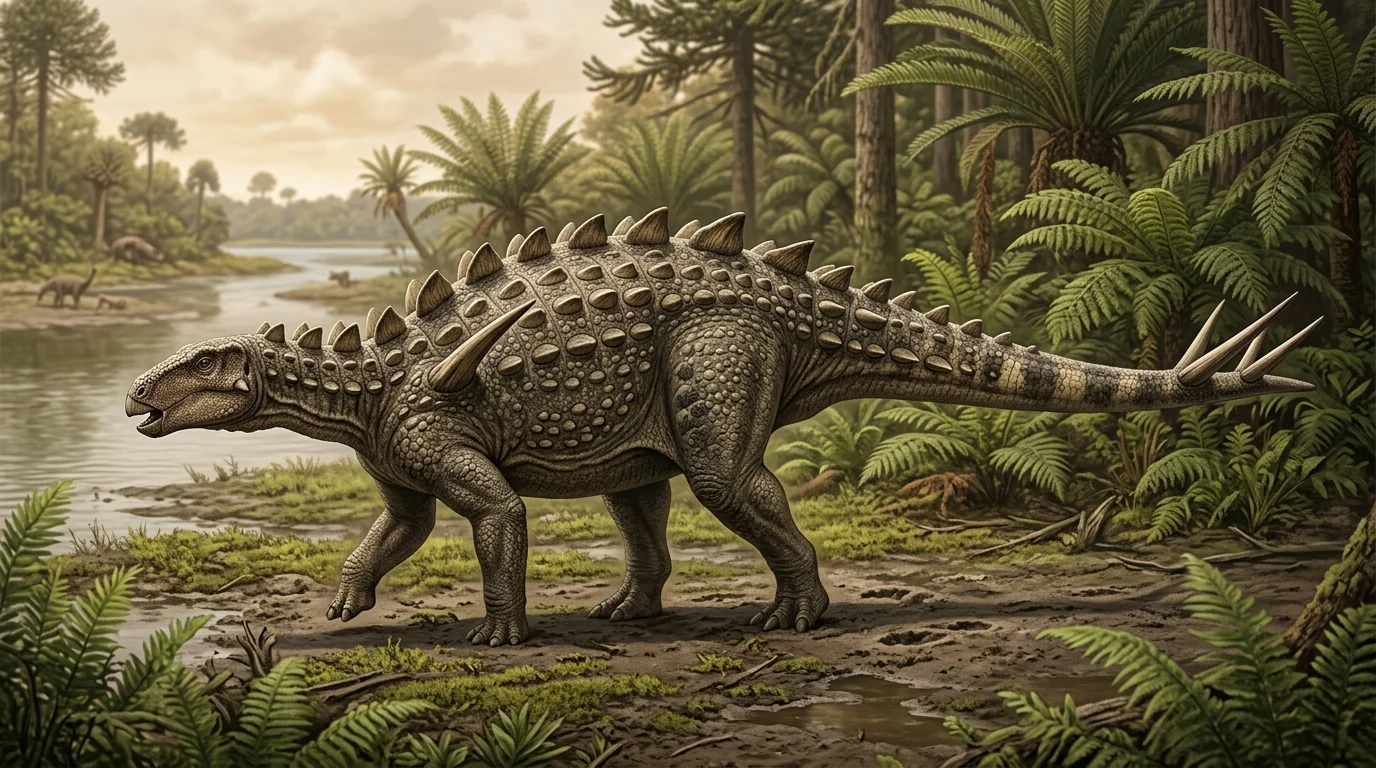
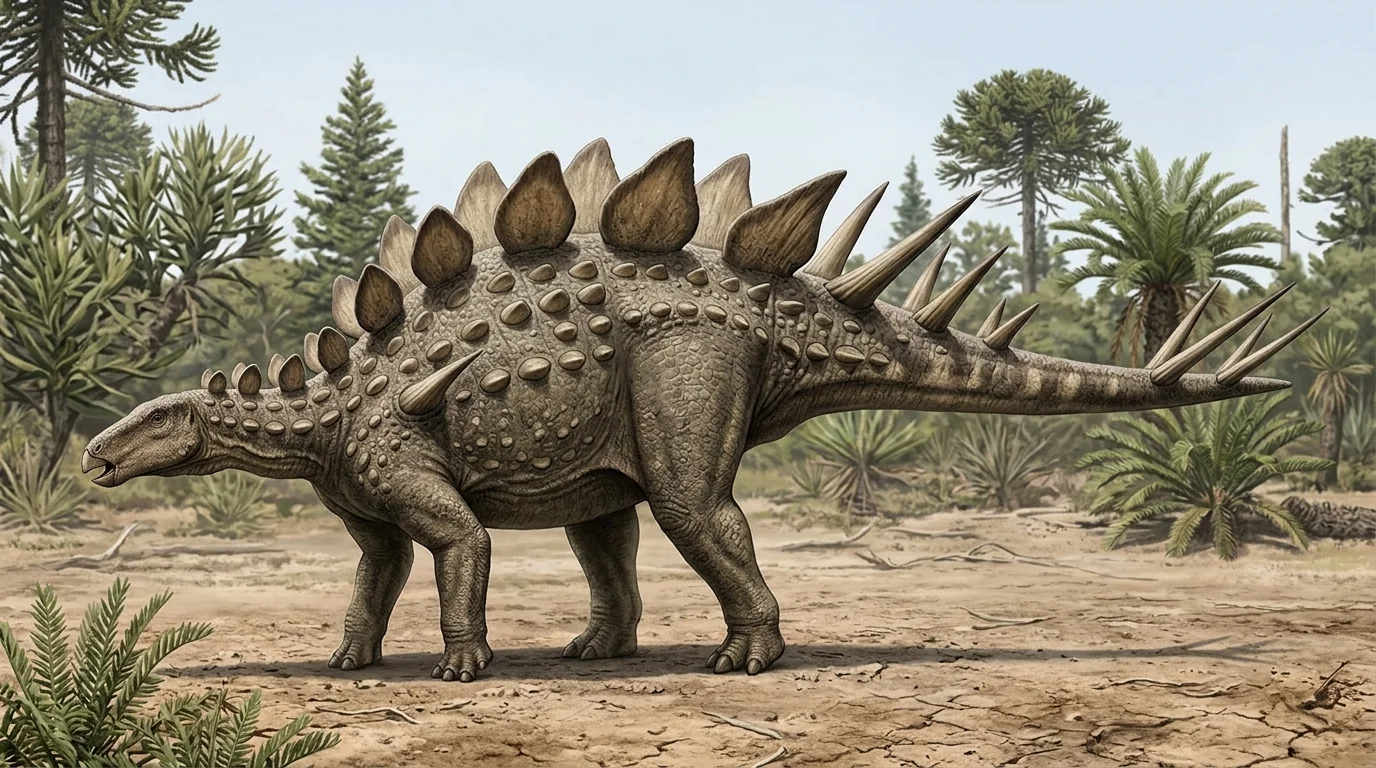
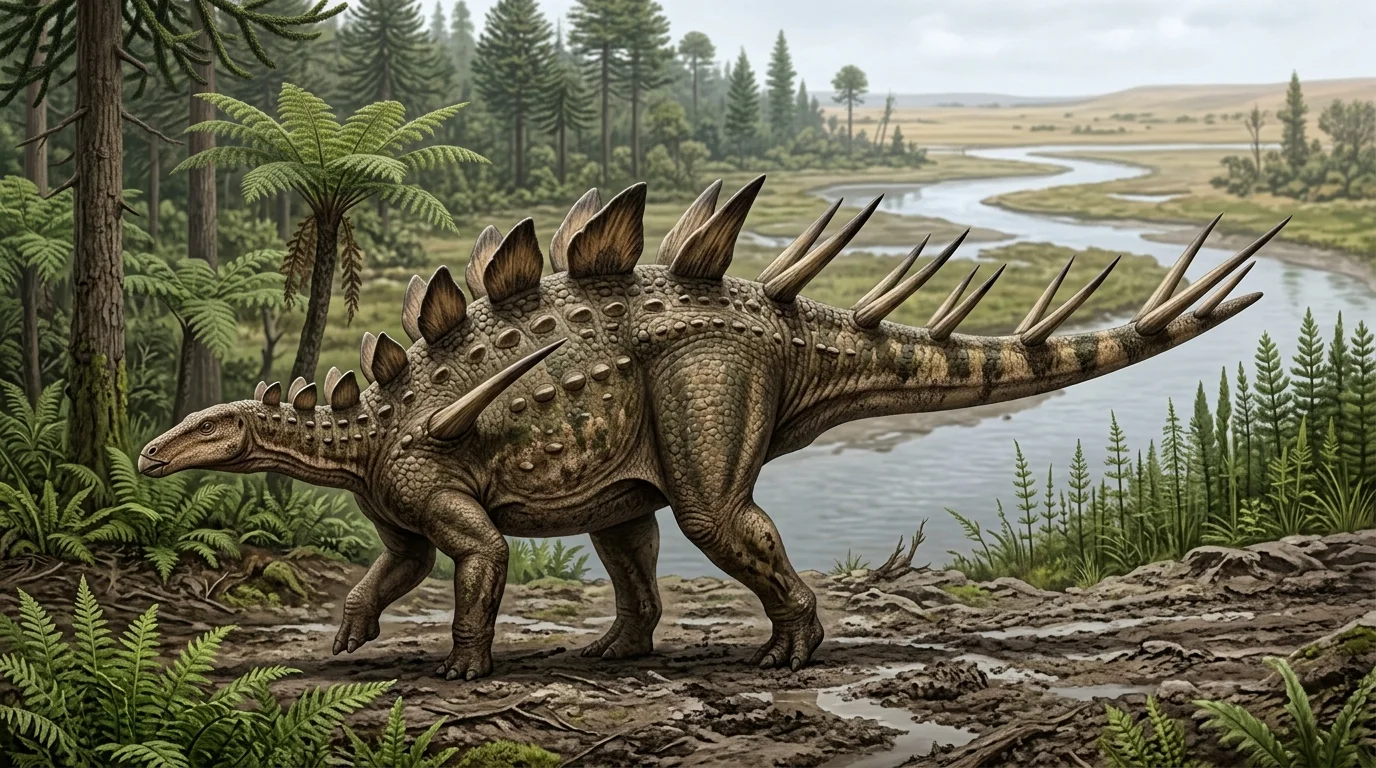
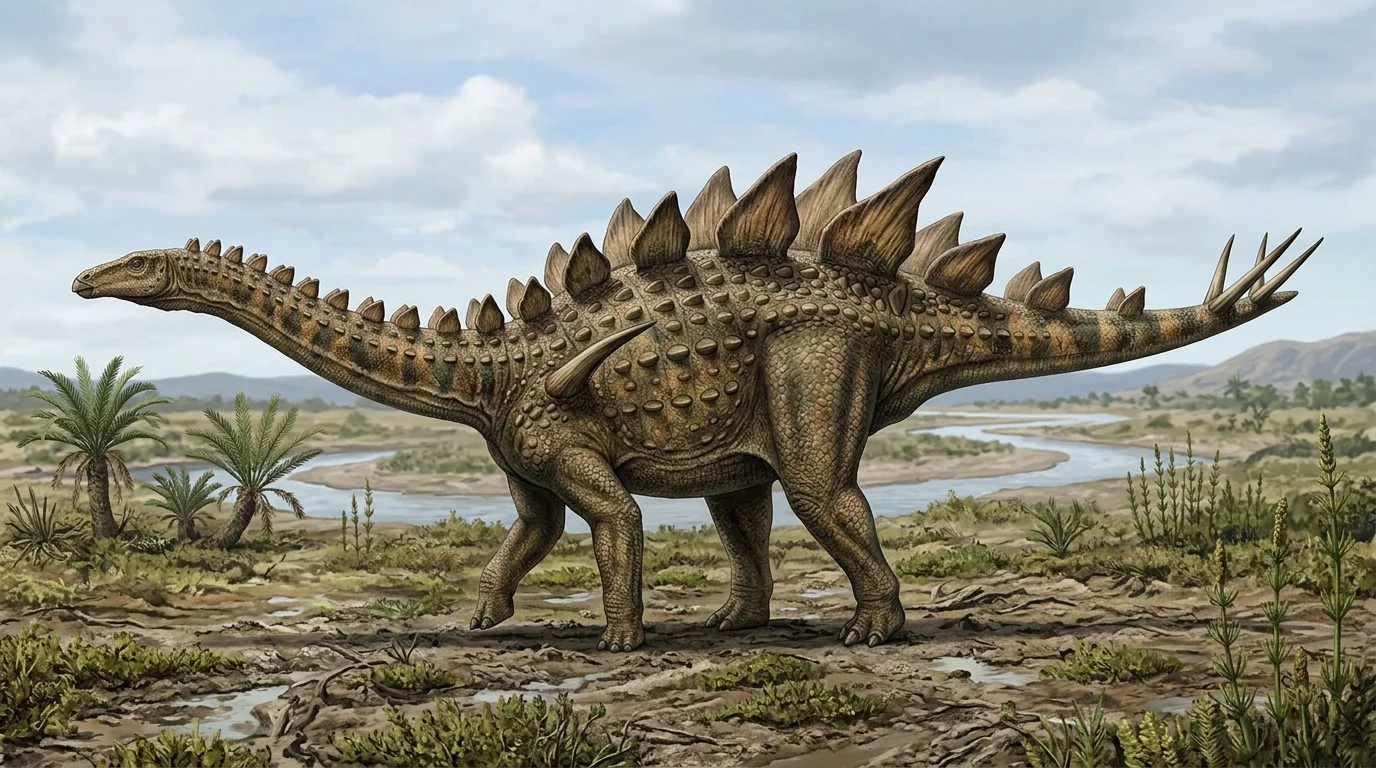
Scientific reconstruction of Huayangosaurus (Huayangosaurus taibaii Dong et al., 1982) in its native Geological period: Jurassic Period.
Image Credit: AI-generated scientific paleoart reconstruction synthesized from species-specific osteological profiles and peer-reviewed descriptions. (AI-Generated / Open Educational Media (DinoOrigin Spec))
Phylogenetic classification of Huayangosaurus taibaii Dong et al., 1982 based on peer-reviewed cladistic analyses of diagnostic skeletal synapomorphies.
| Taxonomic Rank | Taxon / Clade | Diagnostic Context |
|---|---|---|
| Kingdom | Animalia | Monophyletic prehistoric clade |
| Phylum | Chordata | Monophyletic prehistoric clade |
| Clade | Dinosauria | Monophyletic prehistoric clade |
| Order | Ornithischia (Bird-Hipped Dinosaurs) | Characterized by a pelvis with a backwards-pointing pubis parallel to the ischium. |
| Infraorder | Stegosauria | Quadrupedal herbivores distinguished by two rows of alternating dorsal plates and caudal tail spikes (thagomizers). |
| Genus | Huayangosaurus | Monophyletic prehistoric clade |
| Species | Huayangosaurus taibaii Dong et al., 1982 | Specific authority designation |
Huayangosaurus is the most basal well-known stegosaurian dinosaur in the fossil record. Discovered in the Middle Jurassic Lower Shaximiao Formation of Sichuan, China, it lived 20 million years before Stegosaurus.
Unlike later stegosaurids, Huayangosaurus still retained premaxillary teeth in the front of its upper jaw, longer and more flexible forelimbs, and prominent spines projecting from its shoulder blades (parascapular spines).
Broad, deep skull with front teeth, double row of small spike-like plates, shoulder spines, and a four-spiked thagomizer.
Anatomical dimensions relative to an average adult human (1.8 m / 6 ft tall)
Low ferns, cycads, and soft vegetation cropped with small denticulate teeth.
Basal stegosaurian herbivore featuring spiked shoulder spines and premaxillary teeth, retaining primitive thyreophoran traits. In the Dashanpu Quarry of Sichuan, Huayangosaurus coexisted with the club-tailed sauropod Shunosaurus and was preyed upon by predatory theropods like Gasosaurus.
Subtropical lake margins and river floodplains of the Sichuan Basin.
Multiple complete articulated skeletons with skulls displayed at Zigong Dinosaur Museum.
Unearthed by paleontologists Dong Zhiming, Tang Zilu, and Zhou Shiwu.
Marked by lush greenhouse climates, the breakup of Pangaea, and the evolutionary explosion of sauropods, plated stegosaurs, and apex megalosauroid and allosauroid theropods.
During the Mesozoic Era, continental drift progressively reconfigured land bridges, atmospheric currents, and regional precipitation regimes. Fossils of Huayangosaurus evidence its adaptation to the paleoenvironments of Asia.
Renowned for the exceptionally preserved feathered dinosaurs of Liaoning, China and the Cretaceous dune habitats of the Gobi Desert in Mongolia.
The anatomical architecture of Huayangosaurus serves as a crucial benchmark in vertebrate paleontology, illustrating key adaptive radiations within Stegosauria.
Scientifically verified answers based on peer-reviewed paleontological evidence.
Huayangosaurus lived during the Jurassic Period Period, approximately 165–160 Ma (million years ago). This places it within the Mesozoic Era.
Paleontological estimates place Huayangosaurus at a length of 4–4.5 m (13.1–14.8 ft), a hip/standing height of 1.5–1.8 m (4.9–5.9 ft), and a body mass of 0.8–1.2 metric tons (1,764–2,646 lbs).
Classified as a herbivore, Huayangosaurus specialized in consuming Low ferns, cycads, and soft vegetation cropped with small denticulate teeth..
Fossil specimens of Huayangosaurus have been recovered from Dashanpu Quarry, Zigong, Sichuan, China, with notable historic specimens documented in 1979. Unearthed by paleontologists Dong Zhiming, Tang Zilu, and Zhou Shiwu.
Authoritative citations establishing the factual taxonomy, biometrics, and anatomy of Huayangosaurus.
Dong, Z., Tang, Z., & Zhou, S. (1982). Note on the new Mid-Jurassic stegosaur from Sichuan Basin, China. Vertebrata PalAsiatica, 20(4), 283-287.
Curated & Verified: 2026-09-24Deposited in Mesozoic sedimentary strata preserving skeletal remains, teeth, or trace trackways.
Huayangosaurus provides critical insights into the evolutionary radiation of Stegosauria. Holotypes and fossil evidence indicate: Multiple complete articulated skeletons with skulls displayed at Zigong Dinosaur Museum.
Sereno, P. C., & Dong, Z. (1992). The skull of the basal stegosaur Huayangosaurus taibaii and a cladistic diagnosis of Stegosauria. Journal of Vertebrate Paleontology, 12(3), 318-340. https://doi.org/10.1080/02724634.1992.10011462
StegosauriaHesperosaurus mjosi Carpenter et al., 2001
A Late Jurassic stegosaurid from Wyoming featuring wide, oval dorsal plates and a short, deep skull.
StegosauriaKentrosaurus aethiopicus Hennig, 1915
A spiky East African stegosaur equipped with dermal plates along its neck and long sharp spikes along its back and hips.
StegosauriaMiragaia longicollum Mateus et al., 2009
A long-necked European stegosaur from Portugal possessing at least 17 neck vertebrae.