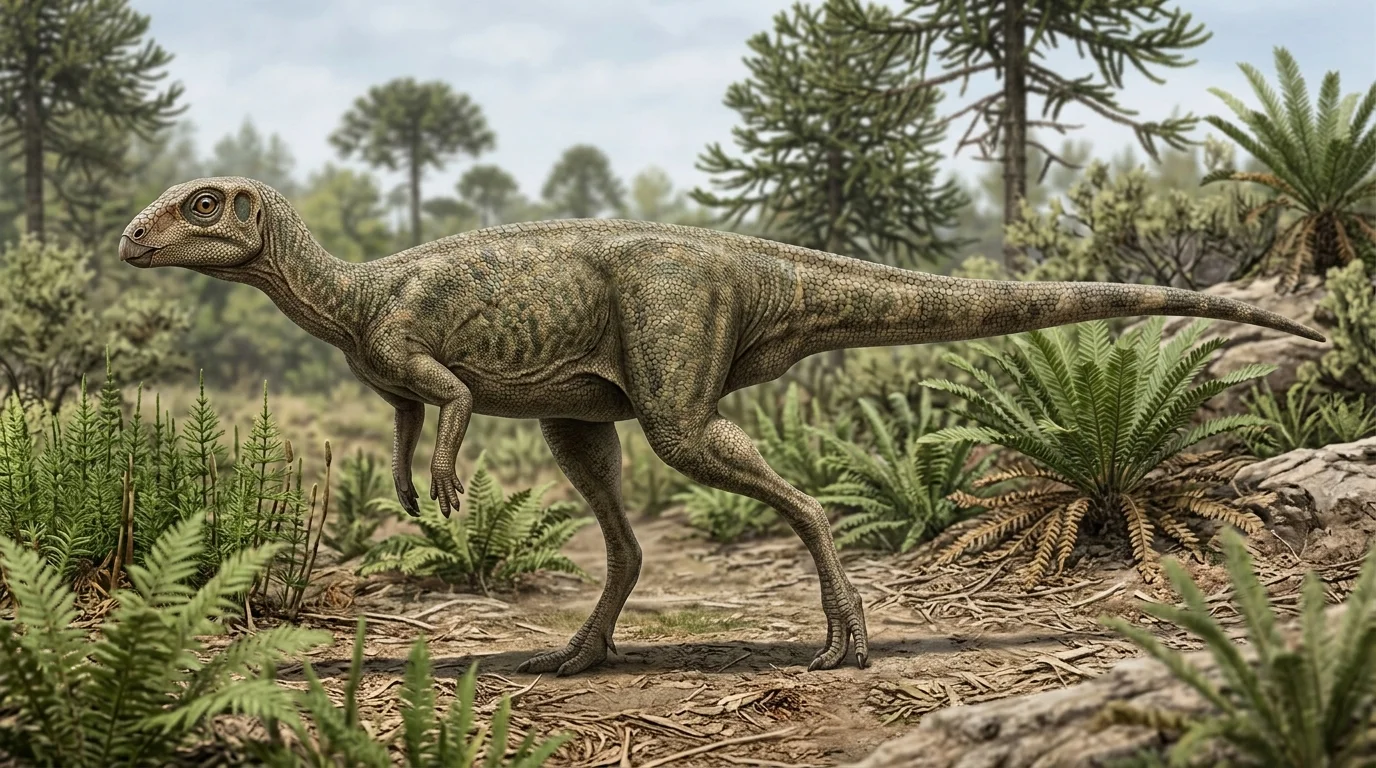
Dryosaurus altus Marsh, 1878
A swift, bipedal ornithopod with large eyes and stiffened tail that dashed across Late Jurassic North America.

Scientific reconstruction of Dryosaurus (Dryosaurus altus Marsh, 1878) in its native Geological period: Jurassic Period.
Image Credit: AI-generated scientific paleoart reconstruction synthesized from species-specific osteological profiles and peer-reviewed descriptions. (AI-Generated / Open Educational Media (DinoOrigin Spec))
Phylogenetic classification of Dryosaurus altus Marsh, 1878 based on peer-reviewed cladistic analyses of diagnostic skeletal synapomorphies.
| Taxonomic Rank | Taxon / Clade | Diagnostic Context |
|---|---|---|
| Kingdom | Animalia | Monophyletic prehistoric clade |
| Phylum | Chordata | Monophyletic prehistoric clade |
| Clade | Dinosauria | Monophyletic prehistoric clade |
| Order | Ornithischia (Bird-Hipped Dinosaurs) | Characterized by a pelvis with a backwards-pointing pubis parallel to the ischium. |
| Suborder | Ornithopoda | Beaked, bipedal and facultatively quadrupedal herbivores with complex multi-layered dental batteries. |
| Genus | Dryosaurus | Monophyletic prehistoric clade |
| Species | Dryosaurus altus Marsh, 1878 | Specific authority designation |
Dryosaurus was a small, graceful bipedal ornithopod that inhabited the Late Jurassic Morrison Formation. Measuring roughly three to four meters in length, it lacked defensive armor or weapons, relying entirely on acute vision, hearing, and explosive sprinting speed to evade predators like Allosaurus and Ceratosaurus.
Its large orbital cavities housed large eyes with sclerotic rings, indicating sharp vision and possible crepuscular activity.
Lightly built biped with large eyes, a horny beak, long slender hind limbs, and a stiffened counterbalance tail.
Anatomical dimensions relative to an average adult human (1.8 m / 6 ft tall)
Herbivorous; cropped tender shoots, ferns, and seeds with its beak and ground them with self-sharpening teeth.
Small, fast-running ornithopod relying on acute vision and cursorial agility to evade predators. In the Morrison Formation, Dryosaurus was a common prey item for carnivorous theropods including Allosaurus and Ceratosaurus.
Open conifer woodlands, fern meadows, and riverbank margins.
Multiple well-preserved adult and juvenile skeletons from Wyoming, Utah, and Colorado.
Found by Samuel Wendell Williston; named by O.C. Marsh in 1878.
Marked by lush greenhouse climates, the breakup of Pangaea, and the evolutionary explosion of sauropods, plated stegosaurs, and apex megalosauroid and allosauroid theropods.
During the Mesozoic Era, continental drift progressively reconfigured land bridges, atmospheric currents, and regional precipitation regimes. Fossils of Dryosaurus evidence its adaptation to the paleoenvironments of North America.
Home to the fossil-rich Morrison Formation of the Late Jurassic and the Hell Creek and Dinosaur Park Formations of the Late Cretaceous.
The anatomical architecture of Dryosaurus serves as a crucial benchmark in vertebrate paleontology, illustrating key adaptive radiations within Ornithopoda.
Scientifically verified answers based on peer-reviewed paleontological evidence.
Dryosaurus lived during the Jurassic Period Period, approximately 155–150 Ma (million years ago). This places it within the Mesozoic Era.
Paleontological estimates place Dryosaurus at a length of 3–4.2 m (9.8–13.8 ft), a hip/standing height of 1.2–1.5 m (3.9–4.9 ft), and a body mass of 70–120 kg (154–265 lbs).
Classified as a herbivore, Dryosaurus specialized in consuming Herbivorous; cropped tender shoots, ferns, and seeds with its beak and ground them with self-sharpening teeth..
Fossil specimens of Dryosaurus have been recovered from Morrison Formation, Como Bluff, Wyoming, United States, with notable historic specimens documented in 1876. Found by Samuel Wendell Williston; named by O.C. Marsh in 1878.
Authoritative citations establishing the factual taxonomy, biometrics, and anatomy of Dryosaurus.
Marsh, O. C. (1878). Notice of new dinosaurian reptiles. American Journal of Science, 15(87), 241-244. https://doi.org/10.2475/ajs.s3-15.87.241
Curated & Verified: 2026-09-24Deposited in Mesozoic sedimentary strata preserving skeletal remains, teeth, or trace trackways.
Dryosaurus provides critical insights into the evolutionary radiation of Ornithopoda. Holotypes and fossil evidence indicate: Multiple well-preserved adult and juvenile skeletons from Wyoming, Utah, and Colorado.