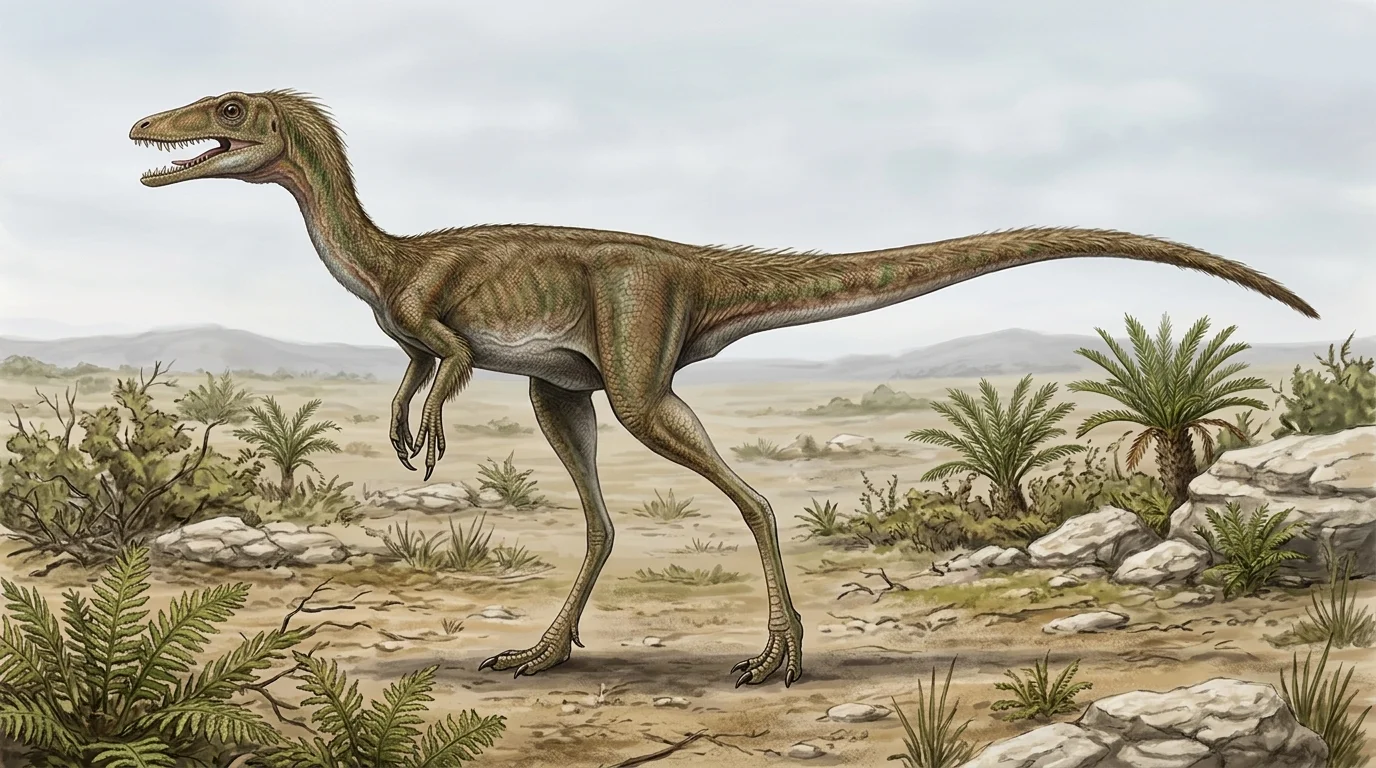
Allosaurus fragilis Marsh, 1877
The most abundant apex theropod of Late Jurassic North America, equipped with a kinetic skull and slashing serrated teeth.

Scientific reconstruction of Allosaurus (Allosaurus fragilis Marsh, 1877) in its native Geological period: Jurassic Period.
Image Credit: AI-generated scientific paleoart reconstruction synthesized from species-specific osteological profiles and peer-reviewed descriptions. (AI-Generated / Open Educational Media (DinoOrigin Spec))
Phylogenetic classification of Allosaurus fragilis Marsh, 1877 based on peer-reviewed cladistic analyses of diagnostic skeletal synapomorphies.
| Taxonomic Rank | Taxon / Clade | Diagnostic Context |
|---|---|---|
| Kingdom | Animalia | Monophyletic prehistoric clade |
| Phylum | Chordata | Monophyletic prehistoric clade |
| Clade | Dinosauria | Monophyletic prehistoric clade |
| Order | Saurischia (Lizard-Hipped Dinosaurs) | Characterized ancestrally by a triradiate pelvis with an anteriorly pointing pubis. |
| Suborder | Theropoda | Bipedal saurischian dinosaurs, historically dominated by carnivores and including the avian lineage. |
| Genus | Allosaurus | Monophyletic prehistoric clade |
| Species | Allosaurus fragilis Marsh, 1877 | Specific authority designation |
Allosaurus fragilis was the dominant apex carnivore of the Morrison Formation ecosystem across western North America during the Late Jurassic Period (~155 to 145 million years ago). Reaching lengths between 8.5 and 9.7 meters and adult weights of 1,500 to 2,500 kg, Allosaurus represents the archetypal member of the Theropoda lineage Allosauroidea.
Locomotion and Biomechanics: Biomechanical limb evaluations indicate that Allosaurus had relatively long hindlimbs and gracile tibia-femur proportions compared to tyrannosaurids, indicating capable cursorial locomotion. Finite element simulations and muscle modeling suggest estimated running speeds between 25 and 35 km/h (model-dependent), although velocity was constrained by body mass and joint stress thresholds. Its skull was uniquely engineered: while static bite force was modest, its cranial architecture and neck musculature were adapted for high-impact slashing strikes against large prey.
Scientific Significance: Allosaurus is one of the most thoroughly analyzed theropods in vertebrate paleontology, providing invaluable baselines for population biology, predator-prey dynamics, and paleopathology. Clear skeletal evidence of violent trophic interactions exists, including an Allosaurus cervical vertebra pierced by a Stegosaurus tail spike and healed Allosaurus bite marks on sauropod vertebrae.
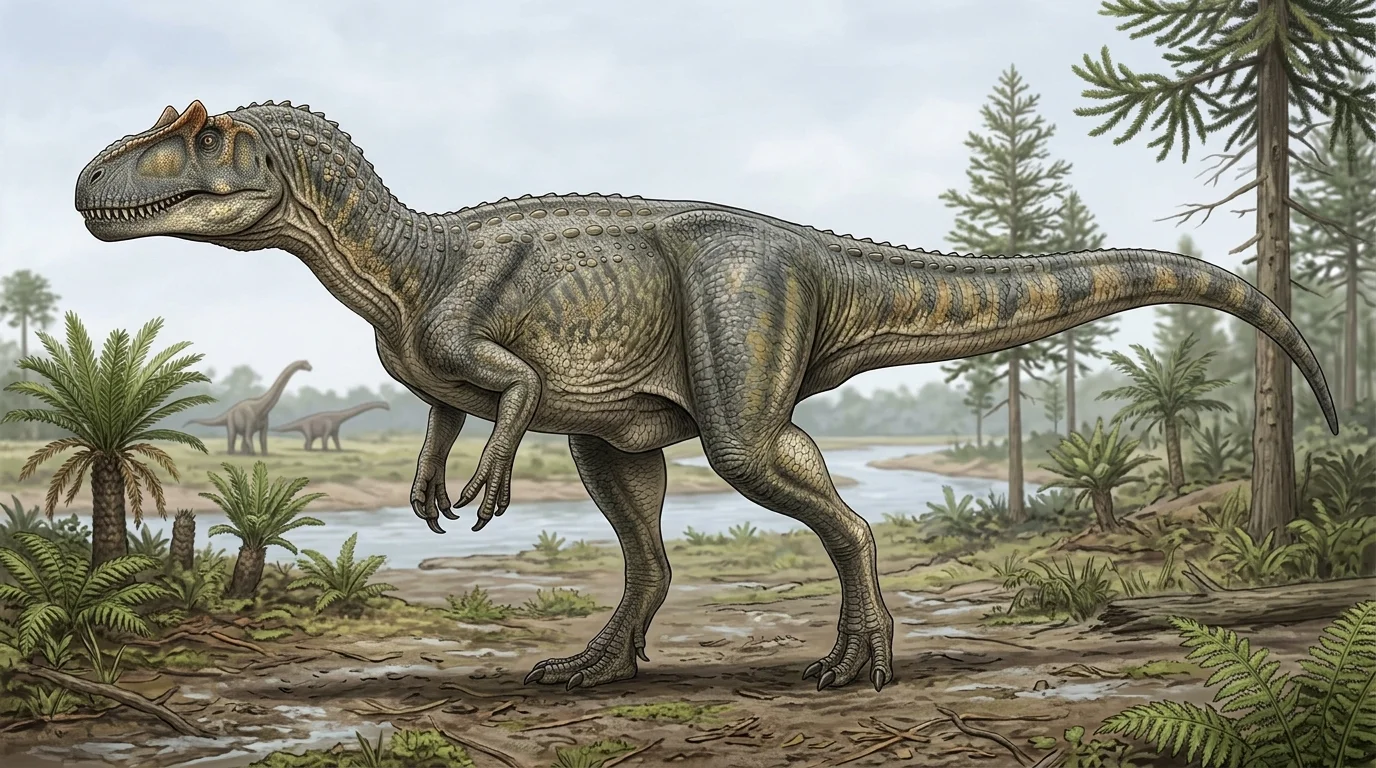
Large bipedal carnivore with prominent lacrimal horns over each eye, three-clawed grasping forelimbs, and a slender muscular physique.
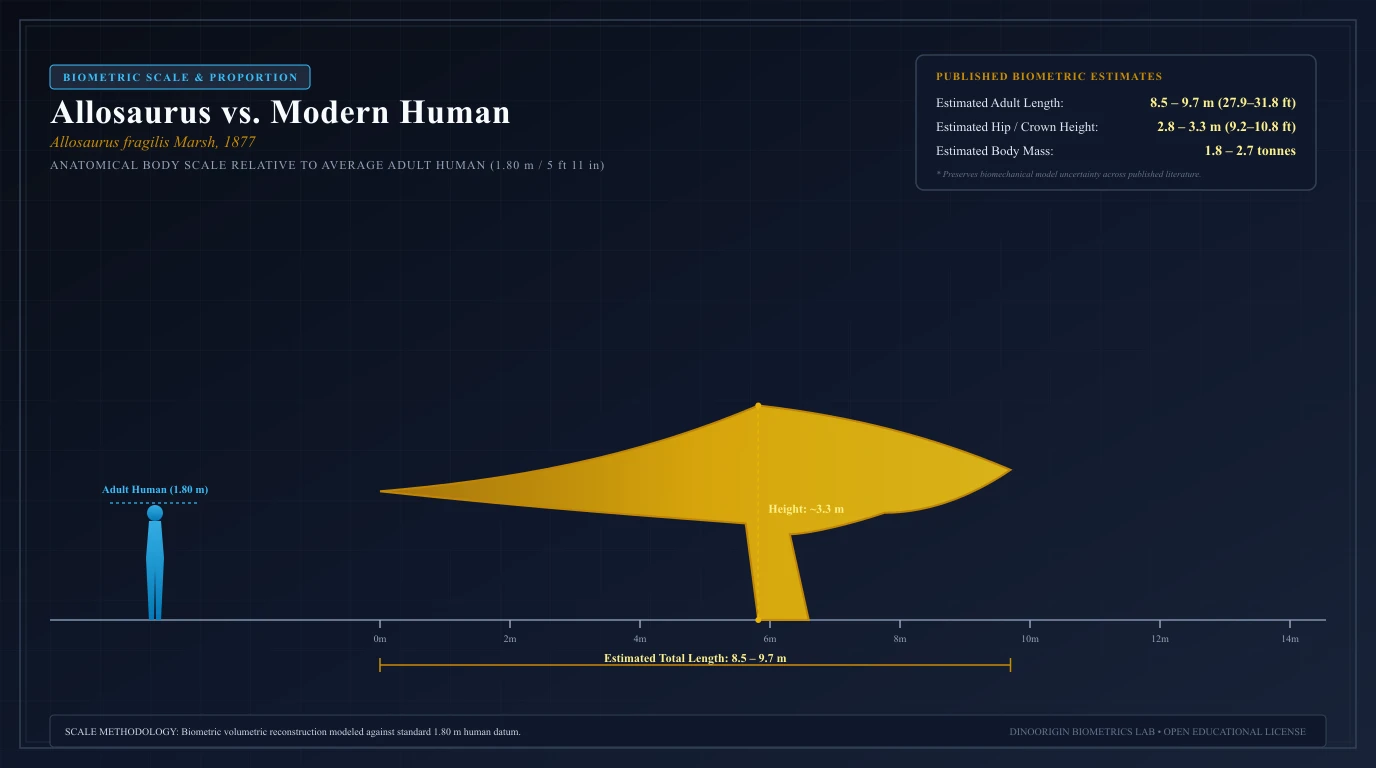
Anatomical dimensions relative to an average adult human (1.8 m / 6 ft tall)
Sauropods (Diplodocus, Camarasaurus), stegosaurs, and ornithopods (Dryosaurus, Camptosaurus).
Bonebed accumulations such as the Cleveland-Lloyd Dinosaur Quarry, where over 40 individual Allosaurus specimens were recovered, have sparked intense scientific discussion. Hypotheses range from catastrophic predator traps around toxic waterholes to drought-driven feeding aggregations. Bone pathologies show frequent fractures and healed injuries, indicating aggressive predatory life encounters and intraspecific fighting.
Semi-arid floodplain ecosystems with scrubland, gallery forests, and seasonal watercourses.
One of the richest fossil records of any large dinosaur, with thousands of bones and dozens of complete or near-complete skeletons known. Iconic specimens include O. C. Marsh's 1877 holotype (YPM 1930) and the subadult specimen MOR 693 ('Big Al'), which preserves 95% of its skeleton alongside 19 distinct bone pathologies.

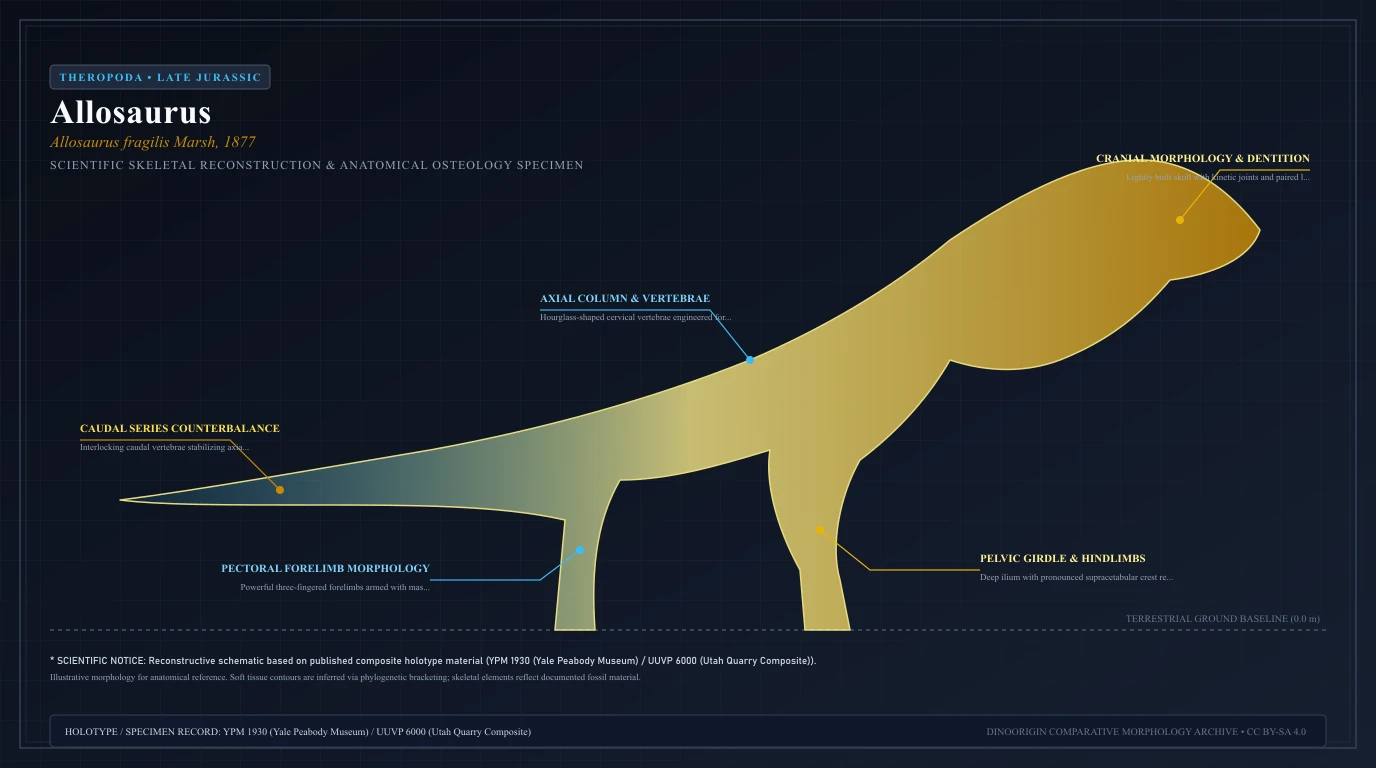
Anatomical skeletal reconstruction of Allosaurus (Allosaurus fragilis Marsh, 1877) illustrating cranial fenestrae, vertebral column, and appendicular proportions based on composite fossil material.
Described by Othniel Charles Marsh based on fragmentary vertebrae; later clarified by abundant material from Bone Cabin and Cleveland-Lloyd quarries.
Marked by lush greenhouse climates, the breakup of Pangaea, and the evolutionary explosion of sauropods, plated stegosaurs, and apex megalosauroid and allosauroid theropods.
During the Mesozoic Era, continental drift progressively reconfigured land bridges, atmospheric currents, and regional precipitation regimes. Fossils of Allosaurus evidence its adaptation to the paleoenvironments of North America.
Home to the fossil-rich Morrison Formation of the Late Jurassic and the Hell Creek and Dinosaur Park Formations of the Late Cretaceous.
The anatomical architecture of Allosaurus serves as a crucial benchmark in vertebrate paleontology, illustrating key adaptive radiations within Theropoda.
Scientifically verified answers based on peer-reviewed paleontological evidence.
Allosaurus lived during the Jurassic Period Period, approximately 155–145 Ma (million years ago). This places it within the Mesozoic Era.
Paleontological estimates place Allosaurus at a length of 8.5–9.7 m (27.9–31.8 ft), a hip/standing height of 2.8–3.3 m (9.2–10.8 ft), and a body mass of 1.8–2.7 metric tons (3,968–5,952 lbs).
Classified as a carnivore, Allosaurus specialized in consuming Sauropods (Diplodocus, Camarasaurus), stegosaurs, and ornithopods (Dryosaurus, Camptosaurus)..
Fossil specimens of Allosaurus have been recovered from Garden Park, Canon City, Colorado, United States, with notable historic specimens documented in 1877. Described by Othniel Charles Marsh based on fragmentary vertebrae; later clarified by abundant material from Bone Cabin and Cleveland-Lloyd quarries.
Authoritative citations establishing the factual taxonomy, biometrics, and anatomy of Allosaurus.
Marsh, O. C. (1877). Notice of new dinosaurian reptiles from the Jurassic formation. American Journal of Science, 14(84), 514-516. https://doi.org/10.2475/ajs.s3-14.84.514
Curated & Verified: 2026-09-24
Comparative size scale of Allosaurus relative to a 1.8-meter adult human, illustrating an estimated length of 8.5–9.7 m and height of 2.8–3.3 m (preserving model uncertainty).
Deposited in Mesozoic sedimentary strata preserving skeletal remains, teeth, or trace trackways.
Allosaurus provides critical insights into the evolutionary radiation of Theropoda. Holotypes and fossil evidence indicate: One of the richest fossil records of any large dinosaur, with thousands of bones and dozens of complete or near-complete skeletons known. Iconic specimens include O. C. Marsh's 1877 holotype (YPM 1930) and the subadult specimen MOR 693 ('Big Al'), which preserves 95% of its skeleton alongside 19 distinct bone pathologies.
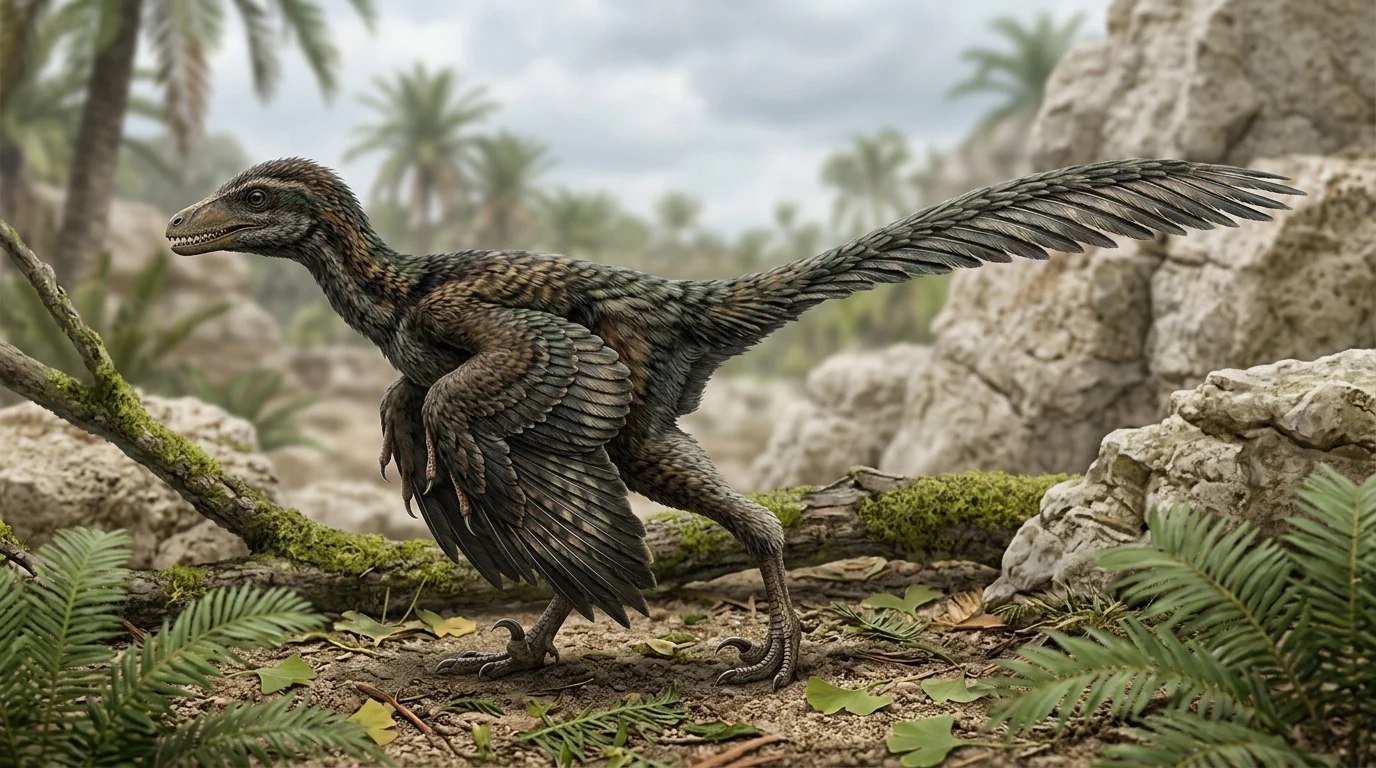
TheropodaArchaeopteryx lithographica von Meyer, 1861
An iconic stem-avialan from the Late Jurassic Solnhofen limestone exhibiting transitional features bridging non-avian theropods and birds.
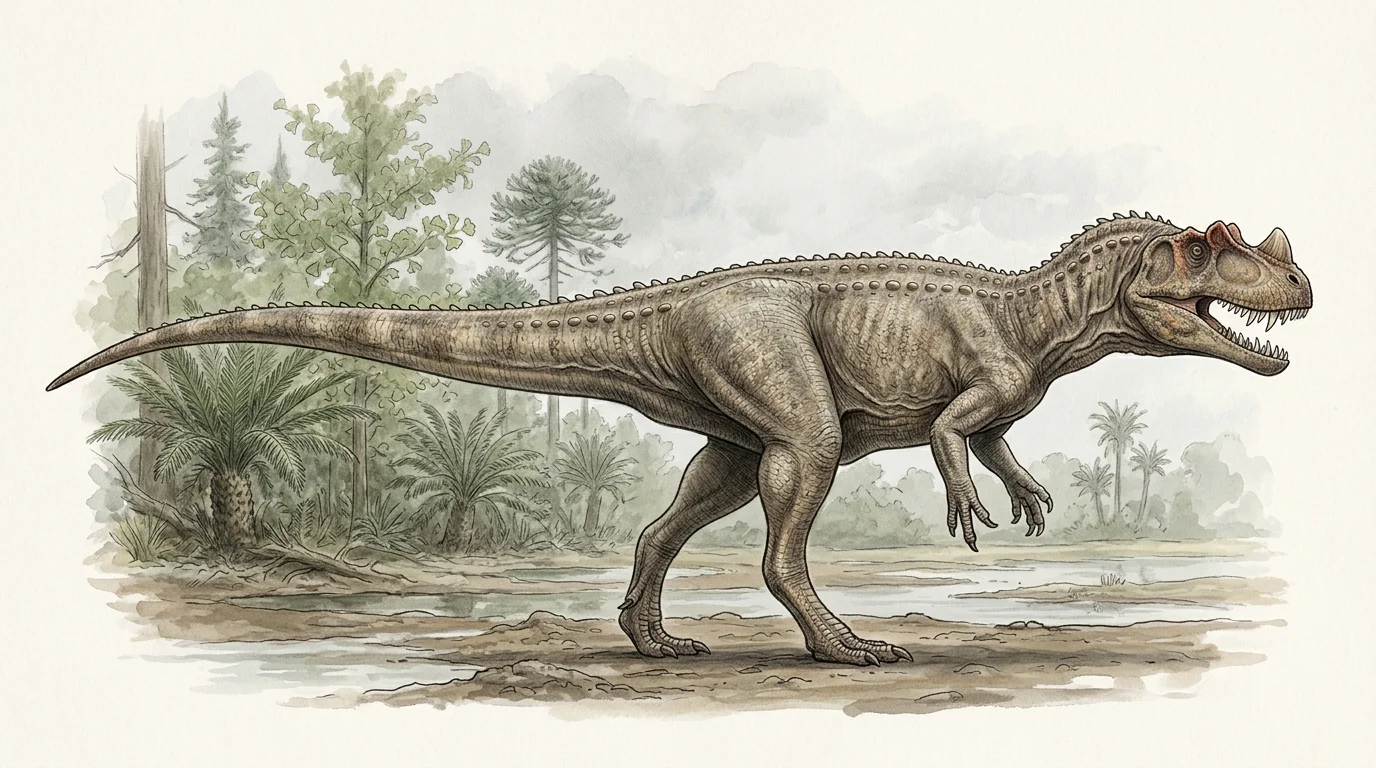
TheropodaCeratosaurus nasicornis Marsh, 1884
A distinctive Late Jurassic theropod sporting a prominent nasal horn core and a line of small osteoderms along its back.
TheropodaCompsognathus longipes Wagner, 1859
A petite, nimble Late Jurassic coelurosaur about the size of a chicken, historically famous as one of the smallest known dinosaurs.