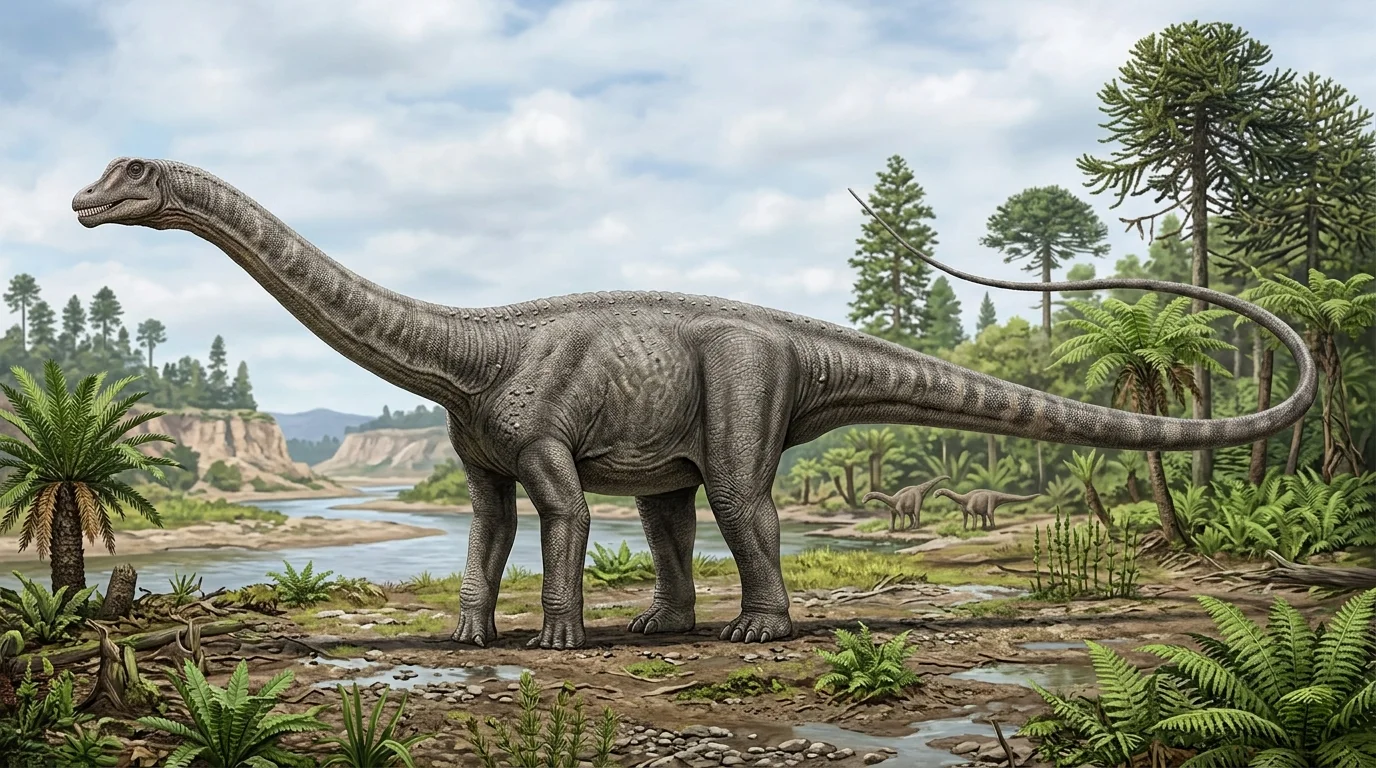
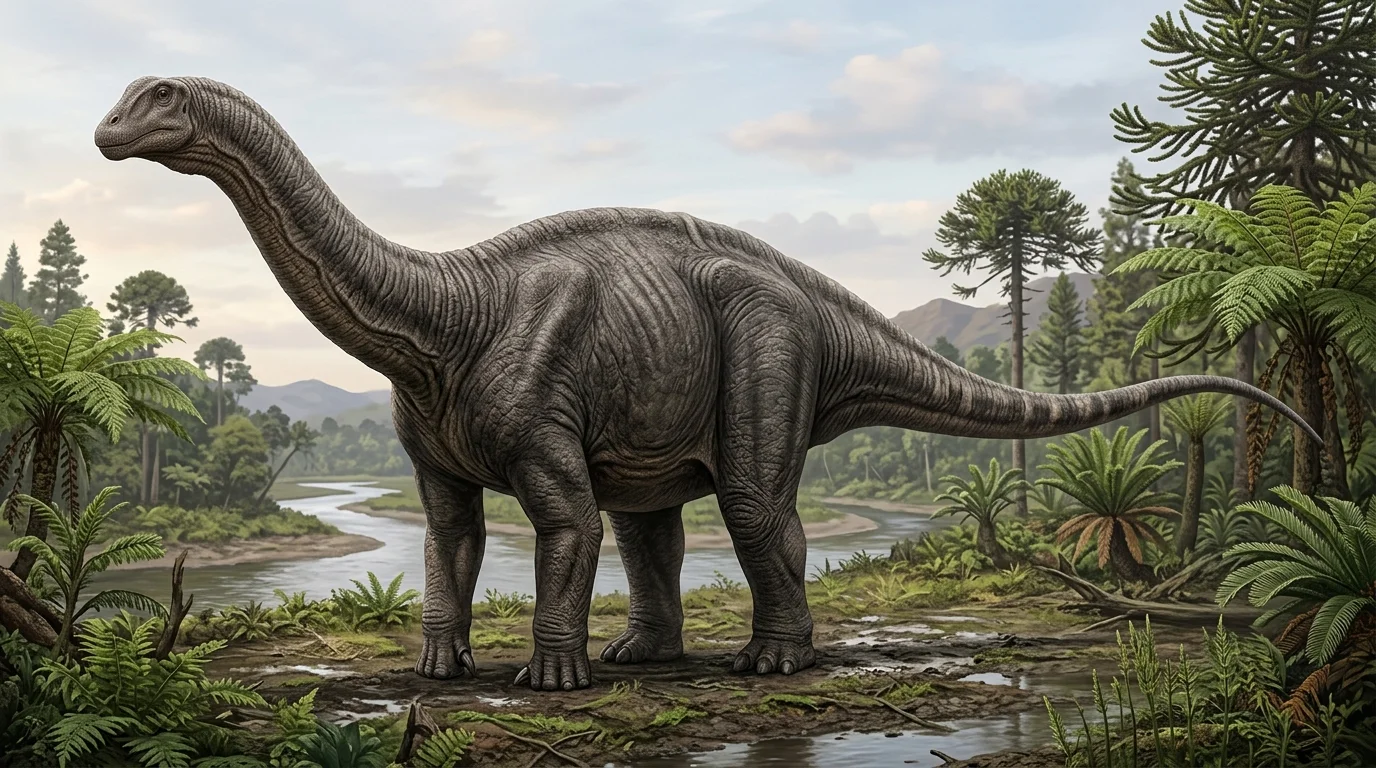
Herbivorous saurischians characterized by elongated necks, columnar limbs, and enormous body volumes.
Genus
Brachiosaurus
Monophyletic prehistoric clade
Species
Brachiosaurus altithorax Riggs, 1903
Specific authority designation
Anatomy & Physical Characteristics
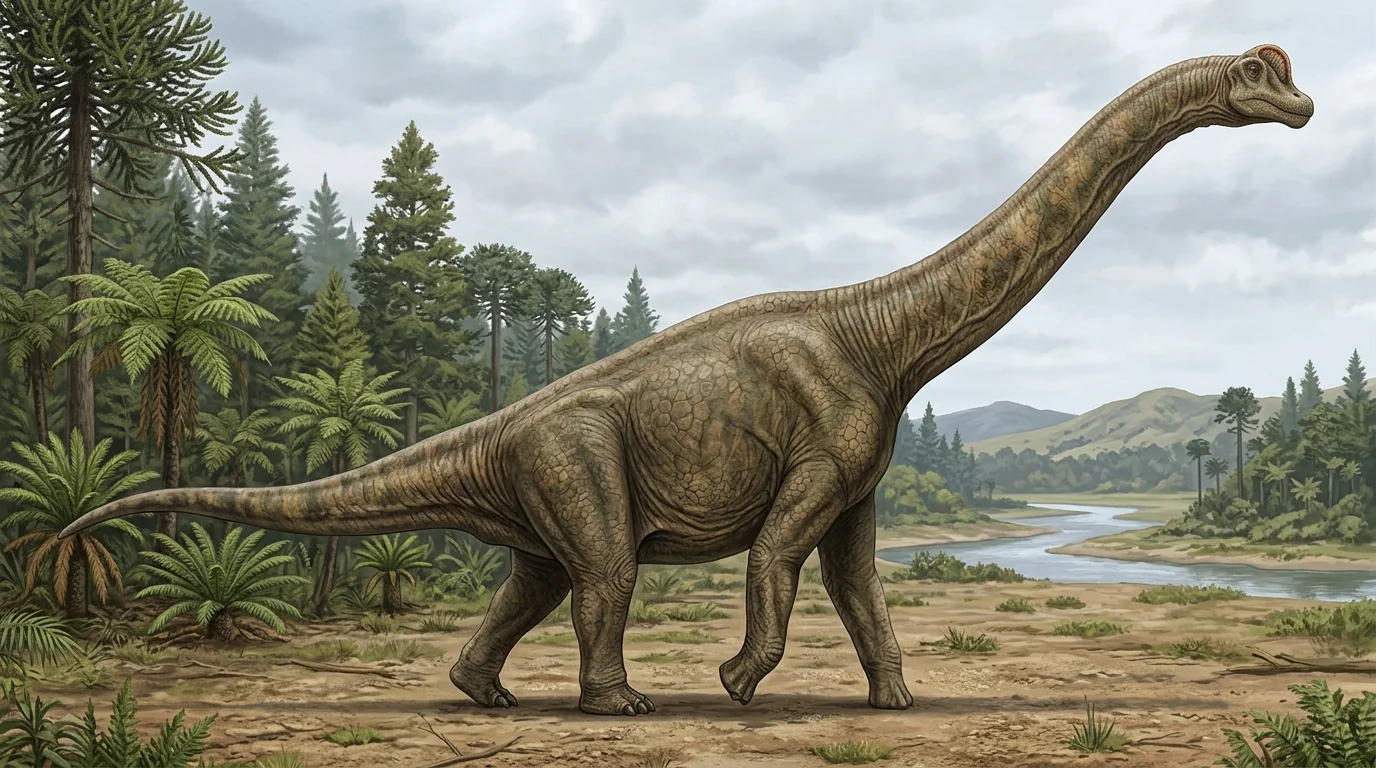
Brachiosaurus altithorax was a colossal herbivorous dinosaur belonging to the Sauropodomorpha lineage Macronaria, living in western North America during the Late Jurassic Period (~154 to 150 million years ago). Unlike diplodocids, Brachiosaurus exhibited an unusual body plan where the elongated humerus exceeded the femur in length, producing a distinctively elevated shoulder girdle and a back that sloped downward toward the hip.
Locomotion and Weight Support:
Brachiosaurus practiced graviportal (weight-bearing) quadrupedal locomotion, supported by column-like limbs and dense carpals. Biomechanical mass estimates derived from bone circumference and volumetric modeling place adult body mass between 28,000 and 40,000 kg. Pacing simulations and trackway analyses indicate slow, steady walking speeds estimated around 12–16 km/h, with running gaits biomechanically impossible under its enormous skeletal loading.
Scientific Significance:
Brachiosaurus is fundamental to the study of sauropod macroevolution and extreme physiological scaling. Its upright neck posture permitted high-canopy browsing up to 12 meters above the ground, allowing it to exploit conifer and ginkgo foliage inaccessible to contemporary sauropods like Apatosaurus. Taxonomic revisions (Taylor, 2009) formally established its distinct generic separation from African Giraffatitan brancai.
Diagnostic Morphological Traits
Immense quadruped with an upward-sloping torso, elongated neck, vaulted skull with dorsal nasal arch, and relatively short tail.
Comparative Scale & Biometrics
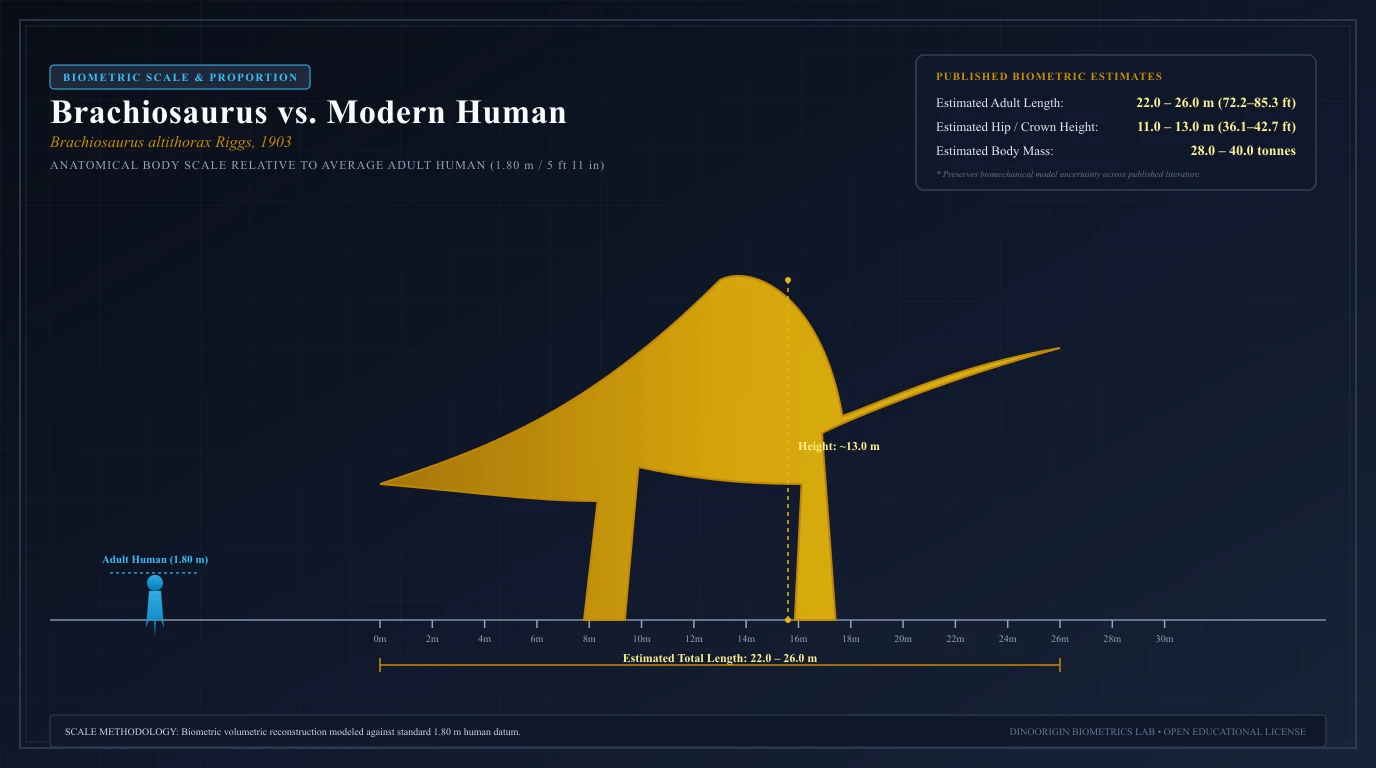
Anatomical dimensions relative to an average adult human (1.8 m / 6 ft tall)
Conifers, ginkgoes, cycads, and high foliage foliage clipped by spatulate teeth and digested via large intestinal fermentation chambers.
Paleobiology & Behavior
Brachiosaurus functioned as a high-tier canopy specialist in semi-arid river basin forests. Broad, spoon-shaped (spatulate) teeth functioned as shearing shears for stripping tough foliage, which was fermented in a cavernous digestive tract. Bonebed taphonomy indicates solitary or small-group movement across expansive ranges to satisfy massive metabolic and caloric requirements.
Habitat & Ecological Biome
Prehistoric Depositional Setting
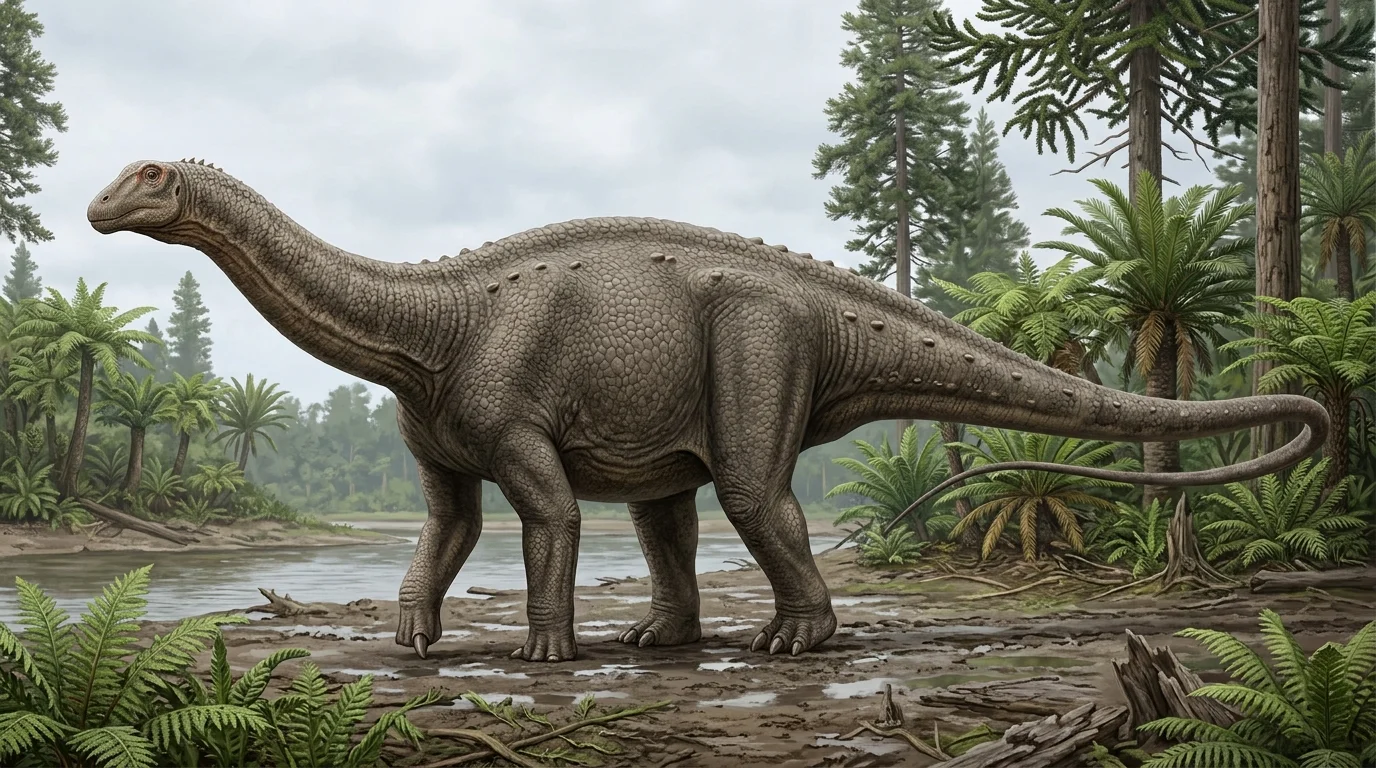
Riparian conifer forests and open floodplain savannahs with year-round river access.
Fossil Evidence & Specimen Records
Preserved Skeletal Material & Bonebeds
Fossils of Brachiosaurus altithorax are relatively rare compared to other Morrison sauropods. The taxon is founded on Elmer Riggs's 1900 holotype (FMNH P 25107) from the Grand River Valley of Colorado, which preserves a sacrum, ribs, coracoid, humerus, and femur. Referred material includes isolated cervical vertebrae and partial postcrania, with cranial anatomy reconstructed from closely related macronarian taxa.
Anatomical Osteology & Skeletal Reconstruction
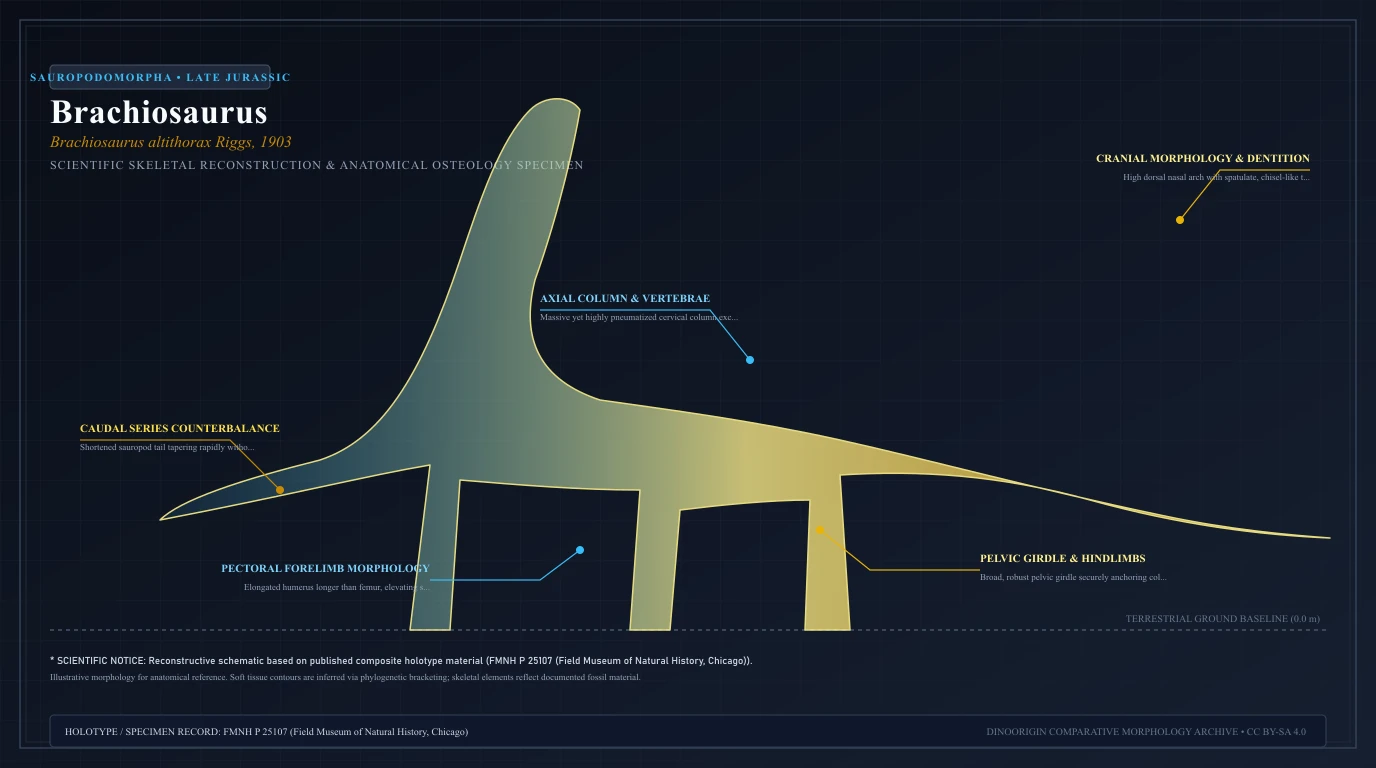
Anatomical skeletal reconstruction of Brachiosaurus (Brachiosaurus altithorax Riggs, 1903) illustrating cranial fenestrae, vertebral column, and appendicular proportions based on composite fossil material.
Discovery & Taxonomic Naming History
Year of Discovery / Description1900
Type Specimen Locality & FormationGrand River Valley, Fruita, Colorado, United States
Discovered by Elmer S. Riggs of the Field Columbian Museum; named Brachiosaurus ('arm lizard') for its elongated forelimbs.
Jurassic Period PeriodTemporal Interval: 154–150 Ma (million years ago)
Marked by lush greenhouse climates, the breakup of Pangaea, and the evolutionary explosion of sauropods, plated stegosaurs, and apex megalosauroid and allosauroid theropods.
During the Mesozoic Era, continental drift progressively reconfigured land bridges, atmospheric currents, and regional precipitation regimes. Fossils of Brachiosaurus evidence its adaptation to the paleoenvironments of North America.
Paleogeographic RealmNorth America (North America)
Home to the fossil-rich Morrison Formation of the Late Jurassic and the Hell Creek and Dinosaur Park Formations of the Late Cretaceous.
Fossil Discovery Locality
Scientific Significance & Evolutionary Impact
The anatomical architecture of Brachiosaurus serves as a crucial benchmark in vertebrate paleontology, illustrating key adaptive radiations within Sauropodomorpha.
Phylogenetic Placement: Informs cladistic debates concerning the divergence, skull biomechanics, and skeletal evolution of Jurassic Period fauna.
Paleoecological Guild: Documents trophic specialization (Herbivore) and predator-prey dynamics across its regional ecosystem.
Taphonomic Record: Fossils of Brachiosaurus altithorax are relatively rare compared to other Morrison sauropods. The taxon is founded on Elmer Riggs's 1900 holotype (FMNH P 25107) from the Grand River Valley of Colorado, which preserves a sacrum, ribs, coracoid, humerus, and femur. Referred material includes isolated cervical vertebrae and partial postcrania, with cranial anatomy reconstructed from closely related macronarian taxa.
Frequently Asked Questions About Brachiosaurus
Scientifically verified answers based on peer-reviewed paleontological evidence.
Q1.When did Brachiosaurus live?
Brachiosaurus lived during the Jurassic Period Period, approximately 154–150 Ma (million years ago). This places it within the Mesozoic Era.
Q2.How big was Brachiosaurus?
Paleontological estimates place Brachiosaurus at a length of 22–26 m (72.2–85.3 ft), a hip/standing height of 11–13 m (36.1–42.7 ft), and a body mass of 28.0–40.0 metric tons (61,729–88,185 lbs).
Q3.What was the diet of Brachiosaurus?
Classified as a herbivore, Brachiosaurus specialized in consuming Conifers, ginkgoes, cycads, and high foliage foliage clipped by spatulate teeth and digested via large intestinal fermentation chambers..
Q4.Where were Brachiosaurus fossils discovered?
Fossil specimens of Brachiosaurus have been recovered from Grand River Valley, Fruita, Colorado, United States, with notable historic specimens documented in 1900. Discovered by Elmer S. Riggs of the Field Columbian Museum; named Brachiosaurus ('arm lizard') for its elongated forelimbs.
Academic Literature & Peer-Reviewed References
Authoritative citations establishing the factual taxonomy, biometrics, and anatomy of Brachiosaurus.
Riggs, E. S. (1903). Brachiosaurus altithorax, the largest known dinosaur. American Journal of Science, 15(88), 299-306. https://doi.org/10.2475/ajs.s4-15.88.299
Comparative size scale of Brachiosaurus relative to a 1.8-meter adult human, illustrating an estimated length of 22.0–26.0 m and height of 11.0–13.0 m (preserving model uncertainty).
Grand River Valley, Fruita, Colorado, United States
Deposited in Mesozoic sedimentary strata preserving skeletal remains, teeth, or trace trackways.
Q5.What makes Brachiosaurus scientifically significant?
Brachiosaurus provides critical insights into the evolutionary radiation of Sauropodomorpha. Holotypes and fossil evidence indicate: Fossils of Brachiosaurus altithorax are relatively rare compared to other Morrison sauropods. The taxon is founded on Elmer Riggs's 1900 holotype (FMNH P 25107) from the Grand River Valley of Colorado, which preserves a sacrum, ribs, coracoid, humerus, and femur. Referred material includes isolated cervical vertebrae and partial postcrania, with cranial anatomy reconstructed from closely related macronarian taxa.
Taylor, M. P. (2009). A re-evaluation of Brachiosaurus altithorax Riggs 1903 (Saurischia, Sauropoda) and its generic separation from Giraffatitan brancai (Janensch 1914). Journal of Vertebrate Paleontology, 29(3), 787-806. https://doi.org/10.1671/039.029.0303