Borealopelta markmitchelli Brown et al., 2017
The world's best-preserved dinosaur fossil, a 110-million-year-old nodosaur with intact skin, armor, and stomach contents.

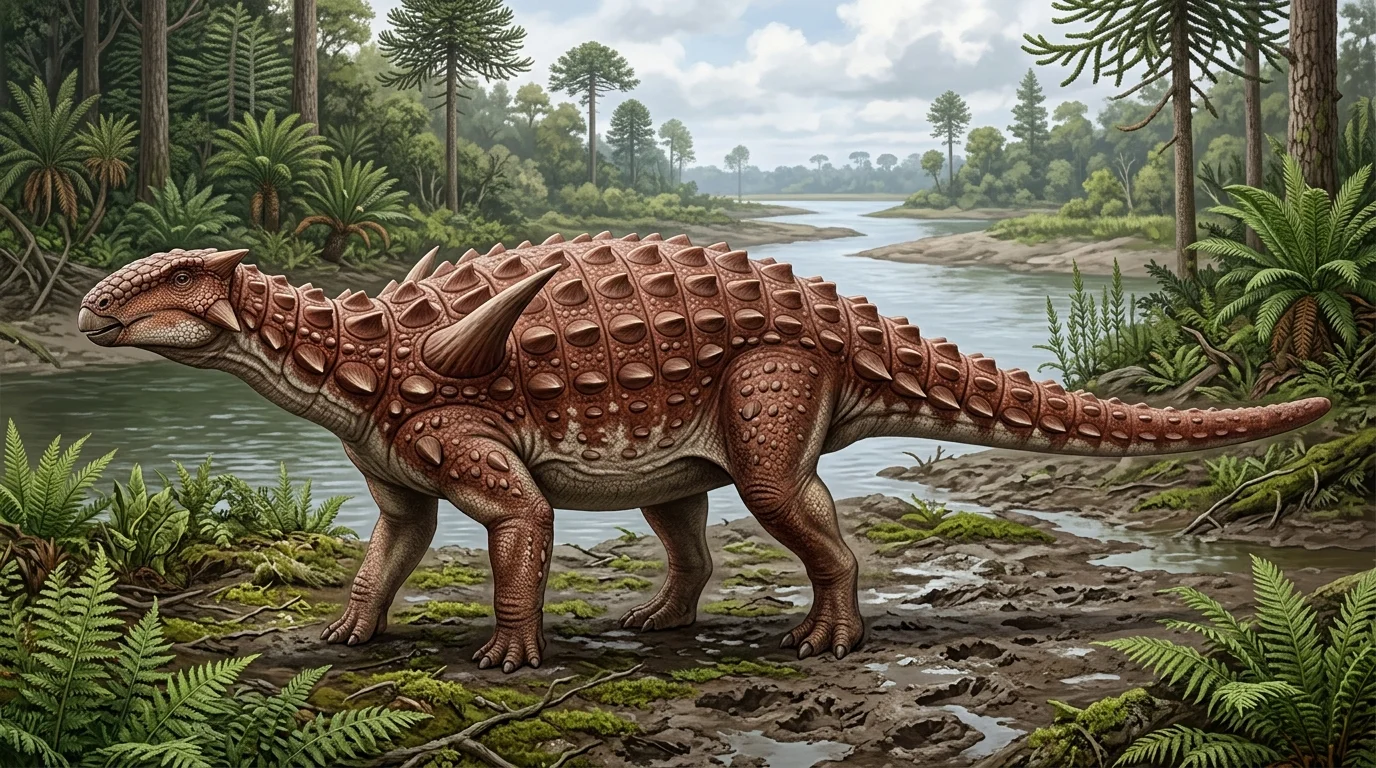
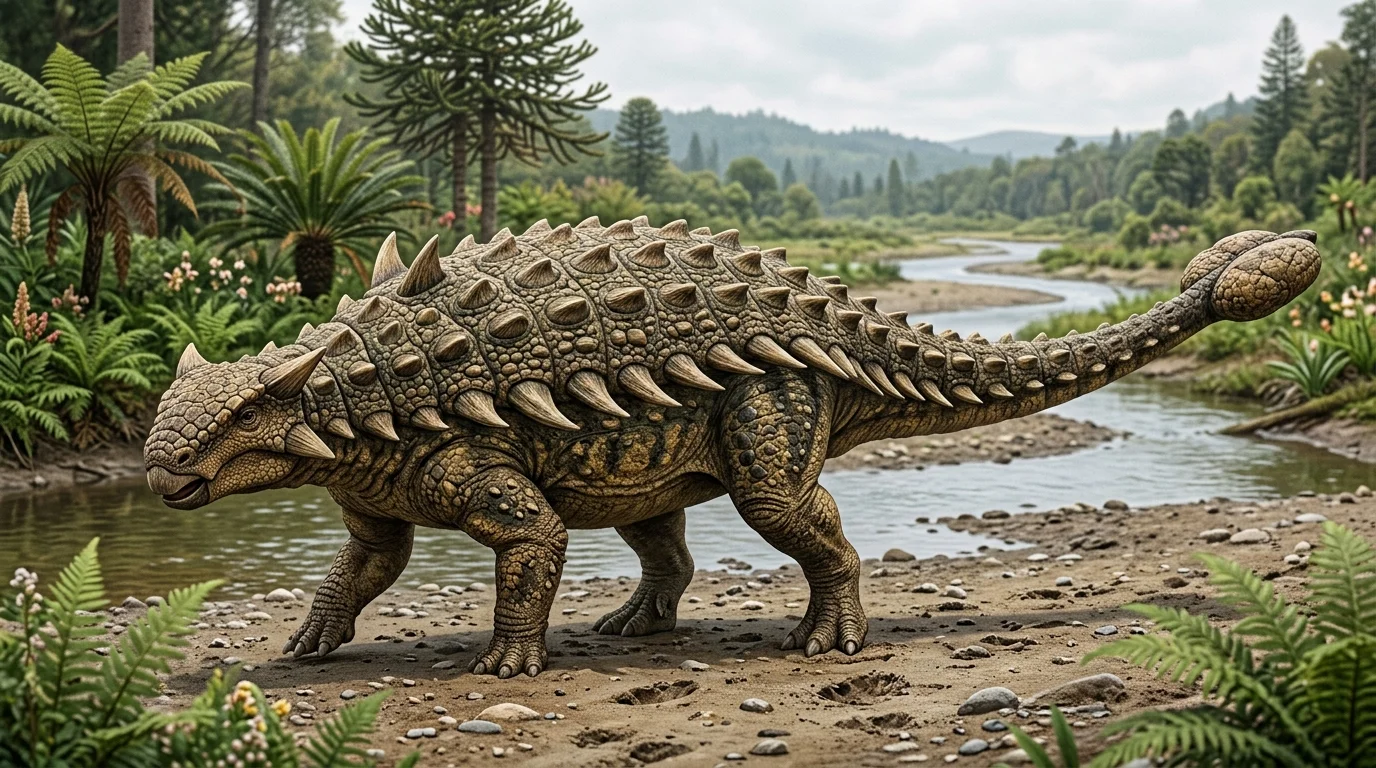
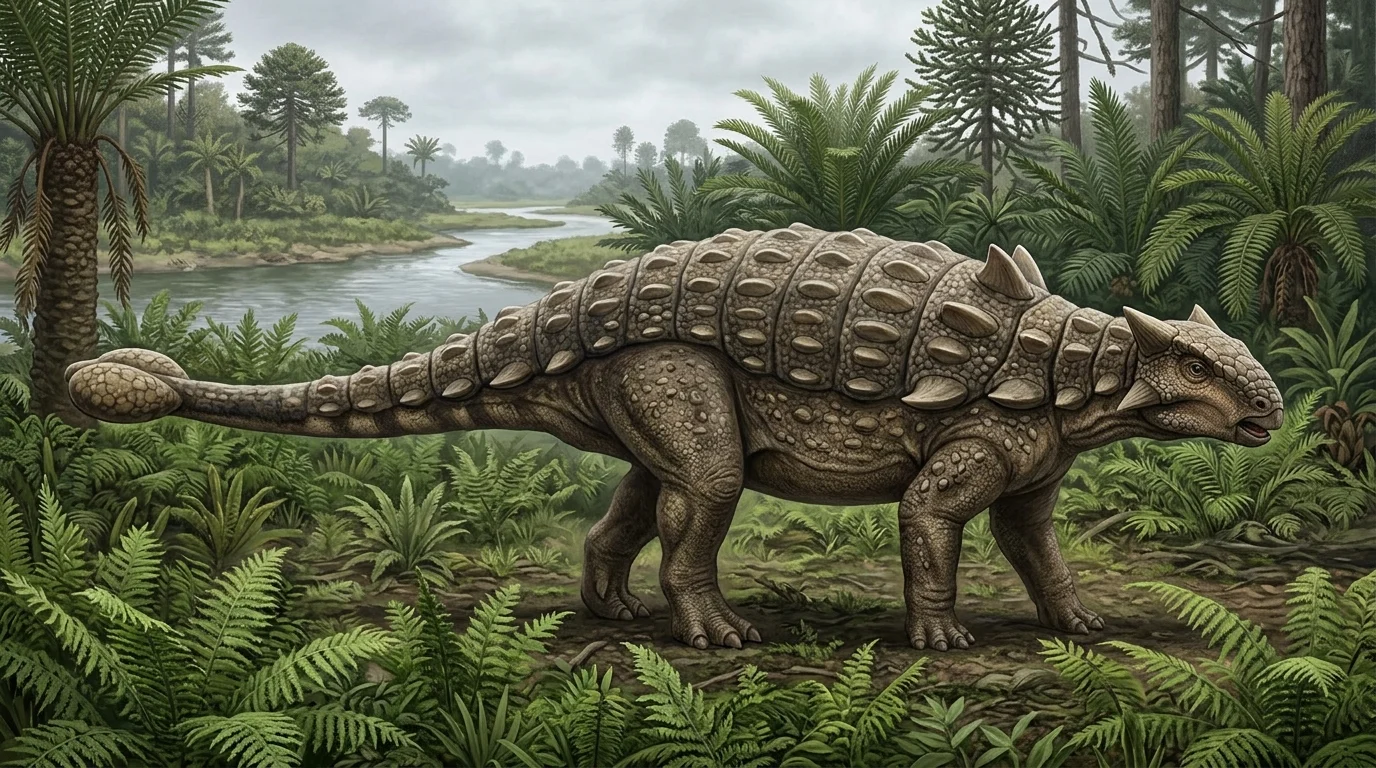
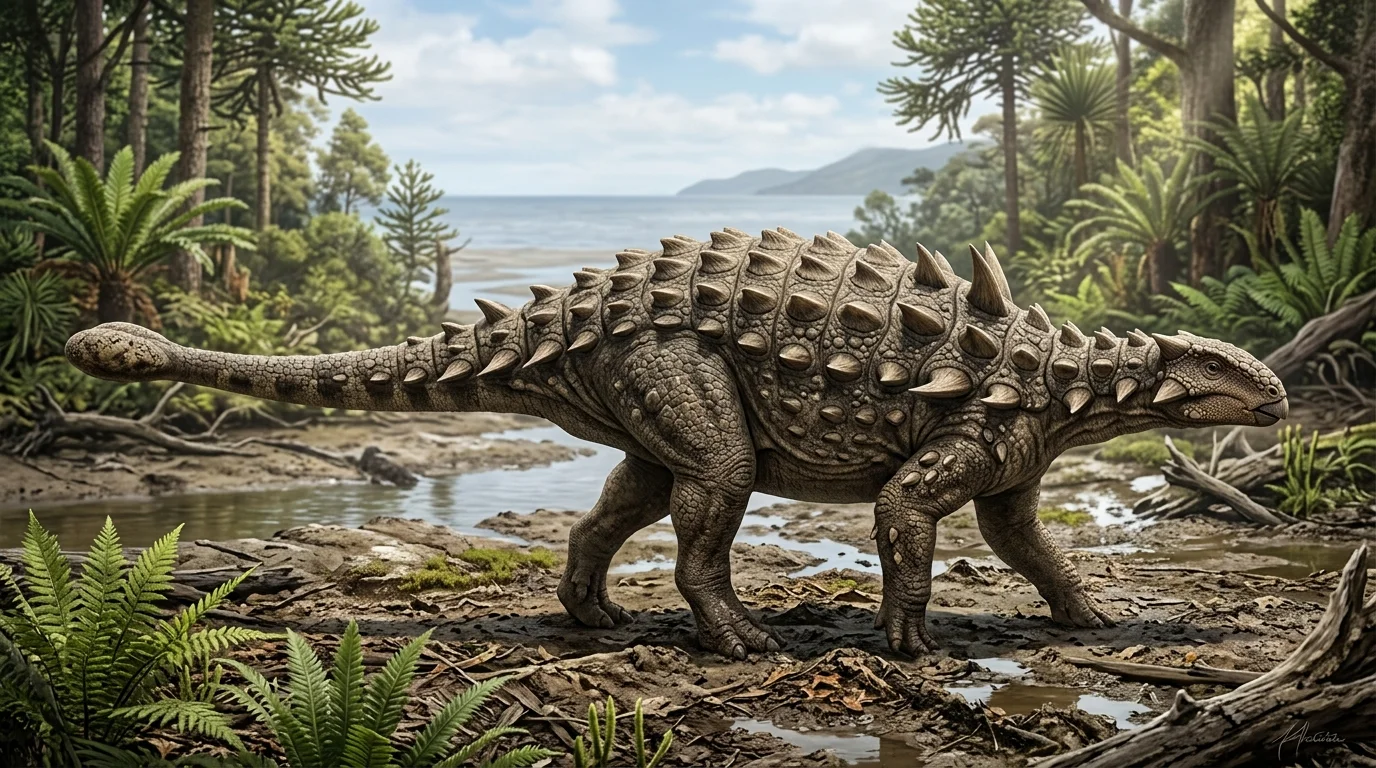
Scientific reconstruction of Borealopelta (Borealopelta markmitchelli Brown et al., 2017) in its native Geological period: Cretaceous Period.
Image Credit: AI-generated scientific paleoart reconstruction synthesized from species-specific osteological profiles and peer-reviewed descriptions. (AI-Generated / Open Educational Media (DinoOrigin Spec))
Phylogenetic classification of Borealopelta markmitchelli Brown et al., 2017 based on peer-reviewed cladistic analyses of diagnostic skeletal synapomorphies.
| Taxonomic Rank | Taxon / Clade | Diagnostic Context |
|---|---|---|
| Kingdom | Animalia | Monophyletic prehistoric clade |
| Phylum | Chordata | Monophyletic prehistoric clade |
| Clade | Dinosauria | Monophyletic prehistoric clade |
| Order | Ornithischia (Bird-Hipped Dinosaurs) | Characterized by a pelvis with a backwards-pointing pubis parallel to the ischium. |
| Infraorder | Ankylosauria | Heavily armored quadrupedal ornithischians protected by osteoderms and tail clubs. |
| Genus | Borealopelta | Monophyletic prehistoric clade |
| Species | Borealopelta markmitchelli Brown et al., 2017 | Specific authority designation |
Direct Size Determination: Unlike dinosaurs known only from fragmentary limbs or isolated teeth, the dimensions of Borealopelta markmitchelli are directly grounded in an extraordinarily complete fossil specimen (TMP 2011.033.0001). Reaching a total body length of approximately 5.0 to 5.5 meters (16.4–18.0 ft) and an estimated living body mass between 1.2 and 1.5 metric tons (1,200–1,500 kg), Borealopelta was a low-slung, heavily armored nodosaur built like a prehistoric tank.
Borealopelta is widely considered the best-preserved dinosaur fossil ever discovered in human history. Found in 2011 by heavy equipment operator Shawn Funk in an oil sands mine near Fort McMurray, Alberta, this 5.5-meter nodosaur was preserved in three dimensions down to its cellular keratinous armor scales.
Chemical analysis of its skin pigments confirmed countershading camouflage with a reddish-brown dorsal coloration, while its stomach preserved over 40 distinct varieties of fossilized fern leaves from its final meal.
Spectacularly armored quadruped with massive outward-projecting shoulder spikes, reddish-brown countershaded hide, and no tail club.
Anatomical dimensions relative to an average adult human (1.8 m / 6 ft tall)
Selective fern eater (85% leptosporangiate ferns) with preserved gastrolith stomach contents.
Heavily armored nodosaurid herbivore that relied on dense osteoderms and countershading camouflage for predator avoidance. Inhabiting coastal plain environments of the Clearwater Formation, it coexisted in the broader Early Cretaceous North American landscape alongside large predators like Acrocanthosaurus.
Coastal marine seaways and adjacent coastal temperate conifer-fern forests.
Unprecedented three-dimensional 'dinosaur mummy' (TMP 2011.033.0001) with intact skin, armor, keratin, and gut.
Discovered in Suncor oil sands mine; prepared by Mark Mitchell over 7,000 hours; named in 2017.
The longest and final period of the Mesozoic Era, characterized by the rise of flowering plants, ceratopsians, hadrosaurs, tyrannosaurids, and concluding with the Chicxulub asteroid impact.
During the Mesozoic Era, continental drift progressively reconfigured land bridges, atmospheric currents, and regional precipitation regimes. Fossils of Borealopelta evidence its adaptation to the paleoenvironments of North America.
Home to the fossil-rich Morrison Formation of the Late Jurassic and the Hell Creek and Dinosaur Park Formations of the Late Cretaceous.
The anatomical architecture of Borealopelta serves as a crucial benchmark in vertebrate paleontology, illustrating key adaptive radiations within Ankylosauria.
Scientifically verified answers based on peer-reviewed paleontological evidence.
Borealopelta markmitchelli measured approximately 5.0 to 5.5 meters (16.4 to 18.0 feet) in total length, stood roughly 1.3 to 1.6 meters (4.3 to 5.2 feet) tall at the shoulder and hips, and had an estimated body mass of 1,200 to 1,500 kg (1.2 to 1.5 metric tons). It was a low-slung, heavily armored quadruped roughly three times the length of an adult human.
The holotype specimen of Borealopelta (TMP 2011.033.0001), discovered in 2011 in the Clearwater Formation at the Suncor Millennium Mine near Fort McMurray, Alberta, is considered one of the best-preserved vertebrate fossils in history. Because the animal was rapidly buried in an offshore marine seabed, its three-dimensional armor osteoderms, keratinous claw and spike sheaths, cellular skin impressions, and internal stomach contents were fossilized intact.
Direct fossilized stomach contents (cololite) analyzed by Brown et al. (2020) proved that Borealopelta was a highly selective herbivore. Its final meal consisted predominantly (85%) of leptosporangiate fern fronds, along with cycad leaves, ingested charcoal fragments from forest fire regrowth, and small gastrolith gizzard stones used for grinding plant matter.
Authoritative citations establishing the factual taxonomy, biometrics, and anatomy of Borealopelta.
Brown, C. M., Henderson, D. M., Vinther, J., Fletcher, I., Sistiaga, A., Herrera, J., & Summons, R. E. (2017). An exceptionally preserved three-dimensional armored dinosaur reveals camouflage coloration in an industrial-scale predator-prey system. Current Biology, 27(16), 2514-2521. https://doi.org/10.1016/j.cub.2017.06.071
Curated & Verified: 2026-09-24Deposited in Mesozoic sedimentary strata preserving skeletal remains, teeth, or trace trackways.
Landmark chemical mass spectrometry of keratinous armor scales by Brown et al. (2017) detected pheomelanin pigments, revealing countershading camouflage: a dark reddish-brown dorsal coloration on its back and spikes transitioning to a lighter underbelly. This camouflage evidence indicates that even a 1.5-ton armored nodosaur faced intense visual predation pressure from giant Early Cretaceous theropods.
Borealopelta was discovered accidentally in March 2011 by heavy equipment operator Shawn Funk at the Suncor Millennium oil sands mine near Fort McMurray, Alberta, Canada. Fossil preparator Mark Mitchell spent over 7,000 hours over five years carefully revealing the skeleton from its hard marine siderite concretion.
AnkylosauriaAnkylosaurus magniventris Brown, 1908
The definitive armored dinosaur of the Late Cretaceous, encased in bony osteoderms and armed with an osseous tail club.
AnkylosauriaEuoplocephalus tutus Lambe, 1910
A heavily armored, tank-like ankylosaurid with armored eyelids and a massive bone-crushing tail club.
AnkylosauriaMinmi paravertebra Molnar, 1980
A small, agile Australian ankylosaur featuring unique horizontal 'paravertebra' bone plates along its spine.