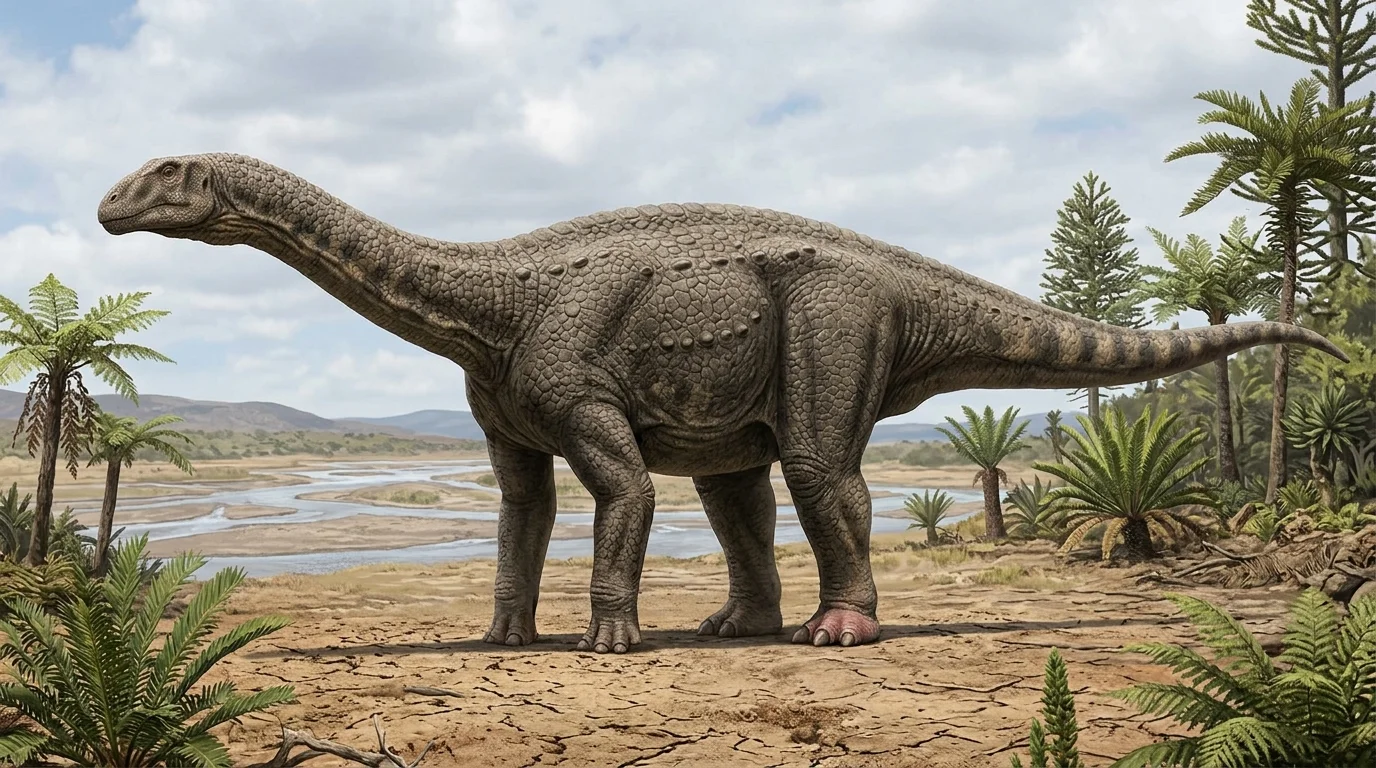
Herbivorous saurischians characterized by elongated necks, columnar limbs, and enormous body volumes.
Genus
Thecodontosaurus
Monophyletic prehistoric clade
Species
Thecodontosaurus antiquus Morris, 1843
Specific authority designation
Anatomy & Physical Characteristics
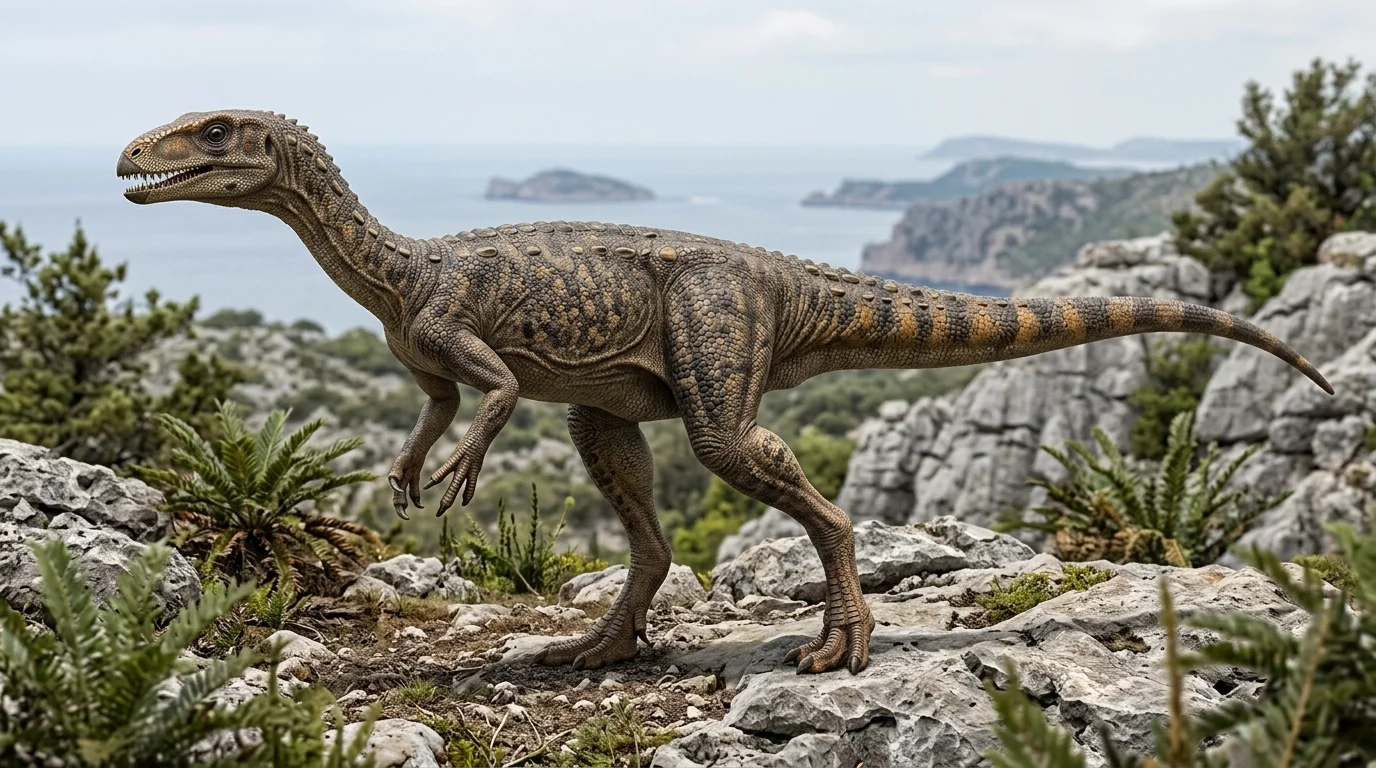
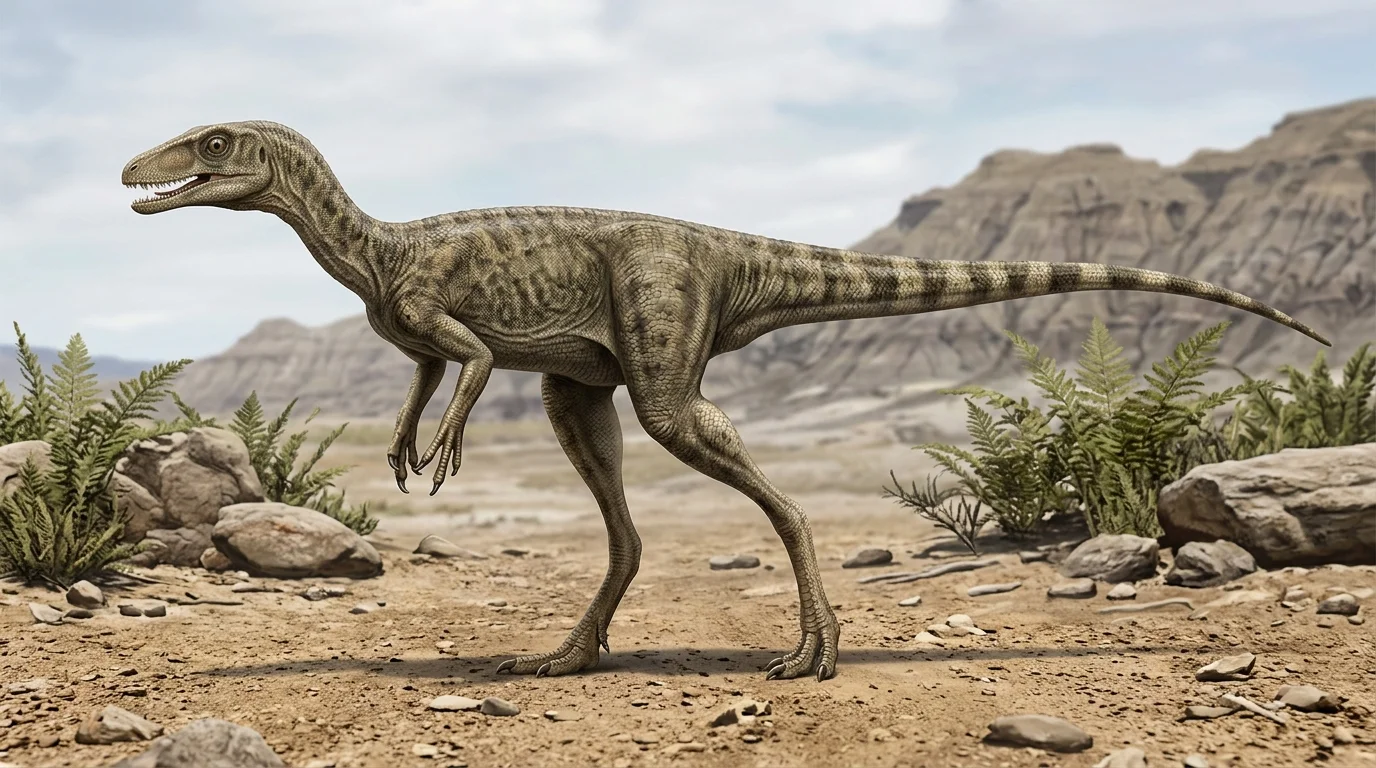
Thecodontosaurus was a compact, bipedal basal sauropodomorph adapted to life on ancient Mesozoic islands in what is now southwest England. Measuring roughly two meters in length, it inhabited coastal karst landscapes characterized by limestone fissures.
CT scans of its braincase reveal well-developed equilibrium centers and optical lobes, suggesting an agile, visually oriented animal.
Diagnostic Morphological Traits
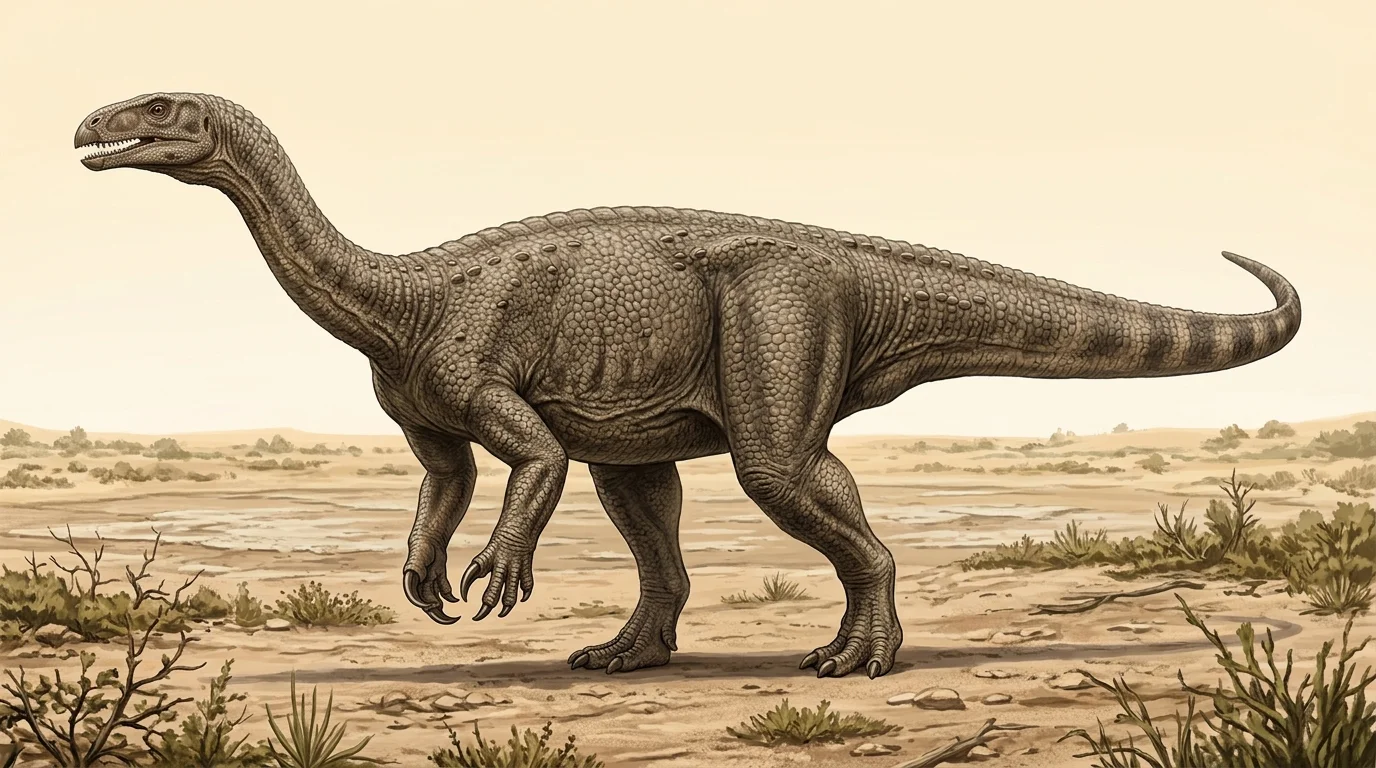
Slender biped with a small pointed head, elongate hindlimbs, grasping hands, and long counterbalance tail.
Comparative Scale & Biometrics
Anatomical dimensions relative to an average adult human (1.8 m / 6 ft tall)
Herbivorous/omnivorous; serrated leaf-shaped teeth were suited for cropping low ferns and shrubby vegetation.
Paleobiology & Behavior
Small, slender bipedal sauropodomorph that inhabited island archipelago environments in Late Triassic Europe. Found in fissure-fill deposits near Bristol, England, Thecodontosaurus represents an early evolutionary ancestor related to larger continental sauropodomorphs like Plateosaurus.
Habitat & Ecological Biome
Prehistoric Depositional Setting
Subtropical archipelago islands and limestone karst upland scrub.
Fossil Evidence & Specimen Records
Preserved Skeletal Material & Bonebeds
Numerous disarticulated bones found inside ancient Triassic cave fills.
Discovery & Taxonomic Naming History
Year of Discovery / Description1834
Type Specimen Locality & FormationDurdham Down, Bristol, United Kingdom
Discovered in a limestone quarry near Bristol by Henry Riley and Samuel Stutchbury.
Triassic Period PeriodTemporal Interval: 205–201.3 Ma (million years ago)
The dawn of the Mesozoic Era. Dinosaurs first emerged in the Late Triassic following the catastrophic Permian-Triassic extinction event, initially occupying modest niches alongside crurotarsan archosaurs.
During the Mesozoic Era, continental drift progressively reconfigured land bridges, atmospheric currents, and regional precipitation regimes. Fossils of Thecodontosaurus evidence its adaptation to the paleoenvironments of Europe.
Paleogeographic RealmEurope (Europe)
During the Mesozoic, Europe was largely an archipelago of islands, resulting in unique insular dwarf species and classic historical fossil discoveries.
Fossil Discovery Locality
Scientific Significance & Evolutionary Impact
The anatomical architecture of Thecodontosaurus serves as a crucial benchmark in vertebrate paleontology, illustrating key adaptive radiations within Sauropodomorpha.
Phylogenetic Placement: Informs cladistic debates concerning the divergence, skull biomechanics, and skeletal evolution of Triassic Period fauna.
Paleoecological Guild: Documents trophic specialization (Herbivore) and predator-prey dynamics across its regional ecosystem.
Taphonomic Record: Numerous disarticulated bones found inside ancient Triassic cave fills.
Frequently Asked Questions About Thecodontosaurus
Scientifically verified answers based on peer-reviewed paleontological evidence.
Q1.When did Thecodontosaurus live?
Thecodontosaurus lived during the Triassic Period Period, approximately 205–201.3 Ma (million years ago). This places it within the Mesozoic Era.
Q2.How big was Thecodontosaurus?
Paleontological estimates place Thecodontosaurus at a length of 1.5–2.1 m (4.9–6.9 ft), a hip/standing height of 0.5–0.7 m (1.6–2.3 ft), and a body mass of 10–20 kg (22–44 lbs).
Q3.What was the diet of Thecodontosaurus?
Classified as a herbivore, Thecodontosaurus specialized in consuming Herbivorous/omnivorous; serrated leaf-shaped teeth were suited for cropping low ferns and shrubby vegetation..
Q4.Where were Thecodontosaurus fossils discovered?
Fossil specimens of Thecodontosaurus have been recovered from Durdham Down, Bristol, United Kingdom, with notable historic specimens documented in 1834. Discovered in a limestone quarry near Bristol by Henry Riley and Samuel Stutchbury.
Academic Literature & Peer-Reviewed References
Authoritative citations establishing the factual taxonomy, biometrics, and anatomy of Thecodontosaurus.
Benton, M. J., Juul, L., Storrs, G. W., & Galton, P. M. (2000). Anatomy and systematics of the prosauropod dinosaur Thecodontosaurus antiquus from the Upper Triassic of southwest England. Journal of Vertebrate Paleontology, 20(1), 77-108. https://doi.org/10.1671/0272-4634(2000)020[0077:AASOTP]2.0.CO;2
Deposited in Mesozoic sedimentary strata preserving skeletal remains, teeth, or trace trackways.
Q5.What makes Thecodontosaurus scientifically significant?
Thecodontosaurus provides critical insights into the evolutionary radiation of Sauropodomorpha. Holotypes and fossil evidence indicate: Numerous disarticulated bones found inside ancient Triassic cave fills.
Riley, H., & Stutchbury, S. (1840). A description of various fossil remains of three distinct saurian animals, recently discovered in the Magnesian Conglomerate near Bristol. Transactions of the Geological Society of London, 5(2), 349-357. https://doi.org/10.1144/transgslb.5.2.349
A diminutive Late Triassic dinosaur from Argentina whose phylogenetic position between basal Theropoda and stem-Sauropodomorpha has been extensively debated.