Tenontosaurus tilletti Ostrom, 1970
A muscular Early Cretaceous ornithopod with an exceptionally long, deep tail, famous as the prey of Deinonychus.

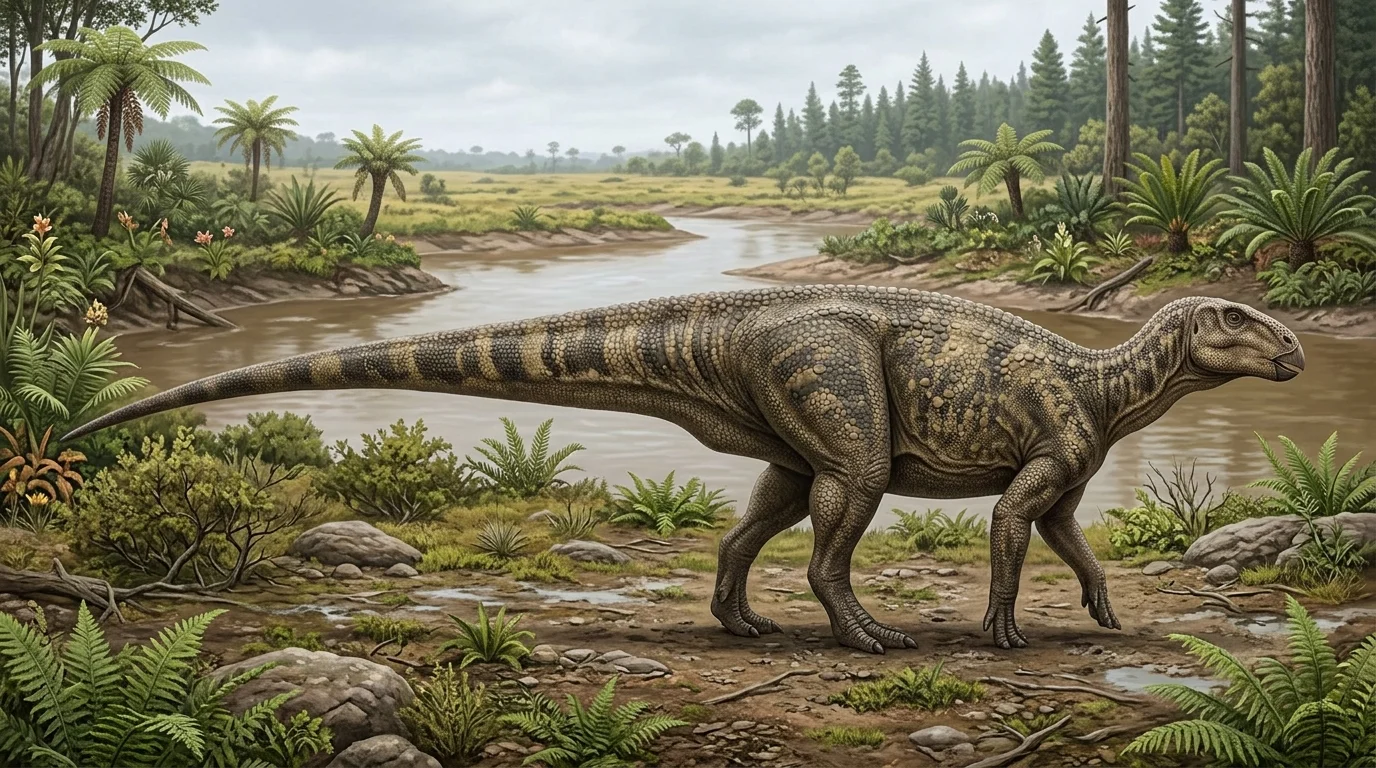
Scientific reconstruction of Tenontosaurus (Tenontosaurus tilletti Ostrom, 1970) in its native Geological period: Cretaceous Period.
Image Credit: AI-generated scientific paleoart reconstruction synthesized from species-specific osteological profiles and peer-reviewed descriptions. (AI-Generated / Open Educational Media (DinoOrigin Spec))
Phylogenetic classification of Tenontosaurus tilletti Ostrom, 1970 based on peer-reviewed cladistic analyses of diagnostic skeletal synapomorphies.
| Taxonomic Rank | Taxon / Clade | Diagnostic Context |
|---|---|---|
| Kingdom | Animalia | Monophyletic prehistoric clade |
| Phylum | Chordata | Monophyletic prehistoric clade |
| Clade | Dinosauria | Monophyletic prehistoric clade |
| Order | Ornithischia (Bird-Hipped Dinosaurs) | Characterized by a pelvis with a backwards-pointing pubis parallel to the ischium. |
| Suborder | Ornithopoda | Beaked, bipedal and facultatively quadrupedal herbivores with complex multi-layered dental batteries. |
| Genus | Tenontosaurus | Monophyletic prehistoric clade |
| Species | Tenontosaurus tilletti Ostrom, 1970 | Specific authority designation |
Tenontosaurus was a medium-sized basal ornithopod that inhabited North America during the Early Cretaceous. Reaching up to seven meters in length, its most striking feature was its immense, deep tail, which accounted for more than half its total length and was stiffened by an elaborate lattice of ossified tendons.
Tenontosaurus is famous for its intimate fossil association with the dromaeosaurid Deinonychus: multiple quarries preserve single Tenontosaurus skeletons surrounded by shed teeth and skeletons of attacking raptors.
Stocky ornithopod with an extraordinarily long, deep tail, strong forelimbs, and a horny cropping beak.
Anatomical dimensions relative to an average adult human (1.8 m / 6 ft tall)
Cycads, ferns, horsetails, and early flowering angiosperms ground with cheek teeth.
Medium-sized ornithopod herbivore possessing an unusually long, stiffened tail. Preserved frequently in the Cloverly Formation in multi-predator association with Deinonychus, Tenontosaurus was a primary food source for regional carnivores including Acrocanthosaurus.
Lush coastal plain floodplains, subtropical river margins, and savannah scrublands.
Dozens of articulated skeletons, frequently found in direct association with Deinonychus.
Excavated by Barnum Brown; comprehensively studied and named by John Ostrom in 1970.
The longest and final period of the Mesozoic Era, characterized by the rise of flowering plants, ceratopsians, hadrosaurs, tyrannosaurids, and concluding with the Chicxulub asteroid impact.
During the Mesozoic Era, continental drift progressively reconfigured land bridges, atmospheric currents, and regional precipitation regimes. Fossils of Tenontosaurus evidence its adaptation to the paleoenvironments of North America.
Home to the fossil-rich Morrison Formation of the Late Jurassic and the Hell Creek and Dinosaur Park Formations of the Late Cretaceous.
The anatomical architecture of Tenontosaurus serves as a crucial benchmark in vertebrate paleontology, illustrating key adaptive radiations within Ornithopoda.
Scientifically verified answers based on peer-reviewed paleontological evidence.
Tenontosaurus lived during the Cretaceous Period Period, approximately 115–108 Ma (million years ago). This places it within the Mesozoic Era.
Paleontological estimates place Tenontosaurus at a length of 6–7 m (19.7–23.0 ft), a hip/standing height of 2–2.4 m (6.6–7.9 ft), and a body mass of 1.0–2.0 metric tons (2,205–4,409 lbs).
Classified as a herbivore, Tenontosaurus specialized in consuming Cycads, ferns, horsetails, and early flowering angiosperms ground with cheek teeth..
Fossil specimens of Tenontosaurus have been recovered from Cloverly Formation, Montana, United States, with notable historic specimens documented in 1903. Excavated by Barnum Brown; comprehensively studied and named by John Ostrom in 1970.
Authoritative citations establishing the factual taxonomy, biometrics, and anatomy of Tenontosaurus.
Ostrom, J. H. (1970). Stratigraphy and paleontology of the Cloverly Formation (Lower Cretaceous) of the Bighorn Basin area, Wyoming and Montana. Peabody Museum of Natural History Bulletin, 35, 1-234.
Curated & Verified: 2026-09-24Deposited in Mesozoic sedimentary strata preserving skeletal remains, teeth, or trace trackways.
Tenontosaurus provides critical insights into the evolutionary radiation of Ornithopoda. Holotypes and fossil evidence indicate: Dozens of articulated skeletons, frequently found in direct association with Deinonychus.
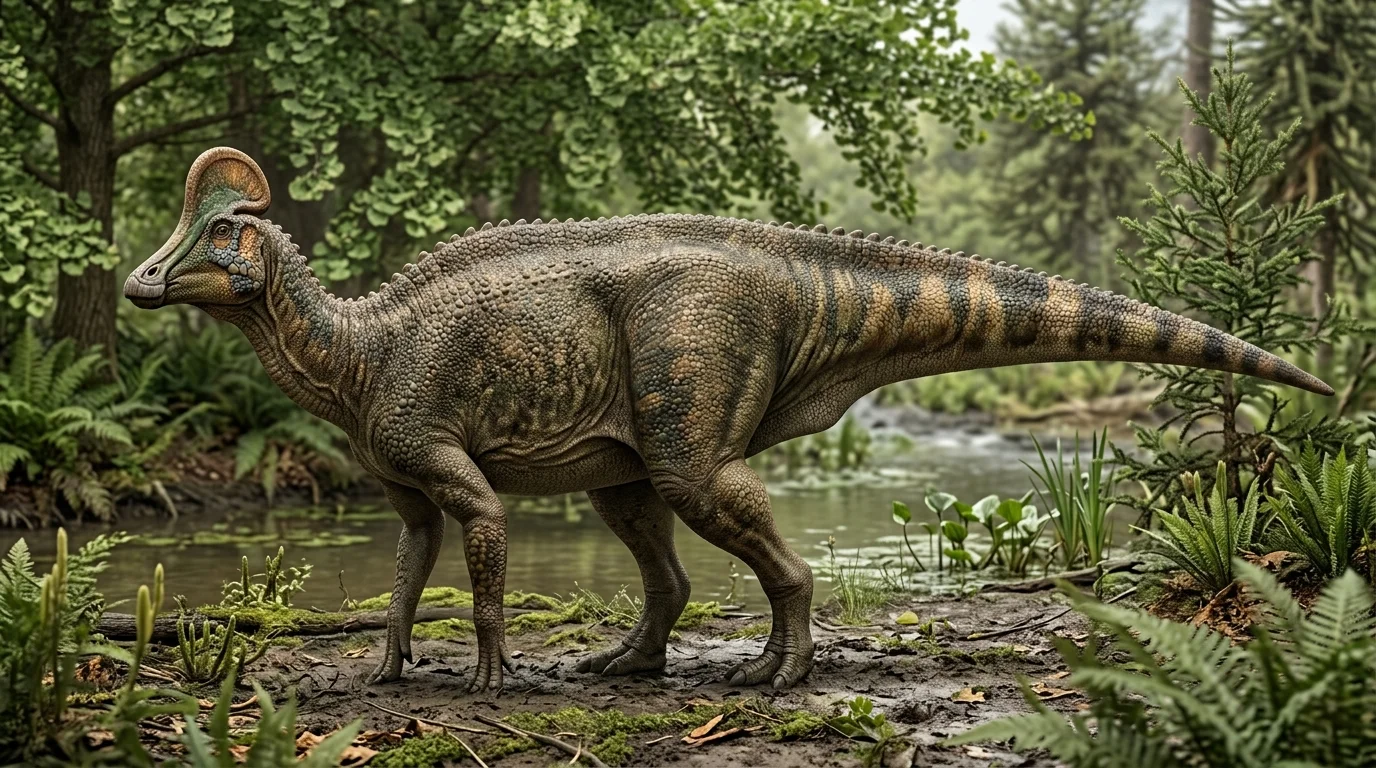
OrnithopodaCorythosaurus casuarius Brown, 1914
A hollow-crested hadrosaurid from Alberta possessing a tall, semicircular helmet crest for sound resonance.
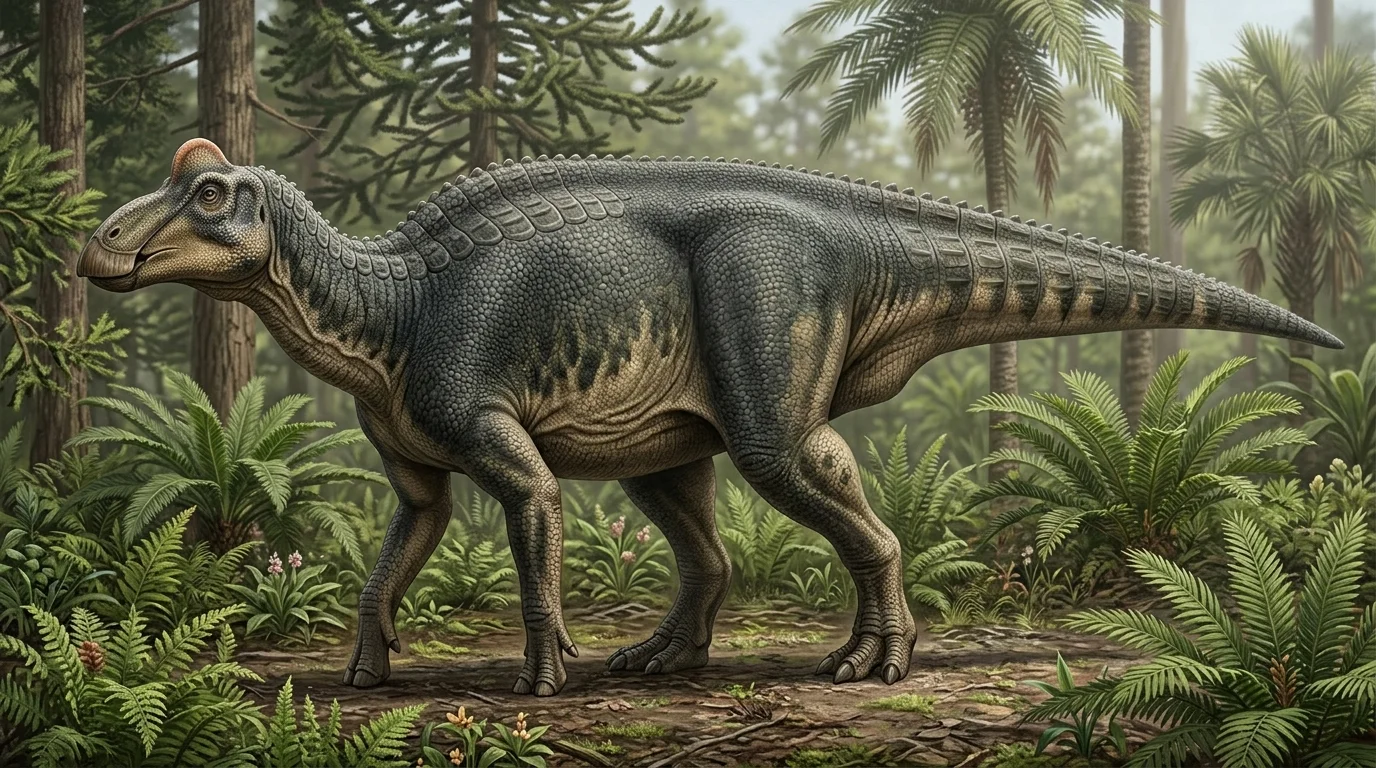
OrnithopodaEdmontosaurus regalis Lambe, 1917
A colossal duck-billed hadrosaurid that was the primary herbivore of Late Cretaceous North America.
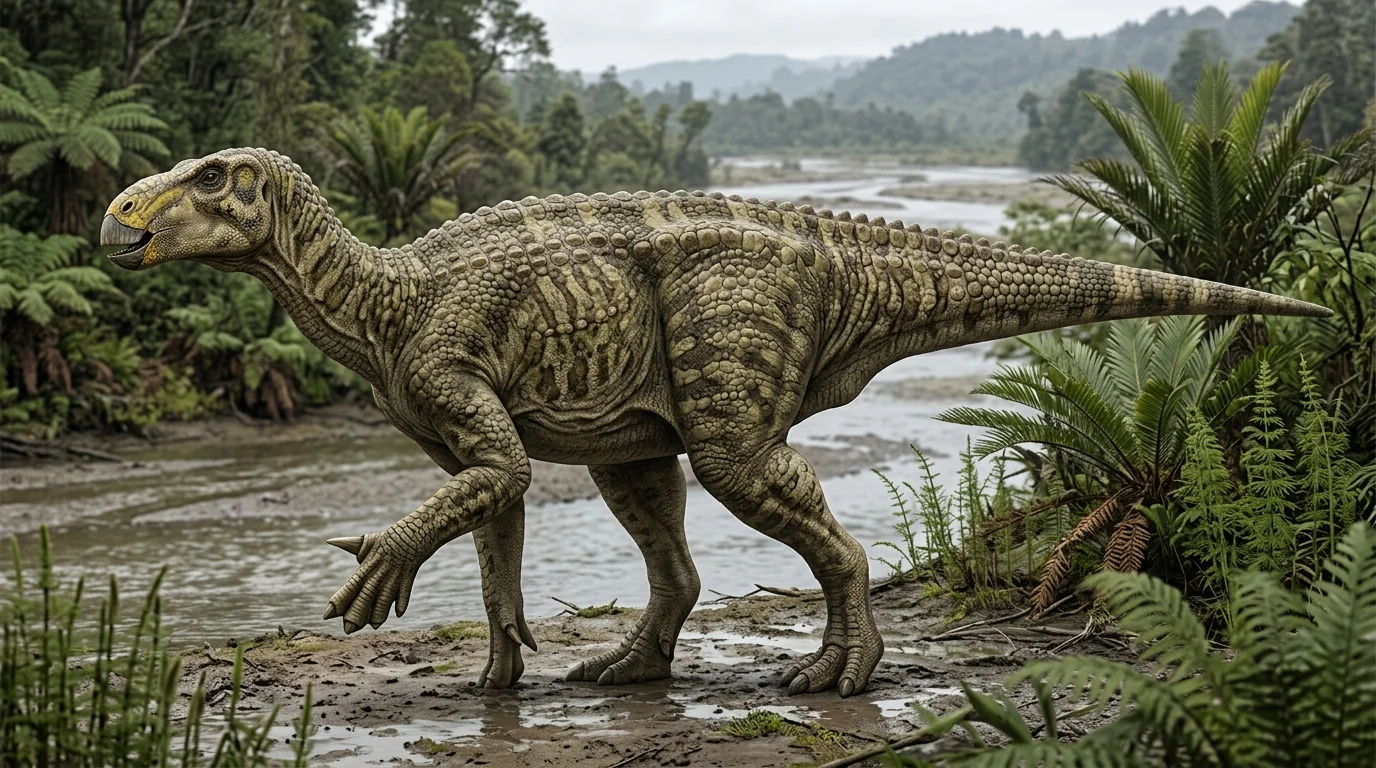
OrnithopodaIguanodon bernissartensis Boulenger, 1881
A foundational Early Cretaceous ornithopod possessing a specialized conical thumb spike and facultative quadrupedal gait.