Archaeopteryx lithographica von Meyer, 1861
An iconic stem-avialan from the Late Jurassic Solnhofen limestone exhibiting transitional features bridging non-avian theropods and birds.

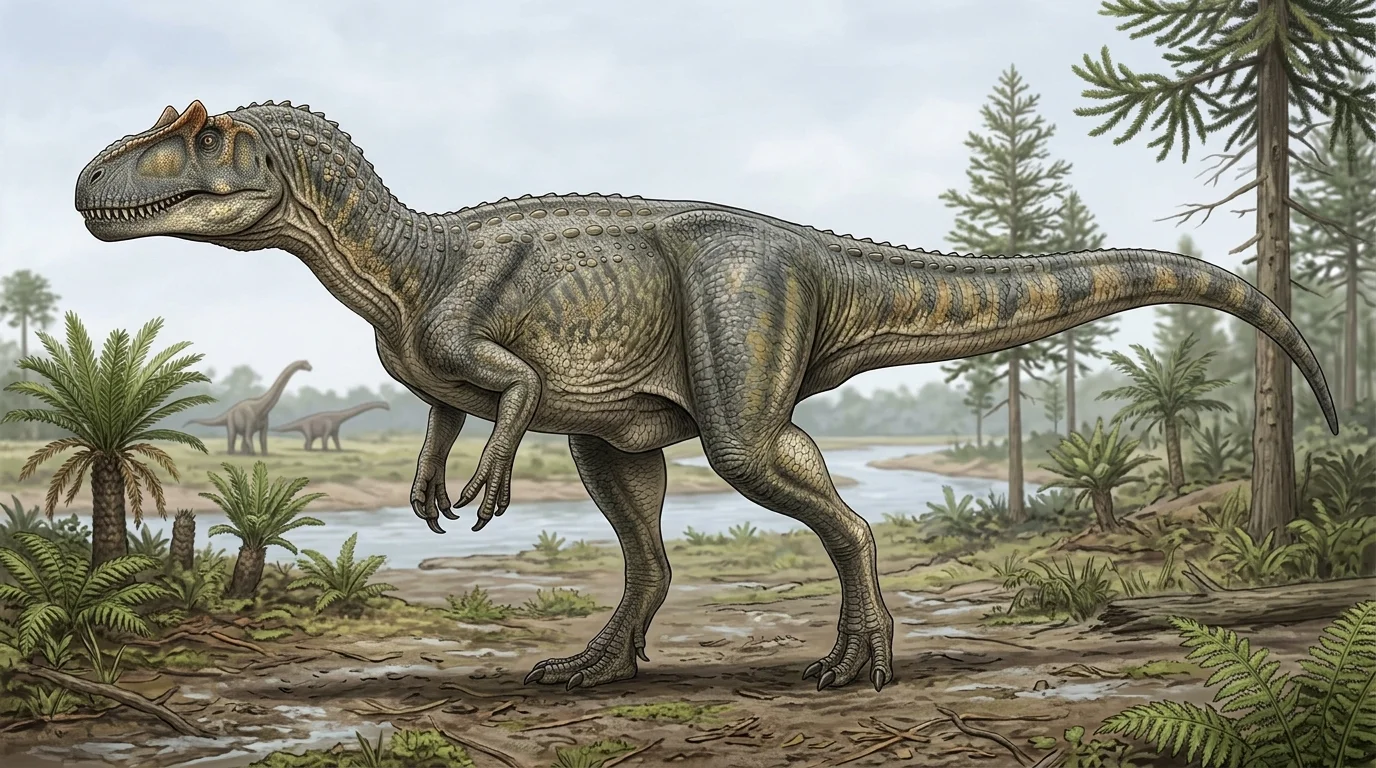
Scientific reconstruction of Archaeopteryx (Archaeopteryx lithographica von Meyer, 1861) in its native Geological period: Jurassic Period.
Image Credit: AI-generated scientific paleoart reconstruction synthesized from species-specific osteological profiles and peer-reviewed descriptions. (AI-Generated / Open Educational Media (DinoOrigin Spec))
Phylogenetic classification of Archaeopteryx lithographica von Meyer, 1861 based on peer-reviewed cladistic analyses of diagnostic skeletal synapomorphies.
| Taxonomic Rank | Taxon / Clade | Diagnostic Context |
|---|---|---|
| Kingdom | Animalia | Monophyletic prehistoric clade |
| Phylum | Chordata | Monophyletic prehistoric clade |
| Clade | Dinosauria | Monophyletic prehistoric clade |
| Order | Saurischia (Lizard-Hipped Dinosaurs) | Characterized ancestrally by a triradiate pelvis with an anteriorly pointing pubis. |
| Suborder | Theropoda | Bipedal saurischian dinosaurs, historically dominated by carnivores and including the avian lineage. |
| Genus | Archaeopteryx | Monophyletic prehistoric clade |
| Species | Archaeopteryx lithographica von Meyer, 1861 | Specific authority designation |
Archaeopteryx is among the most famous transition fossils in paleontological history, discovered in 1861 in the Late Jurassic Period Solnhofen Plattenkalk of Bavaria, Germany (~150 to 148 million years ago). Belonging to basal Theropoda within the stem-avialan lineage, Archaeopteryx preserves a mosaic of anatomical features that clearly bridge non-avian dinosaurs and modern birds.
Flight Mechanics and Locomotion: Aerodynamic and locomotor capabilities in Archaeopteryx remain actively debated, with biomechanical models and aerodynamic simulations providing competing interpretations of its flight performance. Its asymmetric, pennaceous wing feathers indicate aerodynamic function, and X-ray synchrotron phase-contrast tomography reveals that its humerus and ulna bones were adapted to resist torsional flight stresses, suggesting capability for short bursts of powered flapping flight or controlled gliding. However, the absence of a keeled sternum (breastbone) and modern triosseal shoulder canal indicates that flapping gaits were constrained by skeletal anatomy and biomechanically distinct from modern birds.
Scientific Significance: Discovered two years after Charles Darwin published On the Origin of Species, Archaeopteryx provided immediate physical evidence for evolutionary transition. Retaining ancestral theropod teeth, a long bony tail, and clawed manual digits alongside avian flight feathers and a furcula (wishbone), its phylogenetic placement continues to illuminate the origins of avian flight and paravian systematics.
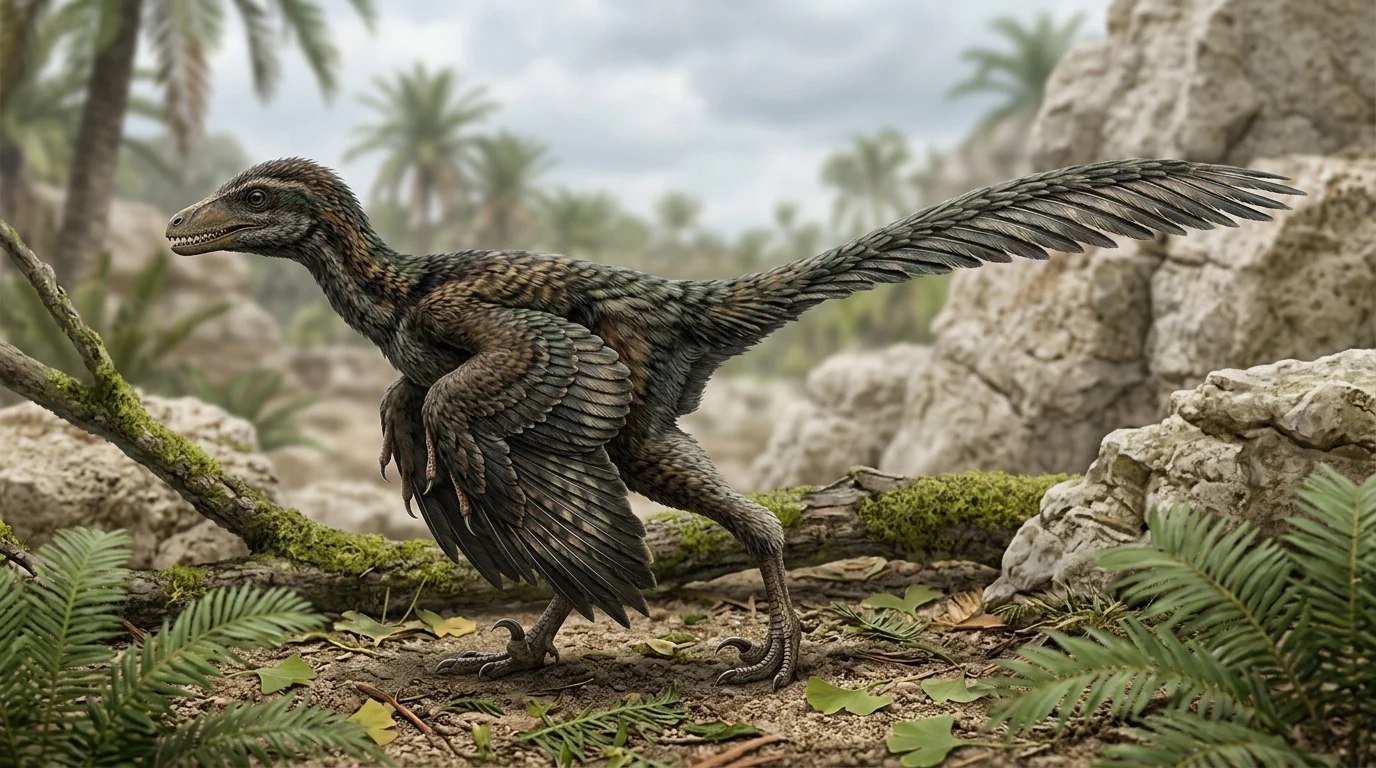
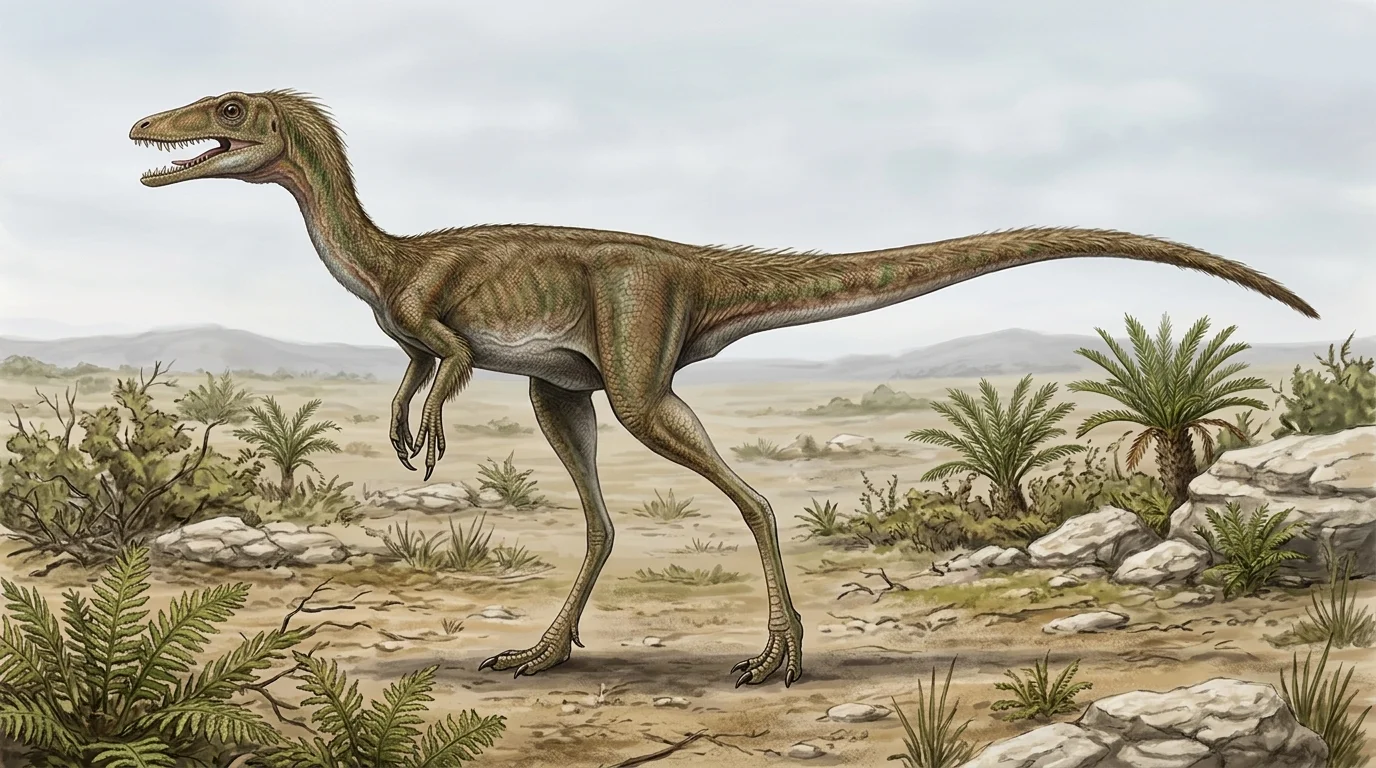
Crow-sized creature with vaned flight feathers, feathered wings and legs, toothed jaws, and a long bony tail.
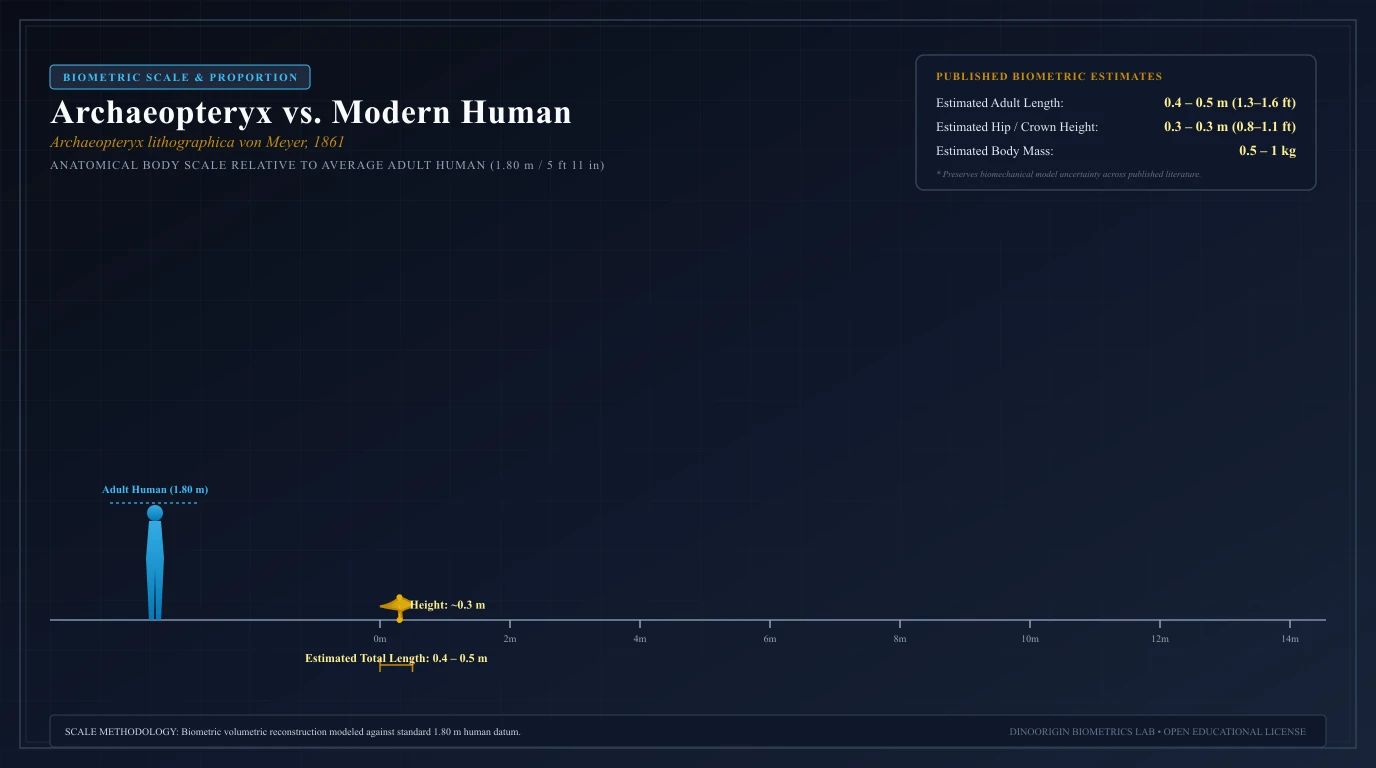
Anatomical dimensions relative to an average adult human (1.8 m / 6 ft tall)
Carnivorous/insectivorous; small lizards, crustaceans, and insects.
Inhabiting a semi-arid subtropical archipelago of lagoonal islands, Archaeopteryx likely foraged along limestone coastlines and scrub conifer thickets for insects, small crustaceans, and small terrestrial reptiles. Claw curvature analyses suggest both cursorial ground foraging and perching or climbing capabilities in low arborescent vegetation.
Arid subtropical archipelago islands with hypersaline coastal lagoons.
Represented by exactly 12 body fossil specimens and one isolated feather impression recovered from the Solnhofen limestone. Notable specimens include the London specimen holotype (NHMUK PV OR 37001), the exquisitely articulated Berlin specimen (HMN 1880/81) preserving clear feather tracts and skull, and the Maxberg and Eichstätt specimens.

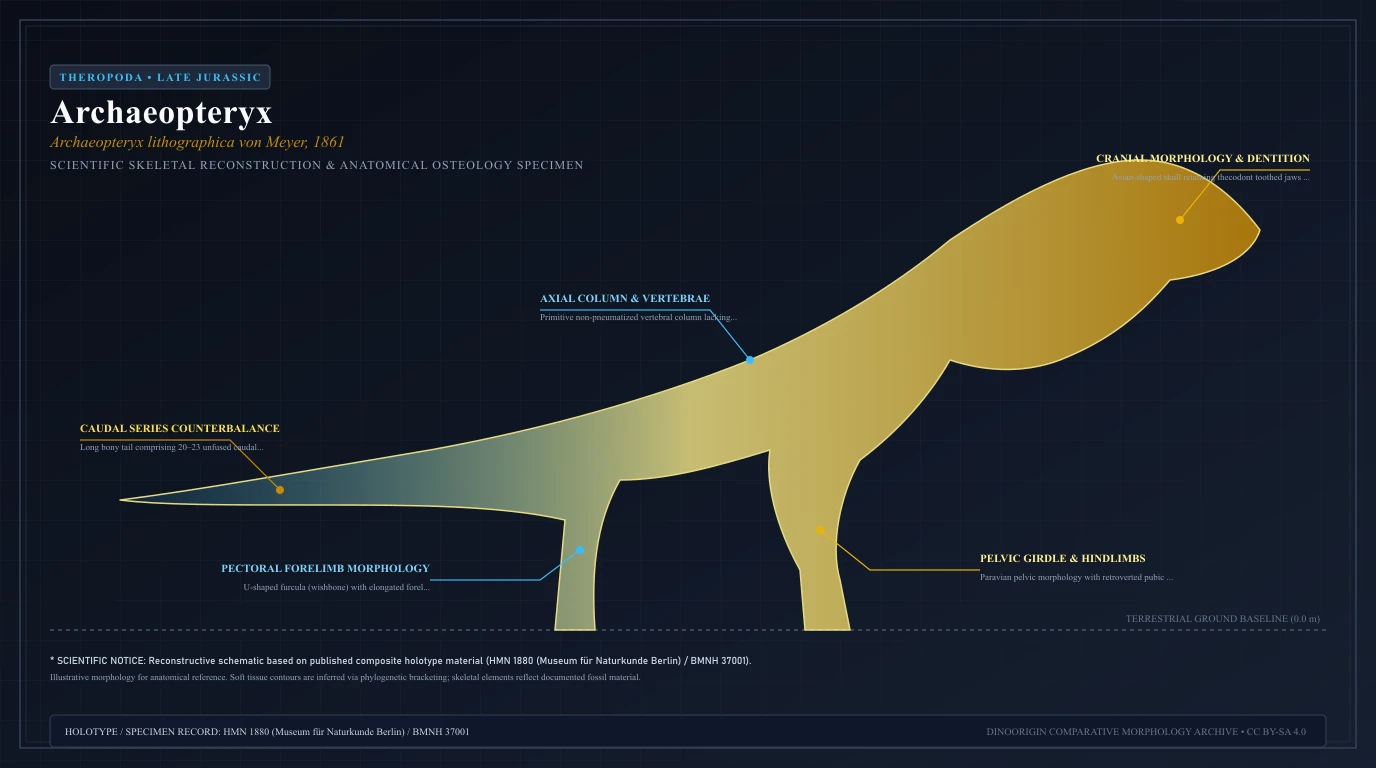
Anatomical skeletal reconstruction of Archaeopteryx (Archaeopteryx lithographica von Meyer, 1861) illustrating cranial fenestrae, vertebral column, and appendicular proportions based on composite fossil material.
First skeleton recovered near Langenaltheim; acquired by Richard Owen for the Natural History Museum, London.
Marked by lush greenhouse climates, the breakup of Pangaea, and the evolutionary explosion of sauropods, plated stegosaurs, and apex megalosauroid and allosauroid theropods.
During the Mesozoic Era, continental drift progressively reconfigured land bridges, atmospheric currents, and regional precipitation regimes. Fossils of Archaeopteryx evidence its adaptation to the paleoenvironments of Europe.
During the Mesozoic, Europe was largely an archipelago of islands, resulting in unique insular dwarf species and classic historical fossil discoveries.
The anatomical architecture of Archaeopteryx serves as a crucial benchmark in vertebrate paleontology, illustrating key adaptive radiations within Theropoda.
Scientifically verified answers based on peer-reviewed paleontological evidence.
Archaeopteryx lived during the Jurassic Period Period, approximately 150–148 Ma (million years ago). This places it within the Mesozoic Era.
Paleontological estimates place Archaeopteryx at a length of 0.4–0.5 m (1.3–1.6 ft), a hip/standing height of 0.25–0.35 m (0.8–1.1 ft), and a body mass of 0.5–1 kg (1–2 lbs).
Classified as a carnivore, Archaeopteryx specialized in consuming Carnivorous/insectivorous; small lizards, crustaceans, and insects..
Fossil specimens of Archaeopteryx have been recovered from Solnhofen Limestone, Bavaria, Germany, with notable historic specimens documented in 1861. First skeleton recovered near Langenaltheim; acquired by Richard Owen for the Natural History Museum, London.
Authoritative citations establishing the factual taxonomy, biometrics, and anatomy of Archaeopteryx.
von Meyer, H. (1861). Archaeopteryx lithographica (Vogel-Feder) und Pterodactylus von Solnhofen. Neues Jahrbuch für Mineralogie, Geognosie, Geologie und Petrefakten-Kunde, 1861, 678-679.
Curated & Verified: 2026-09-24
Comparative size scale of Archaeopteryx relative to a 1.8-meter adult human, illustrating an estimated length of 0.4–0.5 m and height of 0.3–0.3 m (preserving model uncertainty).
Deposited in Mesozoic sedimentary strata preserving skeletal remains, teeth, or trace trackways.
Archaeopteryx provides critical insights into the evolutionary radiation of Theropoda. Holotypes and fossil evidence indicate: Represented by exactly 12 body fossil specimens and one isolated feather impression recovered from the Solnhofen limestone. Notable specimens include the London specimen holotype (NHMUK PV OR 37001), the exquisitely articulated Berlin specimen (HMN 1880/81) preserving clear feather tracts and skull, and the Maxberg and Eichstätt specimens.
Xu, X., You, H., Du, K., & Han, F. (2011). An Archaeopteryx-like theropod from China and the origin of Avialae. Nature, 475(7357), 465-470. https://doi.org/10.1038/nature10284
TheropodaAllosaurus fragilis Marsh, 1877
The most abundant apex theropod of Late Jurassic North America, equipped with a kinetic skull and slashing serrated teeth.
TheropodaCeratosaurus nasicornis Marsh, 1884
A distinctive Late Jurassic theropod sporting a prominent nasal horn core and a line of small osteoderms along its back.
TheropodaCompsognathus longipes Wagner, 1859
A petite, nimble Late Jurassic coelurosaur about the size of a chicken, historically famous as one of the smallest known dinosaurs.