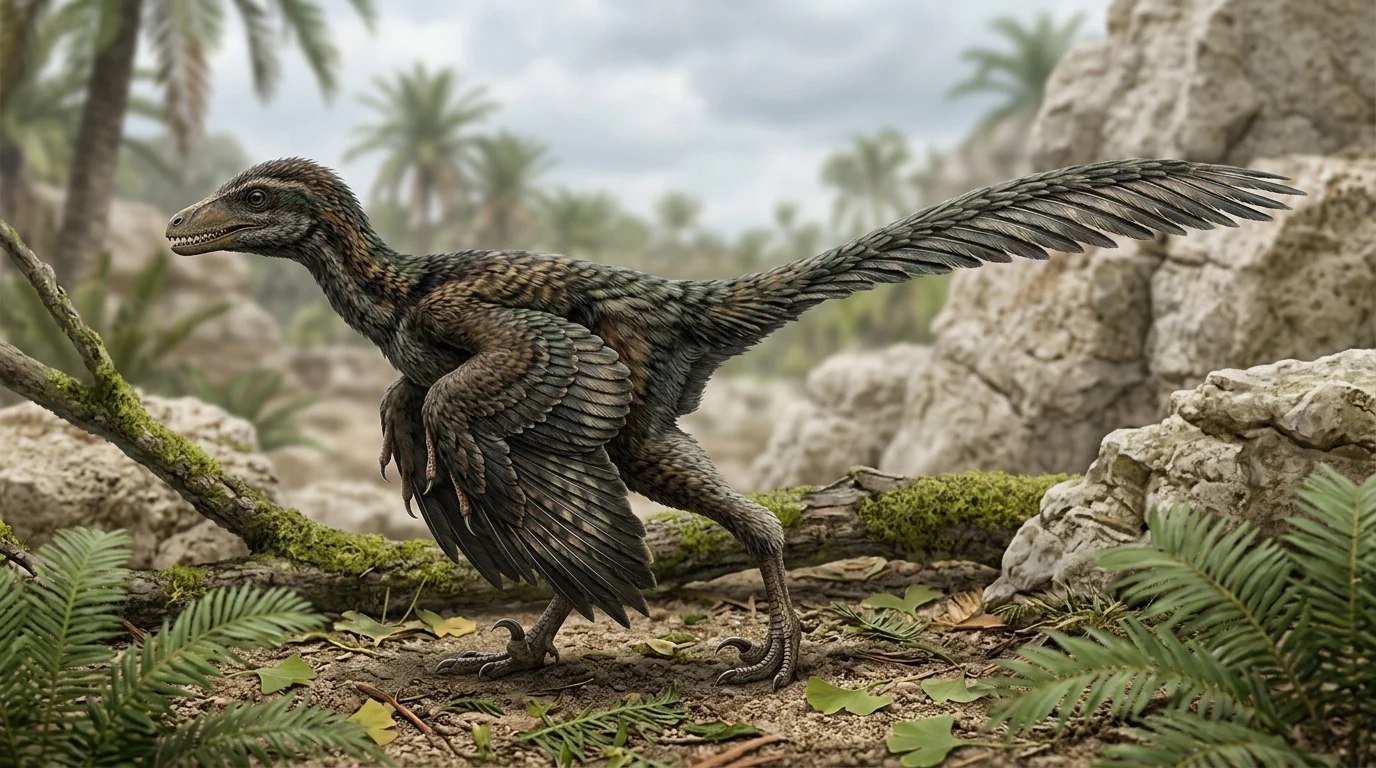
Bipedal saurischian dinosaurs, historically dominated by carnivores and including the avian lineage.
Genus
Dilophosaurus
Monophyletic prehistoric clade
Species
Dilophosaurus wetherilli Welles, 1954
Specific authority designation
Anatomy & Physical Characteristics
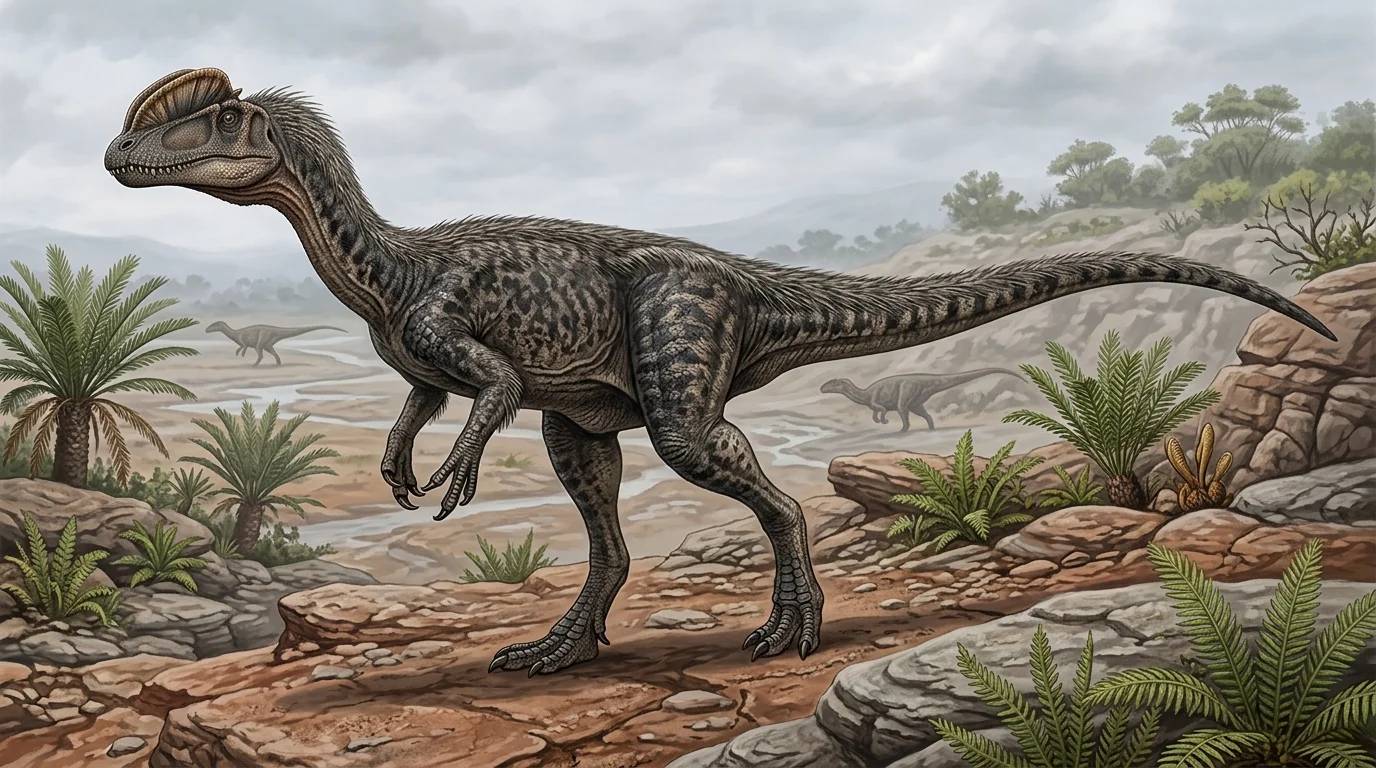
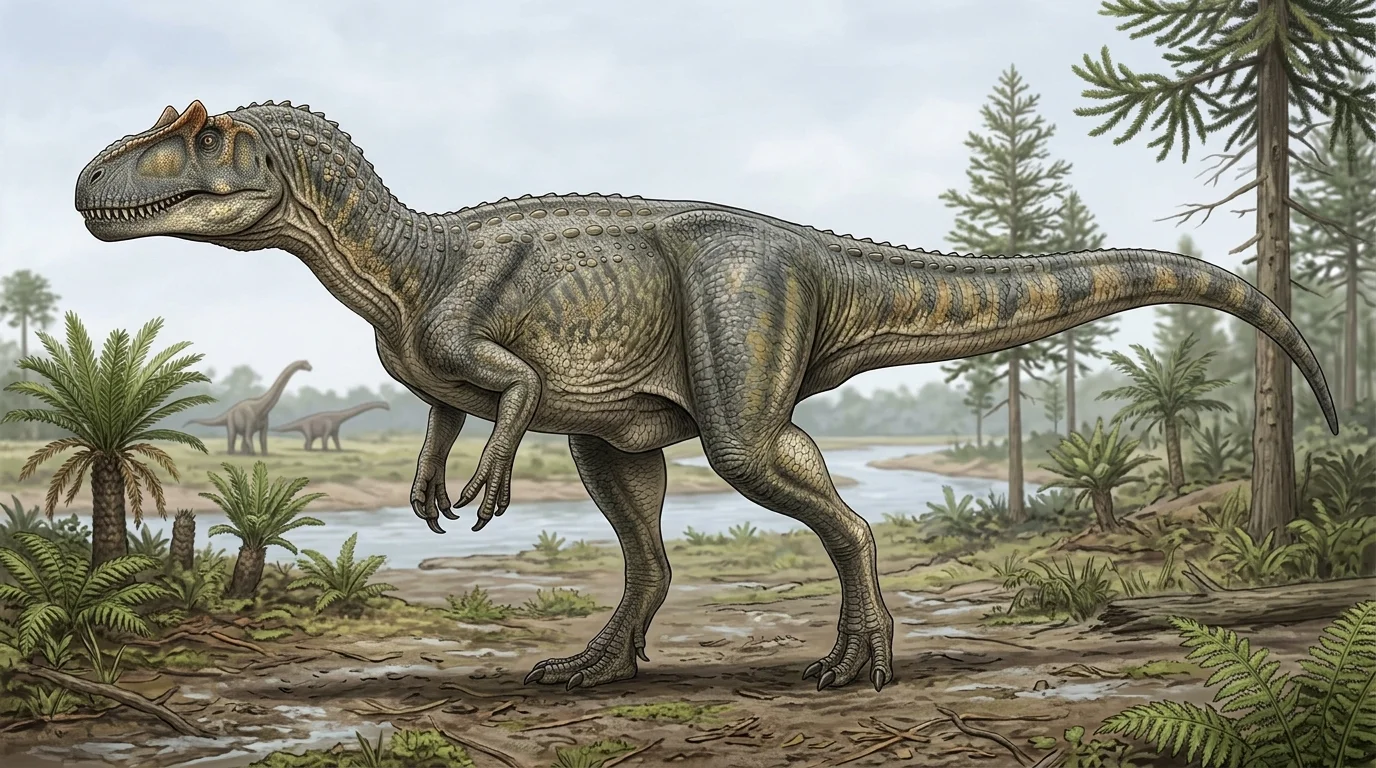
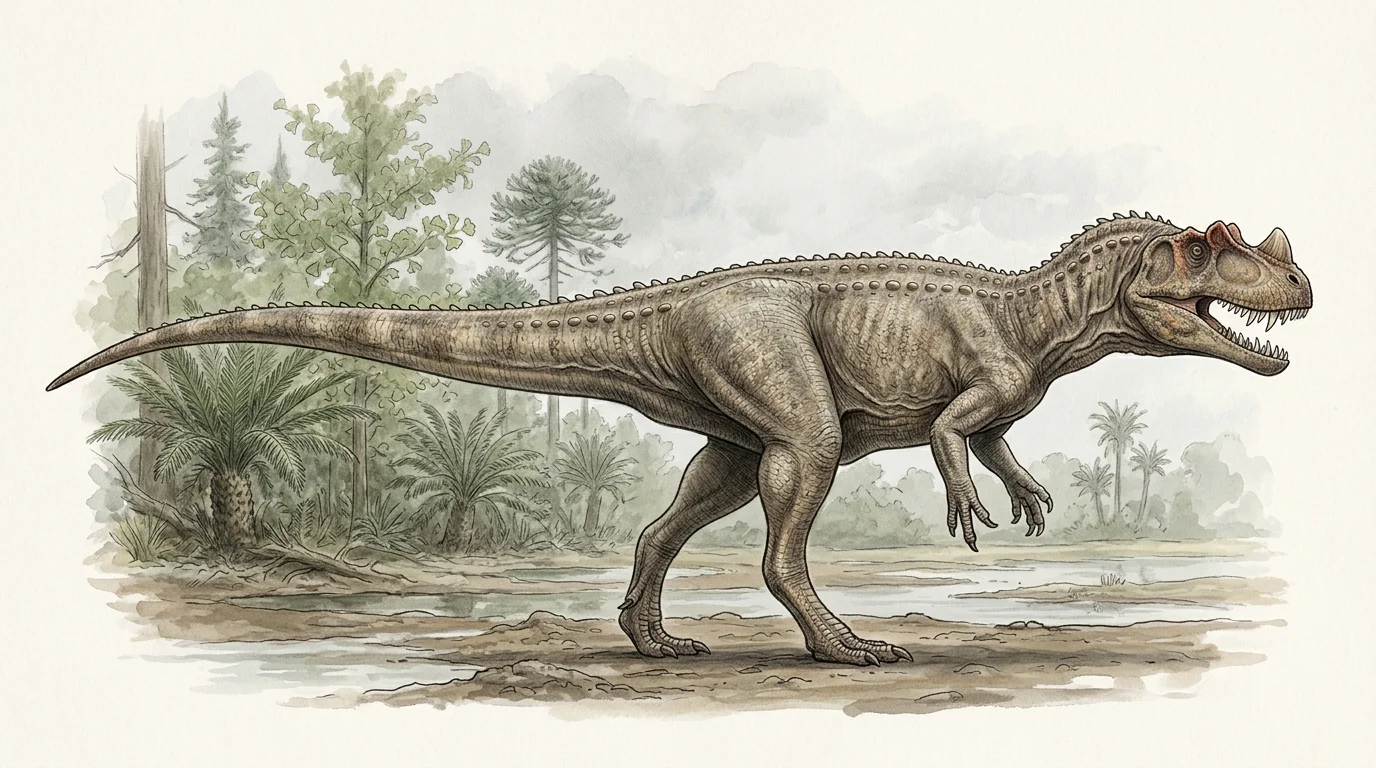
Dilophosaurus wetherilli was one of the earliest large predatory dinosaurs, living in what is now western North America during the Early Jurassic Period (~193 million years ago). Far from cinematic portrayals depicting it as a small, venom-spitting creature with an expanding neck frill, comprehensive anatomical monographs confirm Dilophosaurus was an imposing apex predator reaching approximately 7 meters in length and over 400 kg in body mass, belonging to basal Theropoda.
Locomotion and Posture:
Dilophosaurus possessed long, slender hindlimbs with well-developed femoral muscle attachments indicating capable bipedal cursorial movement. Trackways attributed to early Jurassic theropods in the Kayenta Formation record agile striding gaits, though exact running speeds remain model-dependent and constrained by limb joint reconstruction.
Scientific Significance:
Dilophosaurus is critical for understanding the macroevolutionary transition of theropods following the end-Triassic extinction event. Detailed osteological restudy demonstrates that its upper jaw was far more robust than originally thought, possessing strong nasolacrimal crests that served for visual display and species recognition rather than physical combat. Its forelimbs were strong and mobile, specialized for grasping.
Diagnostic Morphological Traits
Large bipedal theropod with twin delicate longitudinal crests on its head, an arched subnarial gap in the upper jaw, and strong three-clawed hands.
Comparative Scale & Biometrics
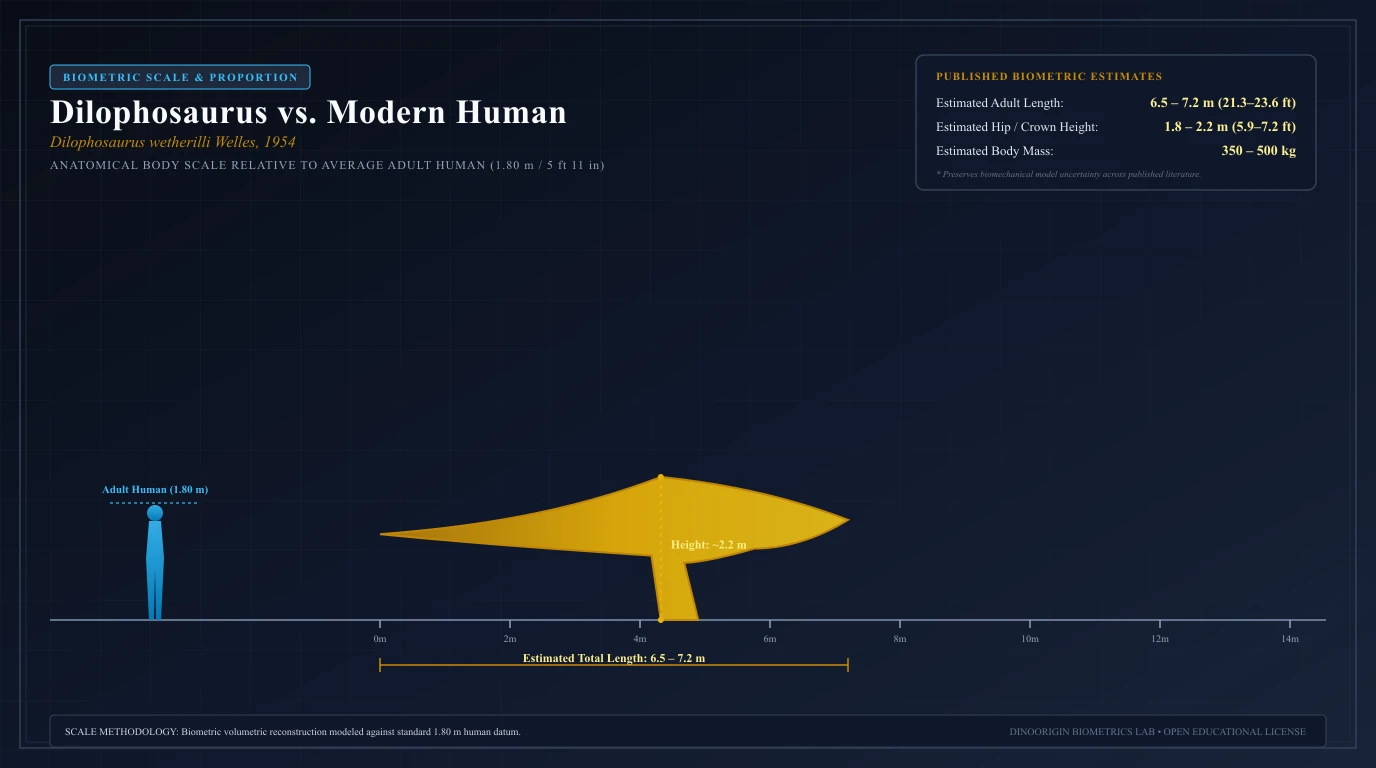
Anatomical dimensions relative to an average adult human (1.8 m / 6 ft tall)
Early herbivorous dinosaurs, fish, and smaller crurotarsan archosaurs.
Paleobiology & Behavior
Anatomical adaptations indicate Dilophosaurus was the dominant terrestrial carnivore of its riverine ecosystem, preying upon early prosauropods and thyreophorans. Fossil trackways in Arizona demonstrate sitting postures where the dinosaur rested on its metatarsals and ischium, leaving clear impressions of its hands and belly skin in riparian mudstones without dragging its tail.
Habitat & Ecological Biome
Prehistoric Depositional Setting
Alluvial plains, seasonal river dunes, and oasis environments of the Kayenta Formation.
Fossil Evidence & Specimen Records
Preserved Skeletal Material & Bonebeds
Represented by multiple well-preserved skeletons discovered in the Kayenta Formation of Arizona. The holotype specimen (UCMP 37302) and referred skeletons (such as UCMP 77270) preserve complete skulls, delicate paired cranial crests, articulated pelvic girdles, and complete forelimbs.
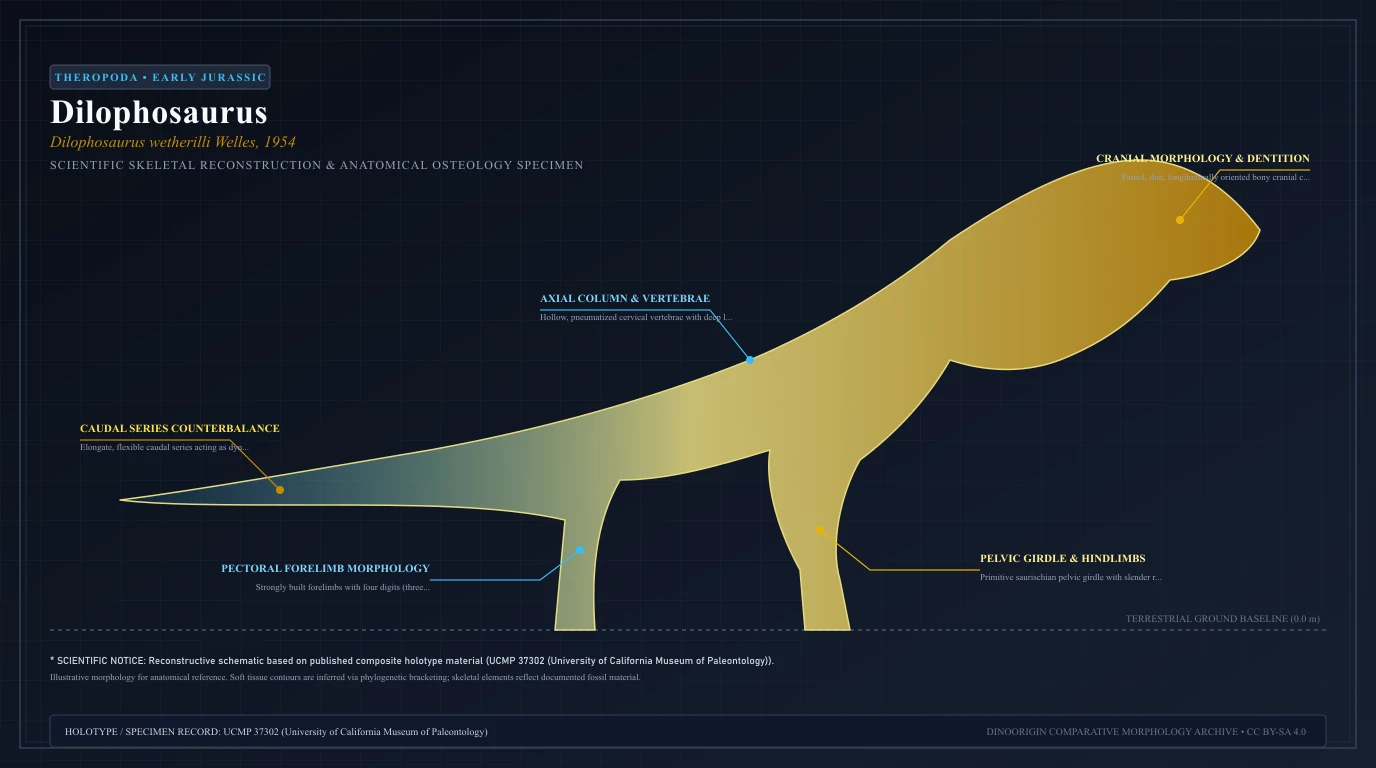
Anatomical Osteology & Skeletal Reconstruction
Anatomical skeletal reconstruction of Dilophosaurus (Dilophosaurus wetherilli Welles, 1954) illustrating cranial fenestrae, vertebral column, and appendicular proportions based on composite fossil material.
Discovery & Taxonomic Naming History
Year of Discovery / Description1942
Type Specimen Locality & FormationKayenta Formation, Navajo County, Arizona, United States
Found by Jesse Williams; described by Samuel P. Welles in 1954 as Megalosaurus, before establishing Dilophosaurus in 1970.
Jurassic Period PeriodTemporal Interval: 193–186 Ma (million years ago)
Marked by lush greenhouse climates, the breakup of Pangaea, and the evolutionary explosion of sauropods, plated stegosaurs, and apex megalosauroid and allosauroid theropods.
During the Mesozoic Era, continental drift progressively reconfigured land bridges, atmospheric currents, and regional precipitation regimes. Fossils of Dilophosaurus evidence its adaptation to the paleoenvironments of North America.
Paleogeographic RealmNorth America (North America)
Home to the fossil-rich Morrison Formation of the Late Jurassic and the Hell Creek and Dinosaur Park Formations of the Late Cretaceous.
Fossil Discovery Locality
Scientific Significance & Evolutionary Impact
The anatomical architecture of Dilophosaurus serves as a crucial benchmark in vertebrate paleontology, illustrating key adaptive radiations within Theropoda.
Phylogenetic Placement: Informs cladistic debates concerning the divergence, skull biomechanics, and skeletal evolution of Jurassic Period fauna.
Paleoecological Guild: Documents trophic specialization (Carnivore) and predator-prey dynamics across its regional ecosystem.
Taphonomic Record: Represented by multiple well-preserved skeletons discovered in the Kayenta Formation of Arizona. The holotype specimen (UCMP 37302) and referred skeletons (such as UCMP 77270) preserve complete skulls, delicate paired cranial crests, articulated pelvic girdles, and complete forelimbs.
Frequently Asked Questions About Dilophosaurus
Scientifically verified answers based on peer-reviewed paleontological evidence.
Q1.When did Dilophosaurus live?
Dilophosaurus lived during the Jurassic Period Period, approximately 193–186 Ma (million years ago). This places it within the Mesozoic Era.
Q2.How big was Dilophosaurus?
Paleontological estimates place Dilophosaurus at a length of 6.5–7.2 m (21.3–23.6 ft), a hip/standing height of 1.8–2.2 m (5.9–7.2 ft), and a body mass of 350–500 kg (772–1,102 lbs).
Q3.What was the diet of Dilophosaurus?
Classified as a carnivore, Dilophosaurus specialized in consuming Early herbivorous dinosaurs, fish, and smaller crurotarsan archosaurs..
Q4.Where were Dilophosaurus fossils discovered?
Fossil specimens of Dilophosaurus have been recovered from Kayenta Formation, Navajo County, Arizona, United States, with notable historic specimens documented in 1942. Found by Jesse Williams; described by Samuel P. Welles in 1954 as Megalosaurus, before establishing Dilophosaurus in 1970.
Academic Literature & Peer-Reviewed References
Authoritative citations establishing the factual taxonomy, biometrics, and anatomy of Dilophosaurus.
Marsh, A. D., & Rowe, T. B. (2020). A comprehensive anatomical and phylogenetic evaluation of Dilophosaurus wetherilli. Journal of Paleontology, 94(S78), 1-103.
Comparative size scale of Dilophosaurus relative to a 1.8-meter adult human, illustrating an estimated length of 6.5–7.2 m and height of 1.8–2.2 m (preserving model uncertainty).
Kayenta Formation, Navajo County, Arizona, United States
Deposited in Mesozoic sedimentary strata preserving skeletal remains, teeth, or trace trackways.
Q5.What makes Dilophosaurus scientifically significant?
Dilophosaurus provides critical insights into the evolutionary radiation of Theropoda. Holotypes and fossil evidence indicate: Represented by multiple well-preserved skeletons discovered in the Kayenta Formation of Arizona. The holotype specimen (UCMP 37302) and referred skeletons (such as UCMP 77270) preserve complete skulls, delicate paired cranial crests, articulated pelvic girdles, and complete forelimbs.
Welles, S. P. (1954). New Jurassic dinosaur from the Kayenta Formation of Arizona. Bulletin of the Geological Society of America, 65(6), 591-598. https://doi.org/10.1130/0016-7606(1954)65[591:NJDFTK]2.0.CO;2