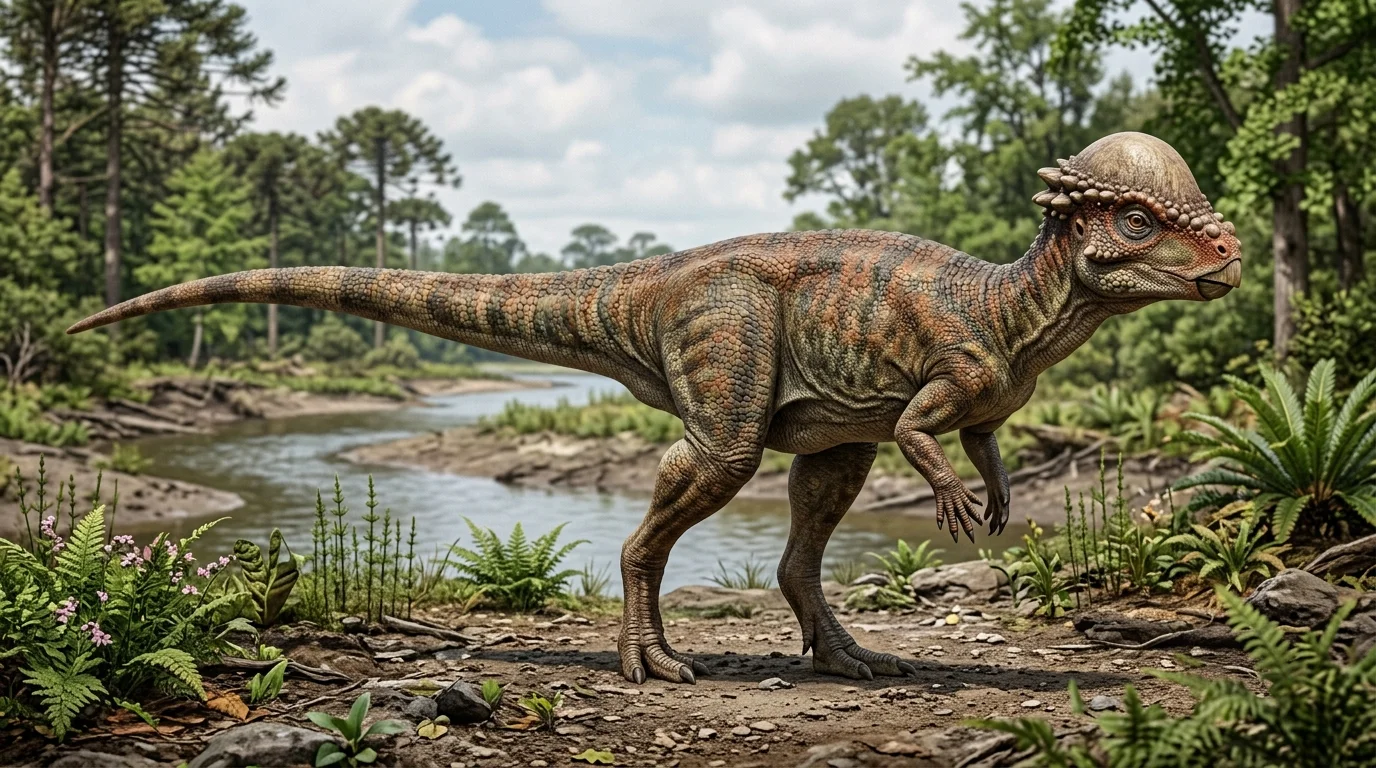
Phylogenetic classification of Pachycephalosaurus wyomingensis Gilmore, 1931 based on peer-reviewed cladistic analyses of diagnostic skeletal synapomorphies.
Bipedal ornithischians with extremely thickened skull domes reinforced by dense cortical bone.
Genus
Pachycephalosaurus
Monophyletic prehistoric clade
Species
Pachycephalosaurus wyomingensis Gilmore, 1931
Specific authority designation
Anatomy & Physical Characteristics
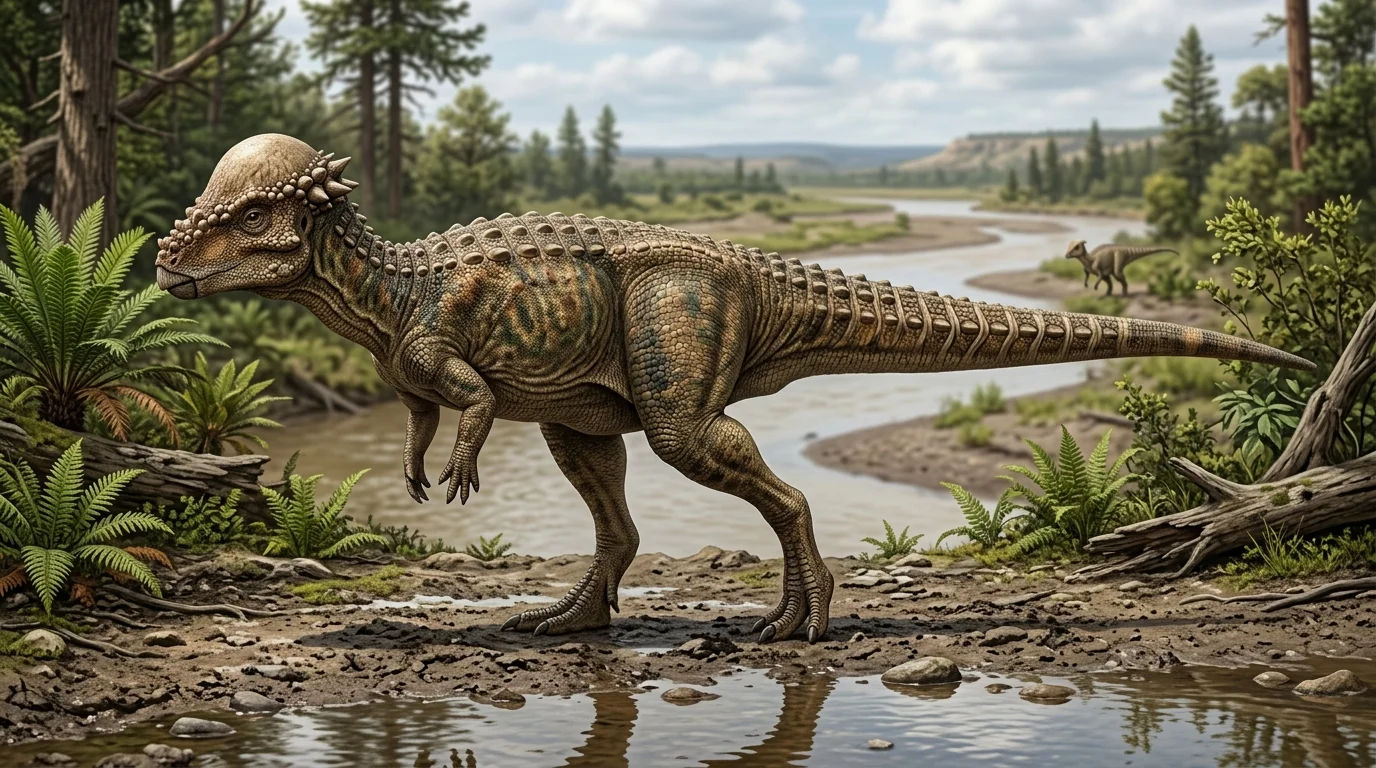
Pachycephalosaurus wyomingensis possessed the most heavily reinforced cranial vault of any terrestrial vertebrate. Its frontoparietal dome formed a solid mass of fibrolamellar bone up to 25 centimeters thick, encircled by blunted osteoderm studs and small hornlets along the squamosal and postorbital margins.
Paleopathological studies of multiple pachycephalosaur skulls reveal healed cranial lesions and osteomyelitis, providing empirical support for the hypothesis that individuals engaged in head-butting or flank-butting combat to establish social hierarchy and mating rights.
Diagnostic Morphological Traits
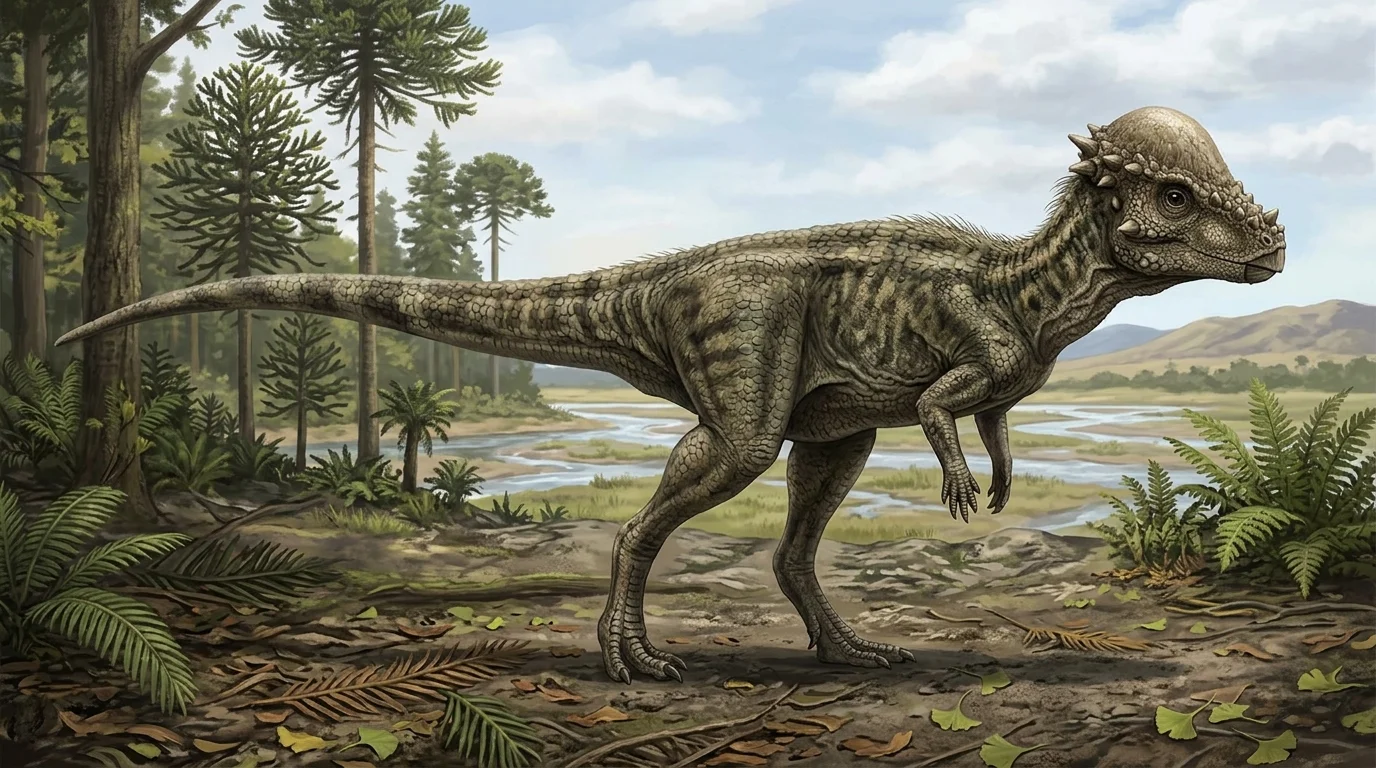
Bipedal herbivore with a massive domed skull cap, long hindlimbs, short forelimbs, and a rigid, tendon-wrapped tail.
Comparative Scale & Biometrics
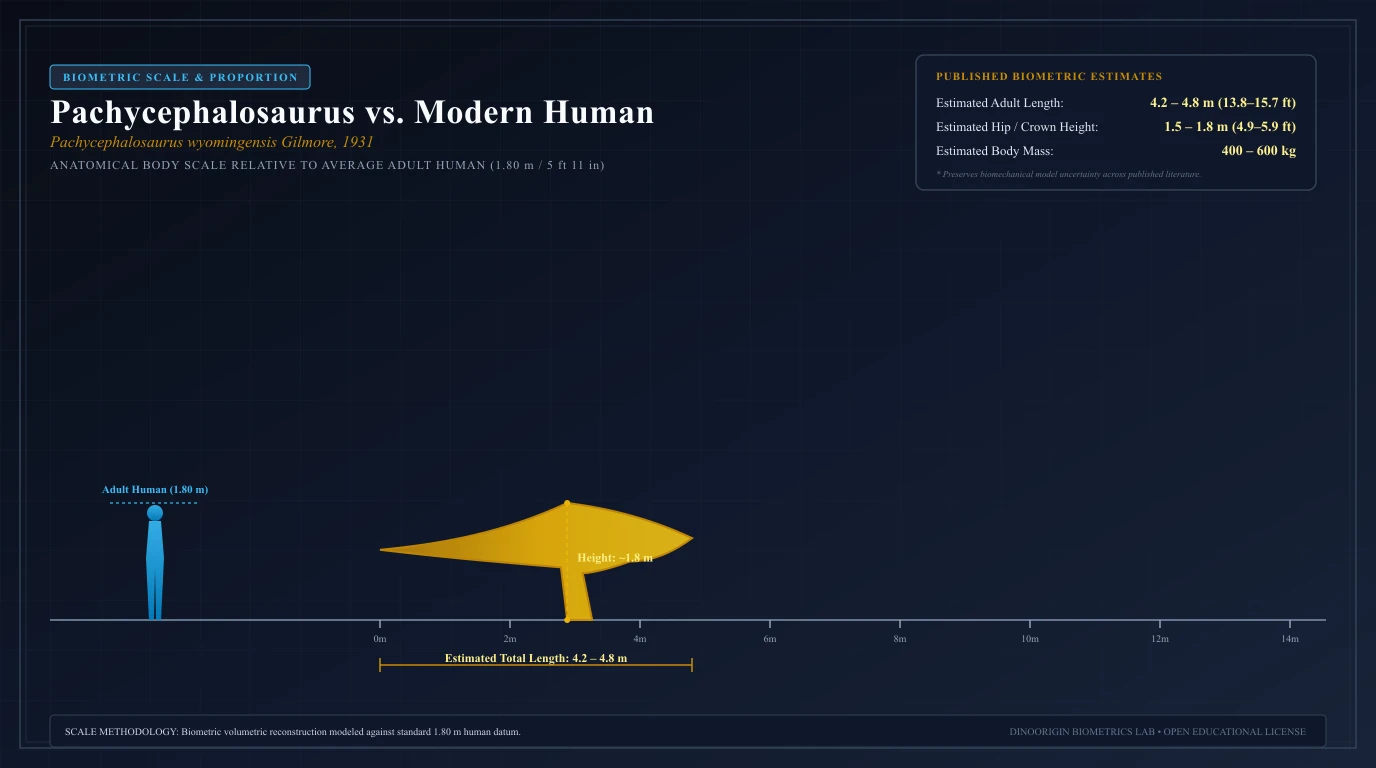
Anatomical dimensions relative to an average adult human (1.8 m / 6 ft tall)
Approx. 2.7× human length
Pachycephalosaurus (Length)4.2–4.8 m (13.8–15.7 ft)
Adult Human1.8 m (6.0 ft)
Length
4.2–4.8 m (13.8–15.7 ft)
Height
1.5–1.8 m (4.9–5.9 ft)
Estimated Mass
400–600 kg (882–1,323 lbs)
Biometric Human Scale Reference
Comparative size scale of Pachycephalosaurus relative to a 1.8-meter adult human, illustrating an estimated length of 4.2–4.8 m and height of 1.5–1.8 m (preserving model uncertainty).
Leaves, seeds, fibrous shoots, and occasional insects, crushed by serrated phylliform cheek teeth.
Paleobiology & Behavior
Bipedal herbivore or omnivore possessing an exceptionally thickened cranial dome, which biomechanical models indicate was used in ritualized flank-butting or head-pushing combat. In the Hell Creek ecosystem, it lived alongside horned dinosaurs like Triceratops and armored Ankylosaurus.
Habitat & Ecological Biome
Prehistoric Depositional Setting
Inland river systems, coastal plain scrublands, and semi-forested plateaus of the Hell Creek Formation.
Fossil Evidence & Specimen Records
Preserved Skeletal Material & Bonebeds
Known almost exclusively from well-preserved, dense skulls and cranial domes that resist weathering.
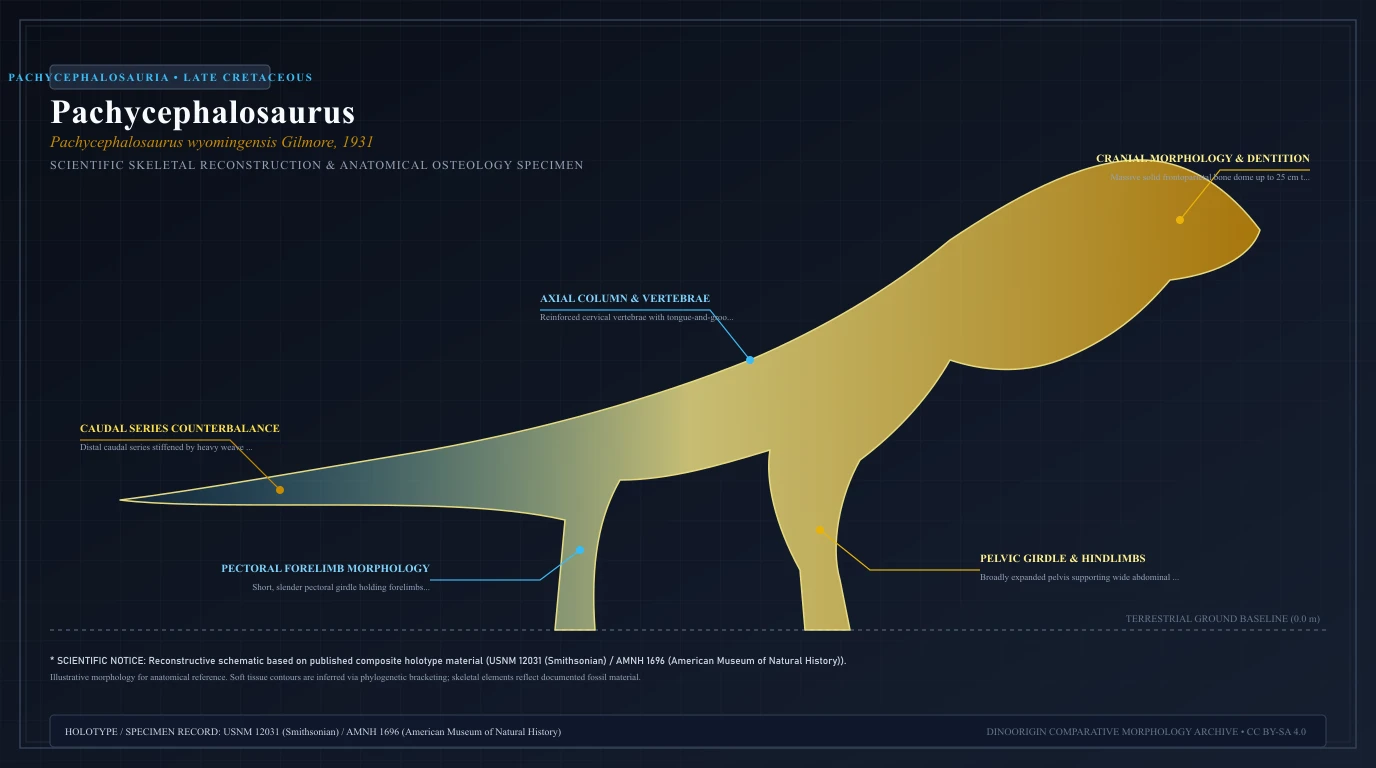
Anatomical Osteology & Skeletal Reconstruction
Anatomical skeletal reconstruction of Pachycephalosaurus (Pachycephalosaurus wyomingensis Gilmore, 1931) illustrating cranial fenestrae, vertebral column, and appendicular proportions based on composite fossil material.
Discovery & Taxonomic Naming History
Year of Discovery / Description1859
Type Specimen Locality & FormationLance Formation, Wyoming, United States
First fragment found by Ferdinand Vandeveer Hayden; complete skull described by Charles W. Gilmore in 1931.
Cretaceous Period PeriodTemporal Interval: 70–66 Ma (million years ago)
The longest and final period of the Mesozoic Era, characterized by the rise of flowering plants, ceratopsians, hadrosaurs, tyrannosaurids, and concluding with the Chicxulub asteroid impact.
During the Mesozoic Era, continental drift progressively reconfigured land bridges, atmospheric currents, and regional precipitation regimes. Fossils of Pachycephalosaurus evidence its adaptation to the paleoenvironments of North America.
Paleogeographic RealmNorth America (North America)
Home to the fossil-rich Morrison Formation of the Late Jurassic and the Hell Creek and Dinosaur Park Formations of the Late Cretaceous.
Fossil Discovery Locality
Scientific Significance & Evolutionary Impact
The anatomical architecture of Pachycephalosaurus serves as a crucial benchmark in vertebrate paleontology, illustrating key adaptive radiations within Pachycephalosauria.
Phylogenetic Placement: Informs cladistic debates concerning the divergence, skull biomechanics, and skeletal evolution of Cretaceous Period fauna.
Paleoecological Guild: Documents trophic specialization (Herbivore) and predator-prey dynamics across its regional ecosystem.
Taphonomic Record: Known almost exclusively from well-preserved, dense skulls and cranial domes that resist weathering.
Frequently Asked Questions About Pachycephalosaurus
Scientifically verified answers based on peer-reviewed paleontological evidence.
Q1.When did Pachycephalosaurus live?
Pachycephalosaurus lived during the Cretaceous Period Period, approximately 70–66 Ma (million years ago). This places it within the Mesozoic Era.
Q2.How big was Pachycephalosaurus?
Paleontological estimates place Pachycephalosaurus at a length of 4.2–4.8 m (13.8–15.7 ft), a hip/standing height of 1.5–1.8 m (4.9–5.9 ft), and a body mass of 400–600 kg (882–1,323 lbs).
Q3.What was the diet of Pachycephalosaurus?
Classified as a herbivore, Pachycephalosaurus specialized in consuming Leaves, seeds, fibrous shoots, and occasional insects, crushed by serrated phylliform cheek teeth..
Q4.Where were Pachycephalosaurus fossils discovered?
Fossil specimens of Pachycephalosaurus have been recovered from Lance Formation, Wyoming, United States, with notable historic specimens documented in 1859. First fragment found by Ferdinand Vandeveer Hayden; complete skull described by Charles W. Gilmore in 1931.
Academic Literature & Peer-Reviewed References
Authoritative citations establishing the factual taxonomy, biometrics, and anatomy of Pachycephalosaurus.
Gilmore, C. W. (1931). A new species of troodont dinosaur from the Lance Formation of Wyoming. Proceedings of the United States National Museum, 79(2875), 1-6. https://doi.org/10.5479/si.00963801.79-2875.1
Deposited in Mesozoic sedimentary strata preserving skeletal remains, teeth, or trace trackways.
Q5.What makes Pachycephalosaurus scientifically significant?
Pachycephalosaurus provides critical insights into the evolutionary radiation of Pachycephalosauria. Holotypes and fossil evidence indicate: Known almost exclusively from well-preserved, dense skulls and cranial domes that resist weathering.
Peterson, J. E., Dischler, C., & Longrich, N. R. (2013). Distributions of cranial pathologies provide evidence for head-butting in dome-headed dinosaurs (Pachycephalosauridae). PLoS ONE, 8(7), e68620. https://doi.org/10.1371/journal.pone.0068620