Ornithischian dinosaurs characterized by beaks, rostral bones, facial horns, and elaborate neck frills.
Genus
Triceratops
Monophyletic prehistoric clade
Species
Triceratops horridus Marsh, 1889
Specific authority designation
Anatomy & Physical Characteristics
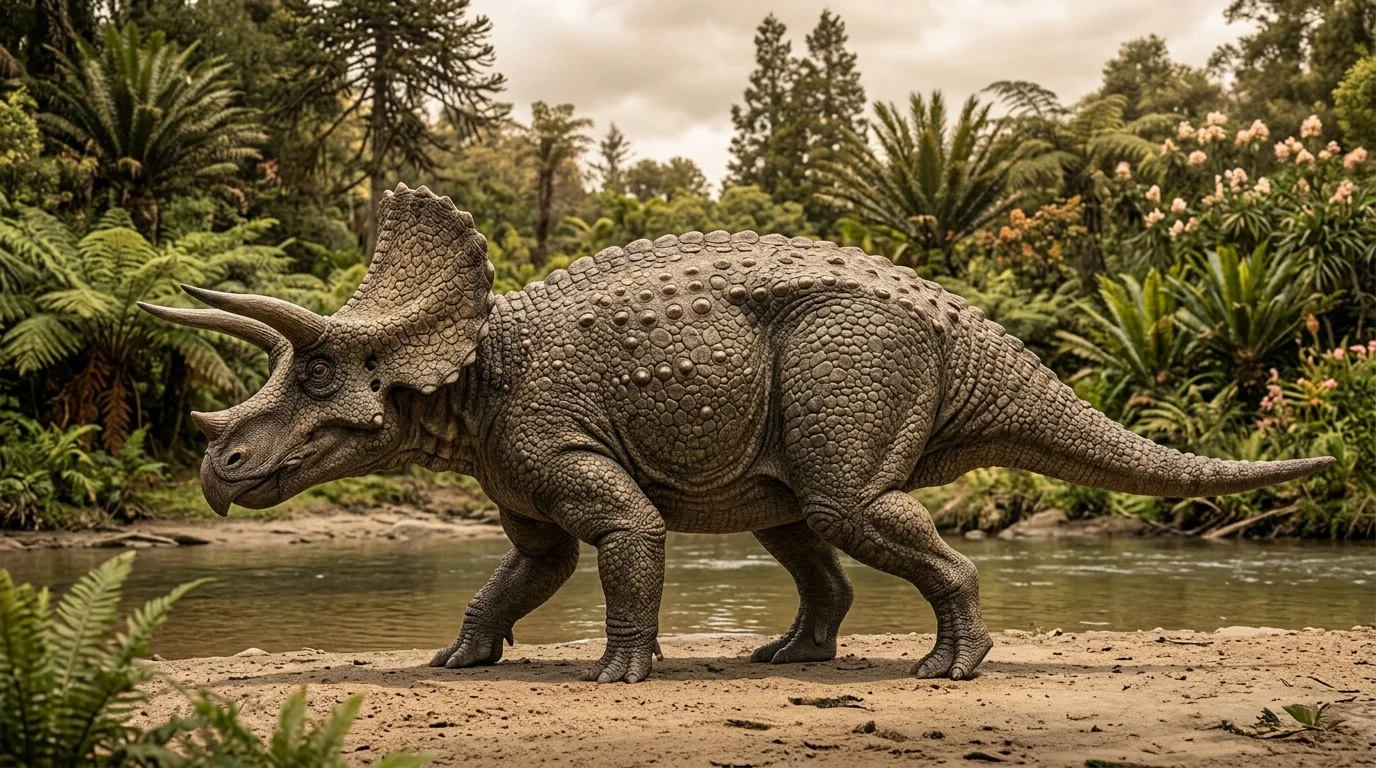
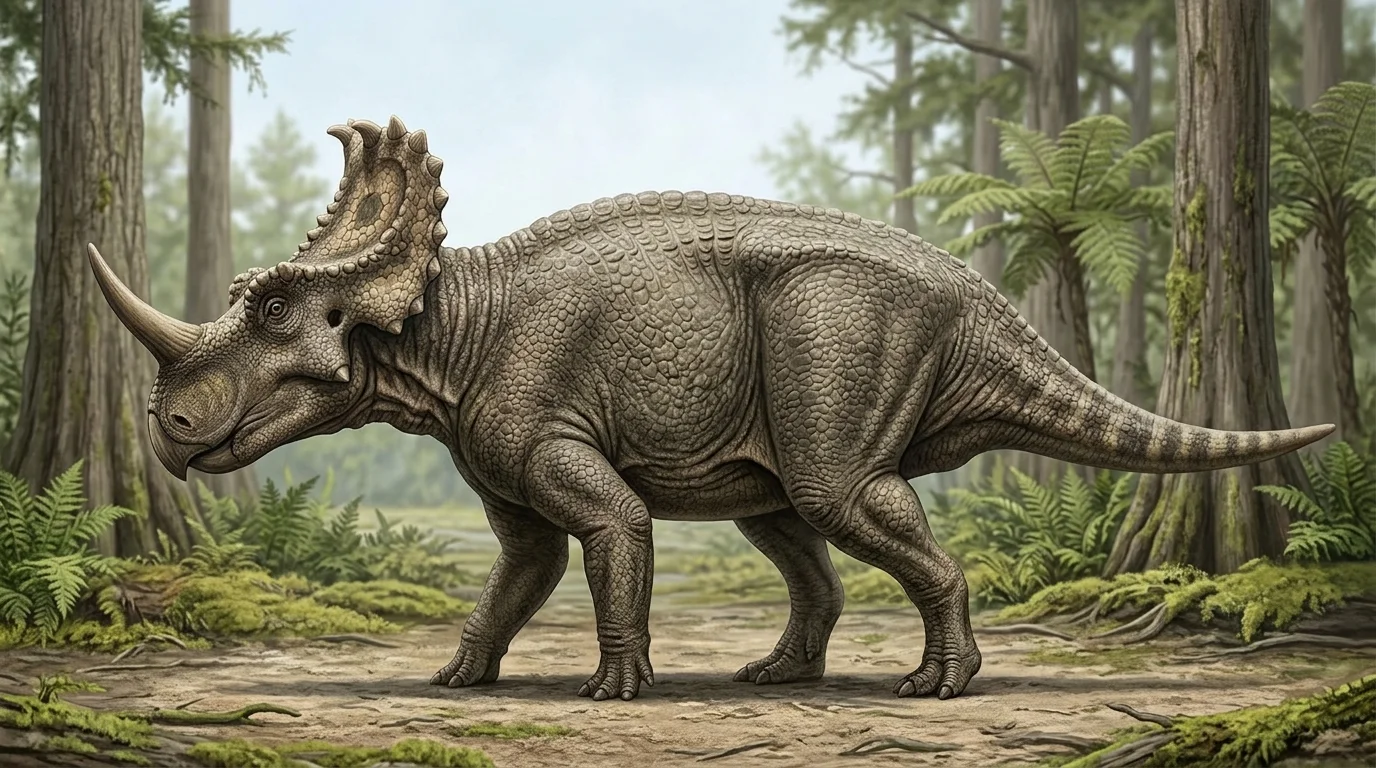
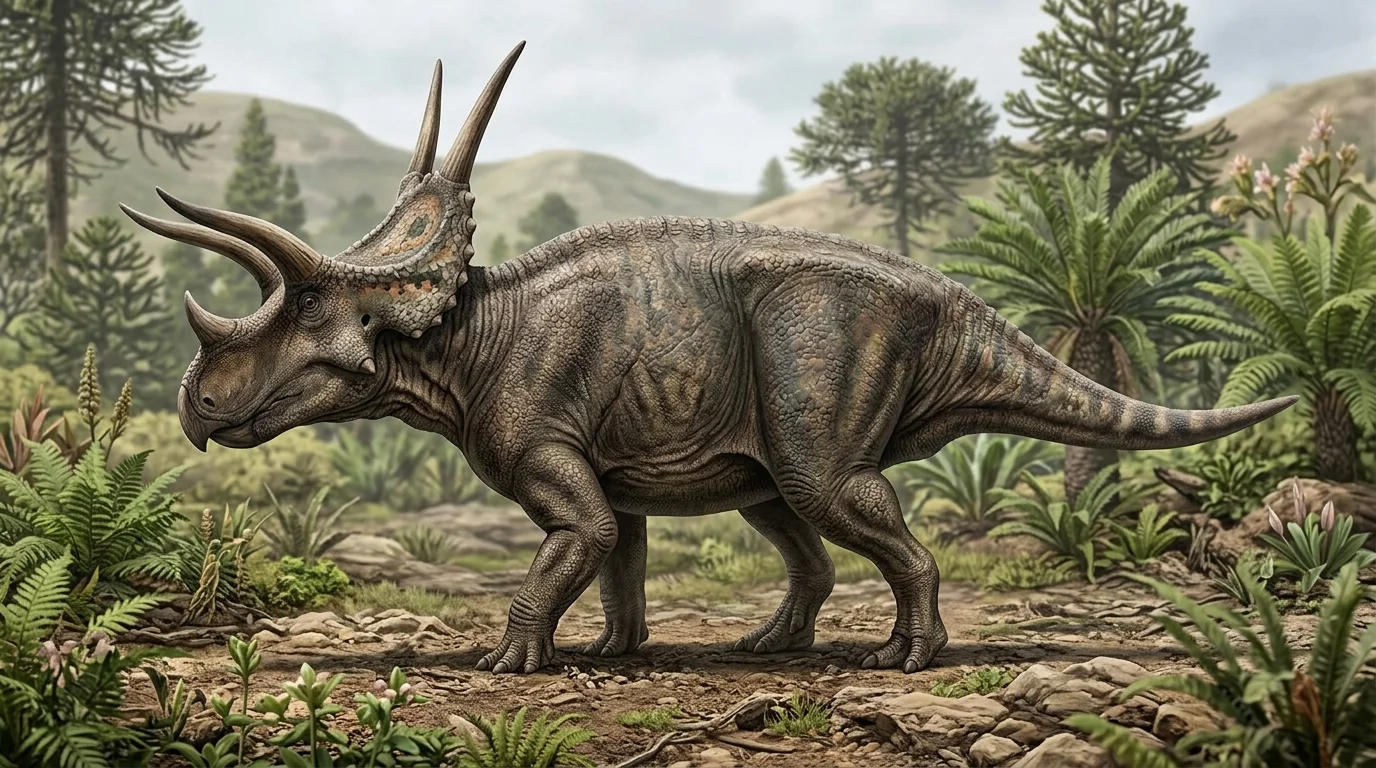
Triceratops is a colossal quadrupedal herbivore belonging to Ceratopsia (horned and frilled dinosaurs) that dominated western North America during the late Cretaceous Period (~68 to 66 million years ago). Characterized by a massive skull exceeding 2.5 meters in length, Triceratops possessed a prominent nasal horn, two brow horns up to one meter long, and a solid, unperforated parietal-squamosal frill that lacked the large fenestrae (openings) seen in other centrosaurines and chasmosaurines.
Locomotion and Posture:
Biomechanical limb analysis and trackway evidence indicate Triceratops maintained an upright, pillar-like forelimb posture with slightly flexed elbows, resolving historic debates over sprawling versus erect limb mechanics. Locomotion models indicate estimated walking speeds of roughly 15–25 km/h, with high-speed galloping biomechanically improbable due to its 6,000 to 9,000 kg adult body mass.
Scientific Significance:
Triceratops is central to Late Cretaceous biostratigraphy and ceratopsian ontogeny. Morphometric and stratigraphic studies across the Hell Creek Formation document an evolutionary transition from Triceratops horridus in lower strata to Triceratops prorsus in upper horizons, providing a rare high-resolution record of anagenetic dinosaur evolution.
Diagnostic Morphological Traits
Quadrupedal herbivore with a prominent rostral beak, three cranial horns, an expansive solid bone neck shield, and robust pillar-like forelimbs.
Comparative Scale & Biometrics
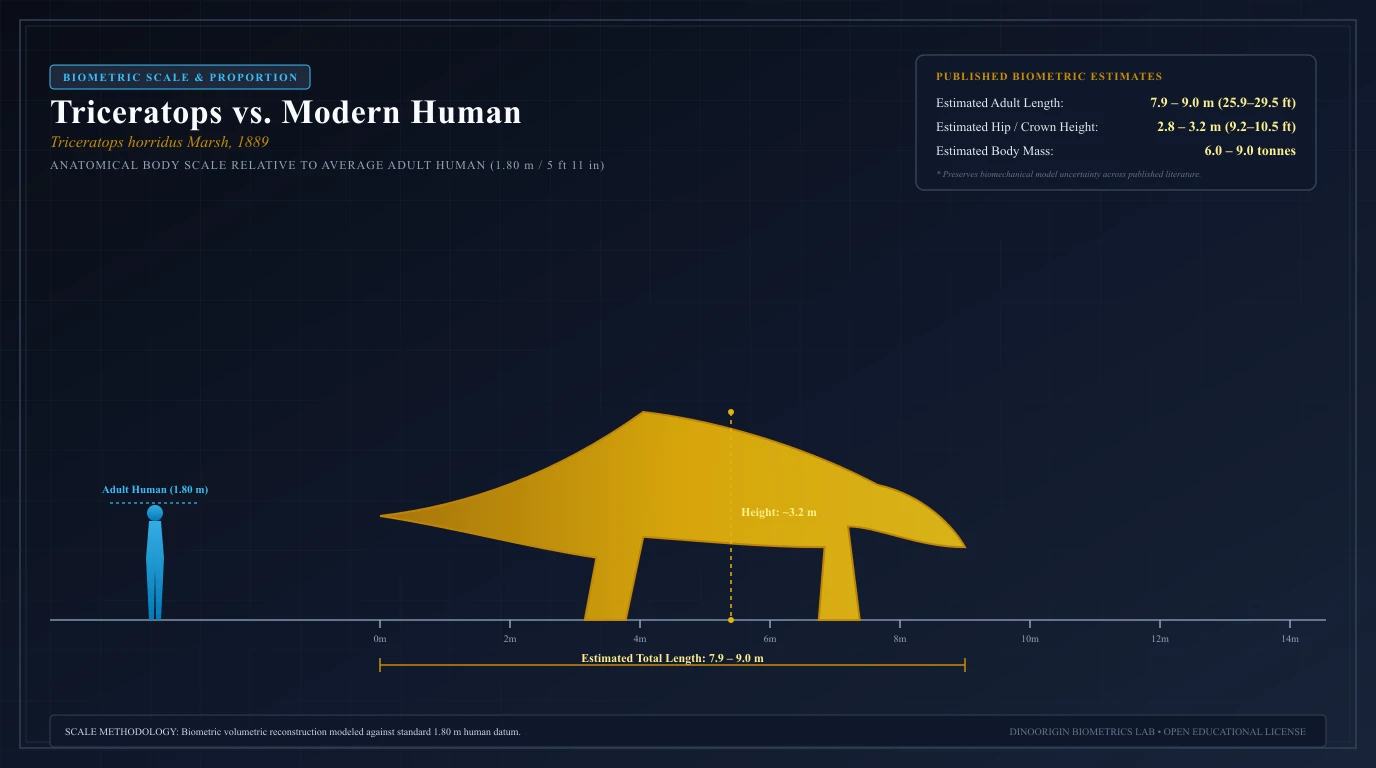
Anatomical dimensions relative to an average adult human (1.8 m / 6 ft tall)
Low-growing fibrous vegetation including palms, ferns, cycads, and angiosperms, processed by specialized shearing dental batteries.
Paleobiology & Behavior
Triceratops operated as a low-tier specialized browser, utilizing shearing dental batteries of hundreds of densely packed teeth to process fibrous palms, cycads, and early angiosperms. Periosteal bone lesions and puncture marks on fossil squamosals matching the morphology of conspecific brow horns provide direct osteological evidence of intraspecific combat and ritualized head-locking. Concurrently, fossil horn cores bearing healed bite marks demonstrate active defense against contemporary apex predators like Tyrannosaurus rex. Bonebed evidence suggests juveniles gathered in small groups, while adult social structures remain an area of active study.
Habitat & Ecological Biome
Prehistoric Depositional Setting
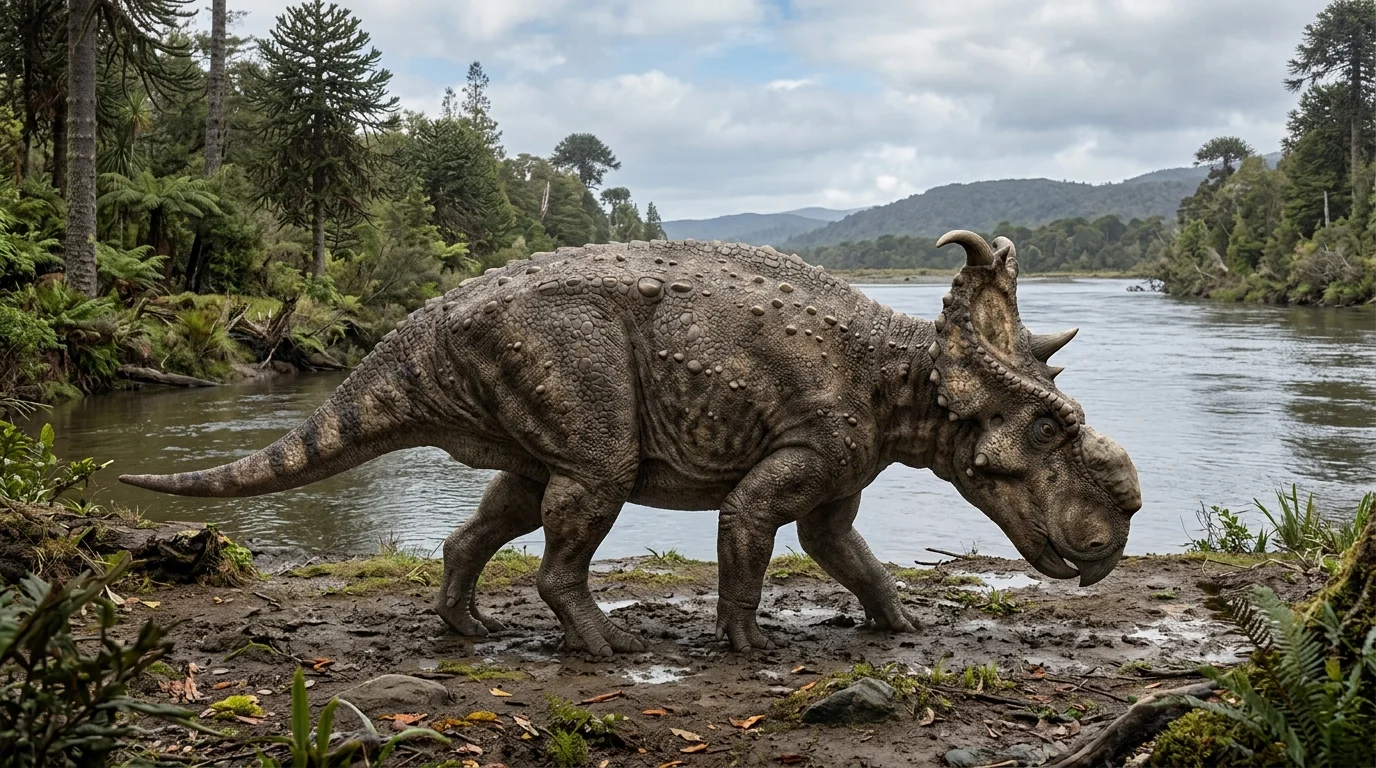
Semi-tropical coastal plains, open forests, and river corridors of ancient Laramidia.
Fossil Evidence & Specimen Records
Preserved Skeletal Material & Bonebeds
Known from hundreds of cranial and postcranial specimens excavated throughout the Hell Creek, Lance, and Scollard Formations. The fossil record encompasses O. C. Marsh's 1889 holotype (YPM 1820), numerous complete skulls, and multi-individual bonebed aggregations documenting embryonic, juvenile, and senescent growth stages.
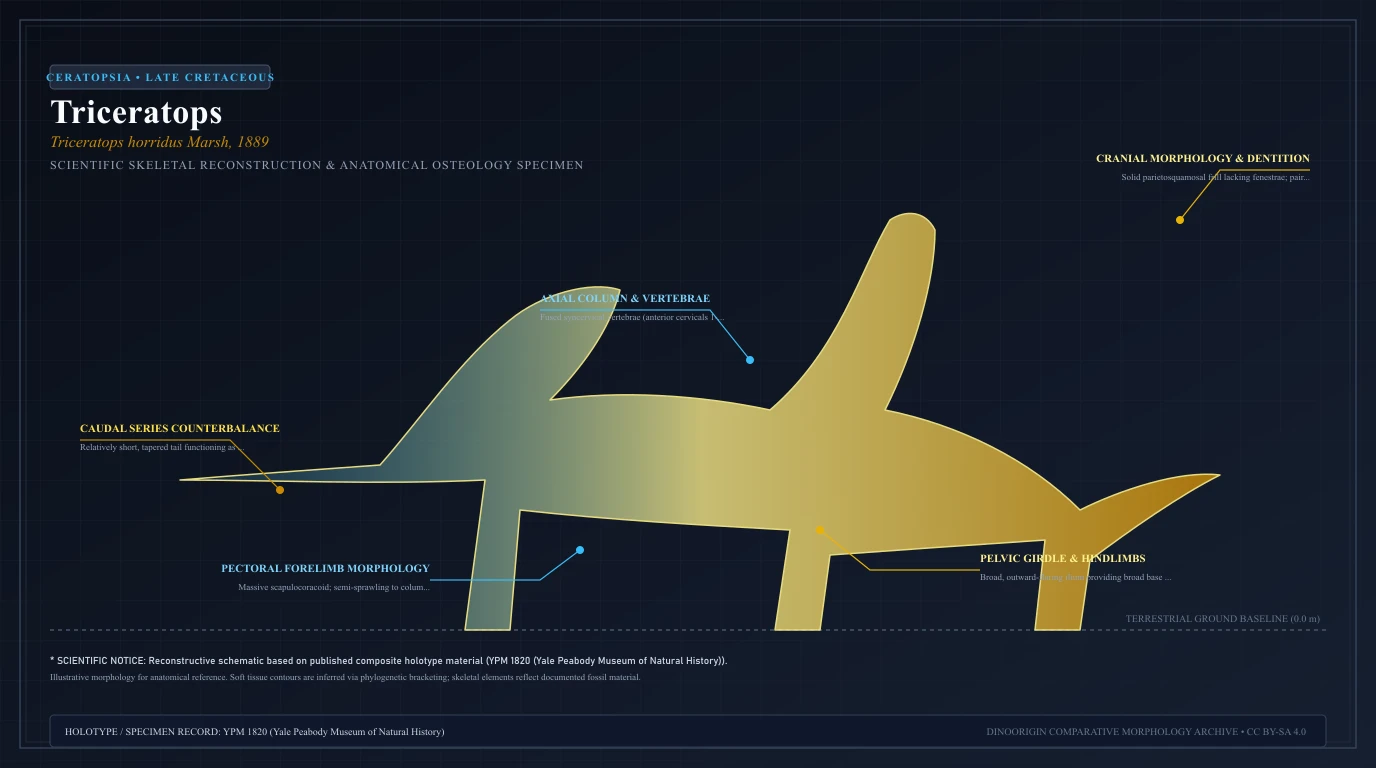
Anatomical Osteology & Skeletal Reconstruction
Anatomical skeletal reconstruction of Triceratops (Triceratops horridus Marsh, 1889) illustrating cranial fenestrae, vertebral column, and appendicular proportions based on composite fossil material.
Discovery & Taxonomic Naming History
Year of Discovery / Description1887
Type Specimen Locality & FormationDenver, Colorado, United States
Initial horn core found by George Lyman Cannon in 1887; named Triceratops horridus by Othniel Charles Marsh in 1889.
Cretaceous Period PeriodTemporal Interval: 68–66 Ma (million years ago)
The longest and final period of the Mesozoic Era, characterized by the rise of flowering plants, ceratopsians, hadrosaurs, tyrannosaurids, and concluding with the Chicxulub asteroid impact.
During the Mesozoic Era, continental drift progressively reconfigured land bridges, atmospheric currents, and regional precipitation regimes. Fossils of Triceratops evidence its adaptation to the paleoenvironments of North America.
Paleogeographic RealmNorth America (North America)
Home to the fossil-rich Morrison Formation of the Late Jurassic and the Hell Creek and Dinosaur Park Formations of the Late Cretaceous.
Fossil Discovery Locality
Scientific Significance & Evolutionary Impact
The anatomical architecture of Triceratops serves as a crucial benchmark in vertebrate paleontology, illustrating key adaptive radiations within Ceratopsia.
Phylogenetic Placement: Informs cladistic debates concerning the divergence, skull biomechanics, and skeletal evolution of Cretaceous Period fauna.
Paleoecological Guild: Documents trophic specialization (Herbivore) and predator-prey dynamics across its regional ecosystem.
Taphonomic Record: Known from hundreds of cranial and postcranial specimens excavated throughout the Hell Creek, Lance, and Scollard Formations. The fossil record encompasses O. C. Marsh's 1889 holotype (YPM 1820), numerous complete skulls, and multi-individual bonebed aggregations documenting embryonic, juvenile, and senescent growth stages.
Frequently Asked Questions About Triceratops
Scientifically verified answers based on peer-reviewed paleontological evidence.
Q1.When did Triceratops live?
Triceratops lived during the Cretaceous Period Period, approximately 68–66 Ma (million years ago). This places it within the Mesozoic Era.
Q2.How big was Triceratops?
Paleontological estimates place Triceratops at a length of 7.9–9 m (25.9–29.5 ft), a hip/standing height of 2.8–3.2 m (9.2–10.5 ft), and a body mass of 6.0–9.0 metric tons (13,228–19,842 lbs).
Q3.What was the diet of Triceratops?
Classified as a herbivore, Triceratops specialized in consuming Low-growing fibrous vegetation including palms, ferns, cycads, and angiosperms, processed by specialized shearing dental batteries..
Q4.Where were Triceratops fossils discovered?
Fossil specimens of Triceratops have been recovered from Denver, Colorado, United States, with notable historic specimens documented in 1887. Initial horn core found by George Lyman Cannon in 1887; named Triceratops horridus by Othniel Charles Marsh in 1889.
Academic Literature & Peer-Reviewed References
Authoritative citations establishing the factual taxonomy, biometrics, and anatomy of Triceratops.
Comparative size scale of Triceratops relative to a 1.8-meter adult human, illustrating an estimated length of 7.9–9.0 m and height of 2.8–3.2 m (preserving model uncertainty).
Denver, Colorado, United States
Deposited in Mesozoic sedimentary strata preserving skeletal remains, teeth, or trace trackways.
Q5.What makes Triceratops scientifically significant?
Triceratops provides critical insights into the evolutionary radiation of Ceratopsia. Holotypes and fossil evidence indicate: Known from hundreds of cranial and postcranial specimens excavated throughout the Hell Creek, Lance, and Scollard Formations. The fossil record encompasses O. C. Marsh's 1889 holotype (YPM 1820), numerous complete skulls, and multi-individual bonebed aggregations documenting embryonic, juvenile, and senescent growth stages.
Marsh, O. C. (1889). Notice of gigantic horned Dinosauria from the Cretaceous. American Journal of Science, 38(224), 173-175. https://doi.org/10.2475/ajs.s3-38.224.173
Scannella, J. B., Fowler, D. W., Goodwin, M. B., & Horner, J. R. (2014). Evolutionary trends in Triceratops from the Hell Creek Formation, Montana. Proceedings of the National Academy of Sciences, 111(28), 10245-10250. https://doi.org/10.1073/pnas.1313334111