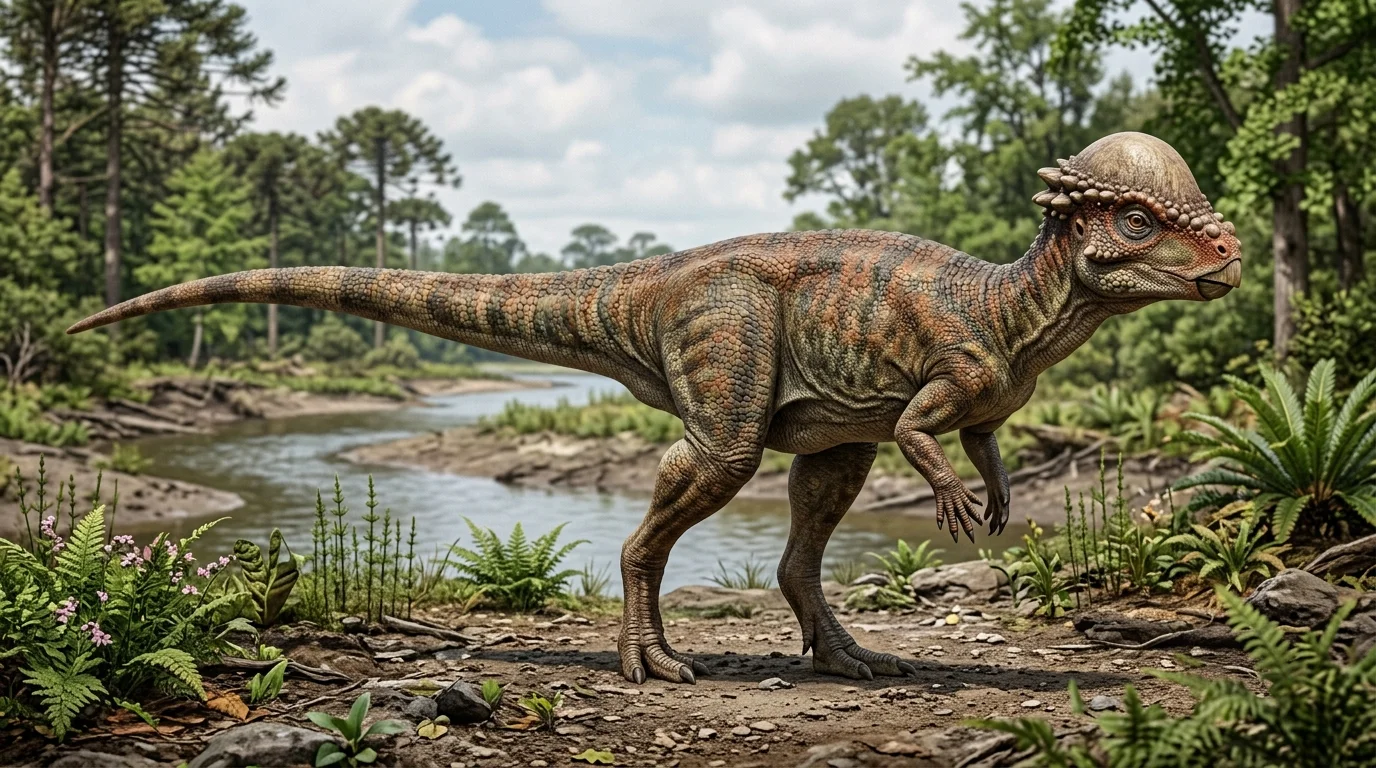
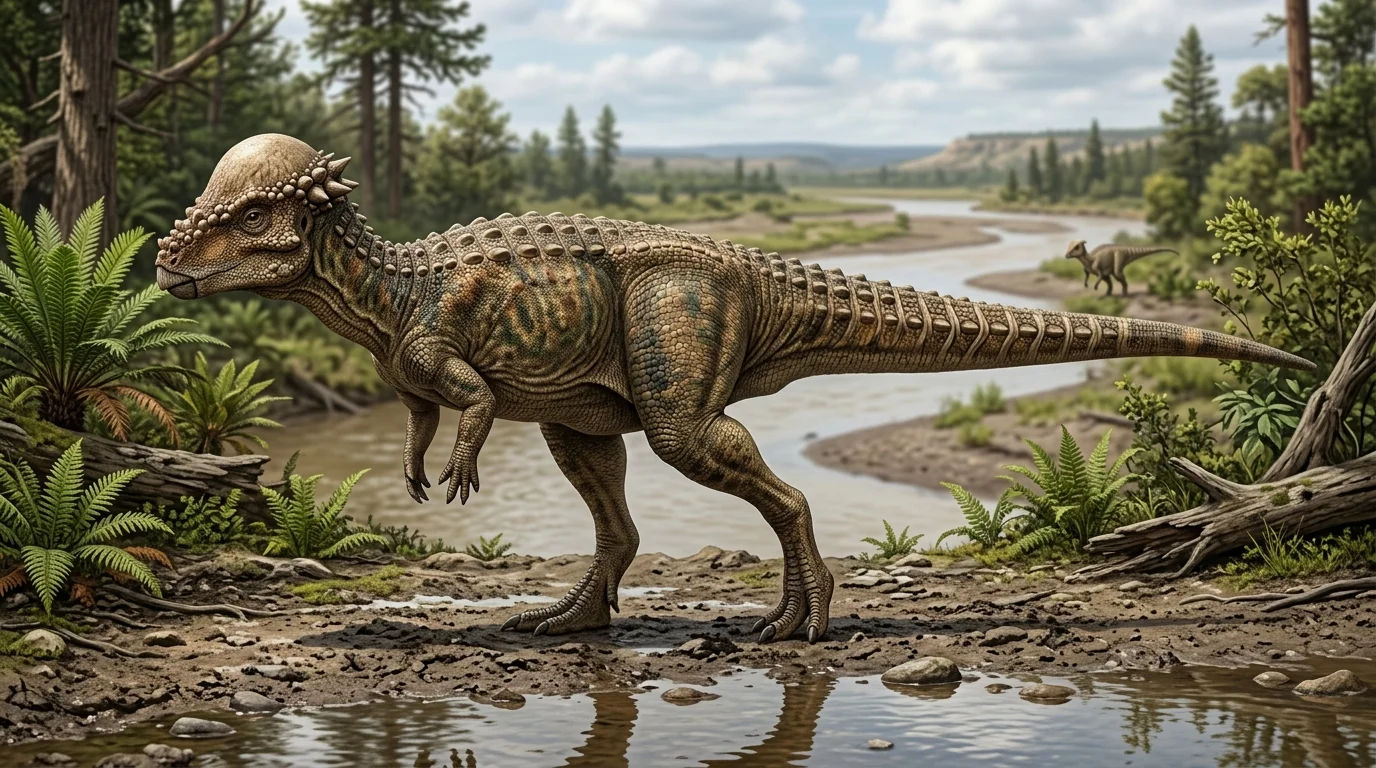
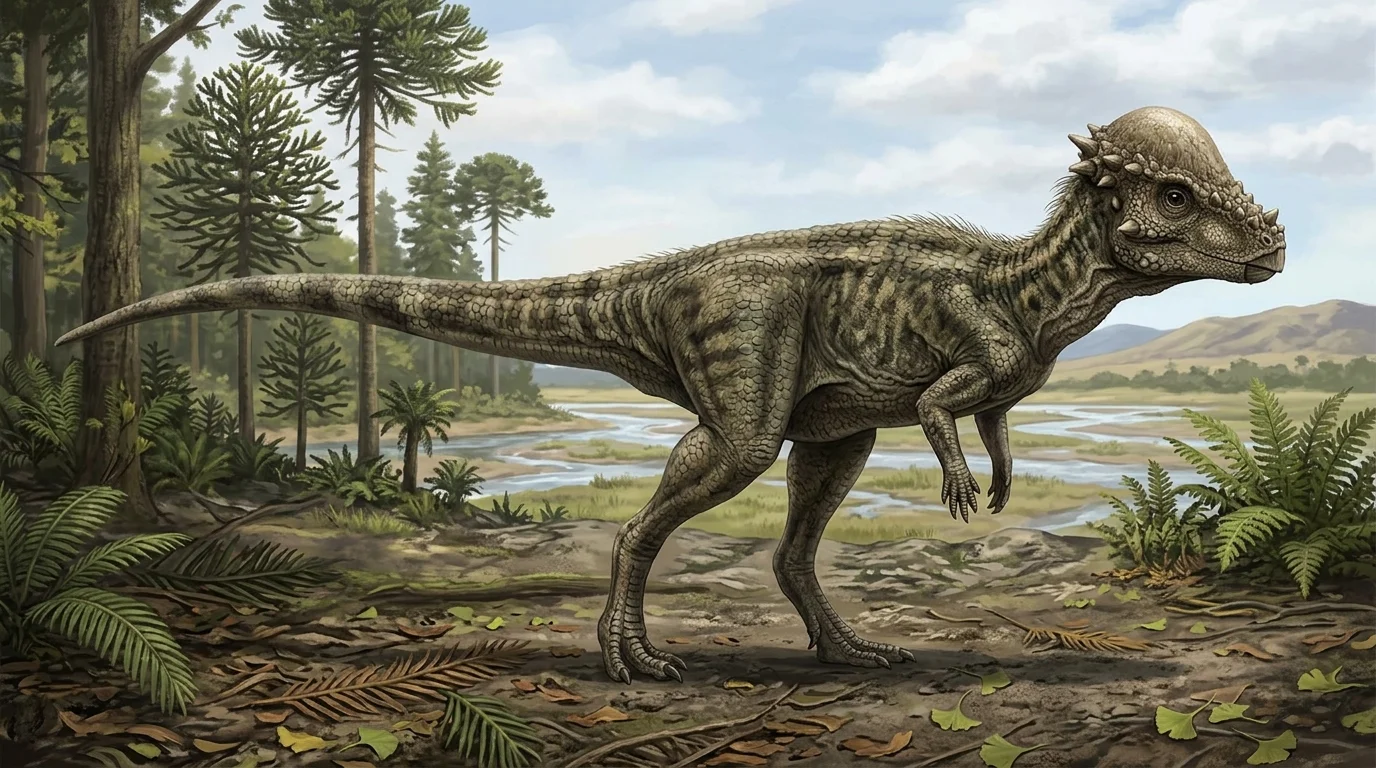
Bipedal ornithischians with extremely thickened skull domes reinforced by dense cortical bone.
Genus
Stegoceras
Monophyletic prehistoric clade
Species
Stegoceras validum Lambe, 1902
Specific authority designation
Anatomy & Physical Characteristics
Stegoceras was a two-meter-long pachycephalosaur that lived during the Late Cretaceous in western North America. Its thick, dome-shaped skull was composed of dense fibrolamellar bone reinforced by vertical collagen fibers.
Biomechanical stress analysis demonstrates that its dome was ideally engineered to withstand violent head-to-head or flank-butting impacts during ritualized intraspecific combat over territory or mates.
Diagnostic Morphological Traits
Small biped with a prominent rounded skull dome, small shelf of bony nodules around the back of the head, and grasping hands.
Comparative Scale & Biometrics
Anatomical dimensions relative to an average adult human (1.8 m / 6 ft tall)
Leaves, seeds, fruits, and fibrous shrubs clipped with serrated teeth.
Paleobiology & Behavior
Small, agile pachycephalosaur possessing a thickened frontoparietal dome used in social display or intraspecific head-butting. In the Dinosaur Park Formation, Stegoceras shared floodplain woodlands with horned dinosaurs like Centrosaurus and Styracosaurus.
Habitat & Ecological Biome
Prehistoric Depositional Setting
Coastal river floodplains, open pine-ginkgo forests, and semi-arid river valleys.
Fossil Evidence & Specimen Records
Preserved Skeletal Material & Bonebeds
Dozens of complete skull domes and partial skeletons showing dramatic ontogenetic growth changes.
Discovery & Taxonomic Naming History
Year of Discovery / Description1898
Type Specimen Locality & FormationDinosaur Park Formation, Alberta, Canada
Cretaceous Period PeriodTemporal Interval: 77–74 Ma (million years ago)
The longest and final period of the Mesozoic Era, characterized by the rise of flowering plants, ceratopsians, hadrosaurs, tyrannosaurids, and concluding with the Chicxulub asteroid impact.
During the Mesozoic Era, continental drift progressively reconfigured land bridges, atmospheric currents, and regional precipitation regimes. Fossils of Stegoceras evidence its adaptation to the paleoenvironments of North America.
Paleogeographic RealmNorth America (North America)
Home to the fossil-rich Morrison Formation of the Late Jurassic and the Hell Creek and Dinosaur Park Formations of the Late Cretaceous.
Fossil Discovery Locality
Scientific Significance & Evolutionary Impact
The anatomical architecture of Stegoceras serves as a crucial benchmark in vertebrate paleontology, illustrating key adaptive radiations within Pachycephalosauria.
Phylogenetic Placement: Informs cladistic debates concerning the divergence, skull biomechanics, and skeletal evolution of Cretaceous Period fauna.
Paleoecological Guild: Documents trophic specialization (Herbivore) and predator-prey dynamics across its regional ecosystem.
Taphonomic Record: Dozens of complete skull domes and partial skeletons showing dramatic ontogenetic growth changes.
Frequently Asked Questions About Stegoceras
Scientifically verified answers based on peer-reviewed paleontological evidence.
Q1.When did Stegoceras live?
Stegoceras lived during the Cretaceous Period Period, approximately 77–74 Ma (million years ago). This places it within the Mesozoic Era.
Q2.How big was Stegoceras?
Paleontological estimates place Stegoceras at a length of 1.8–2.2 m (5.9–7.2 ft), a hip/standing height of 0.8–1 m (2.6–3.3 ft), and a body mass of 25–40 kg (55–88 lbs).
Q3.What was the diet of Stegoceras?
Classified as a herbivore, Stegoceras specialized in consuming Leaves, seeds, fruits, and fibrous shrubs clipped with serrated teeth..
Q4.Where were Stegoceras fossils discovered?
Fossil specimens of Stegoceras have been recovered from Dinosaur Park Formation, Alberta, Canada, with notable historic specimens documented in 1898. Collected by Lawrence Lambe; named in 1902.
What makes Stegoceras scientifically significant?
Academic Literature & Peer-Reviewed References
Authoritative citations establishing the factual taxonomy, biometrics, and anatomy of Stegoceras.
Deposited in Mesozoic sedimentary strata preserving skeletal remains, teeth, or trace trackways.
Q5.
Stegoceras provides critical insights into the evolutionary radiation of Pachycephalosauria. Holotypes and fossil evidence indicate: Dozens of complete skull domes and partial skeletons showing dramatic ontogenetic growth changes.
Snively, E., & Theodor, J. M. (2011). Common functional features of dome-headed dinosaurs and bighorn sheep: skull strain and the role of the horncore in Pachycephalosauria. PLoS ONE, 6(6), e21422. https://doi.org/10.1371/journal.pone.0021422