Prenocephale prenes Maryańska & Osmólska, 1974
A complete, high-domed pachycephalosaur from the Late Cretaceous Nemegt Basin of Mongolia.

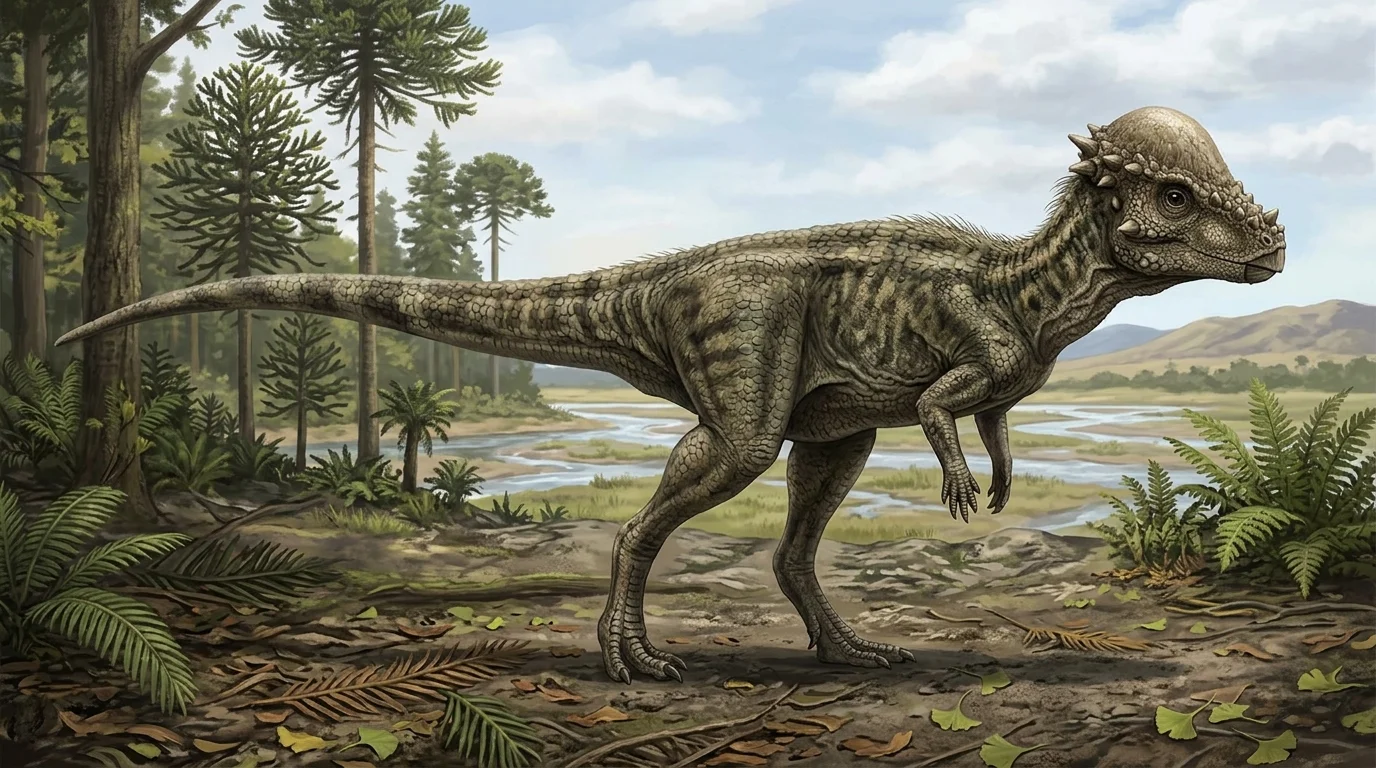
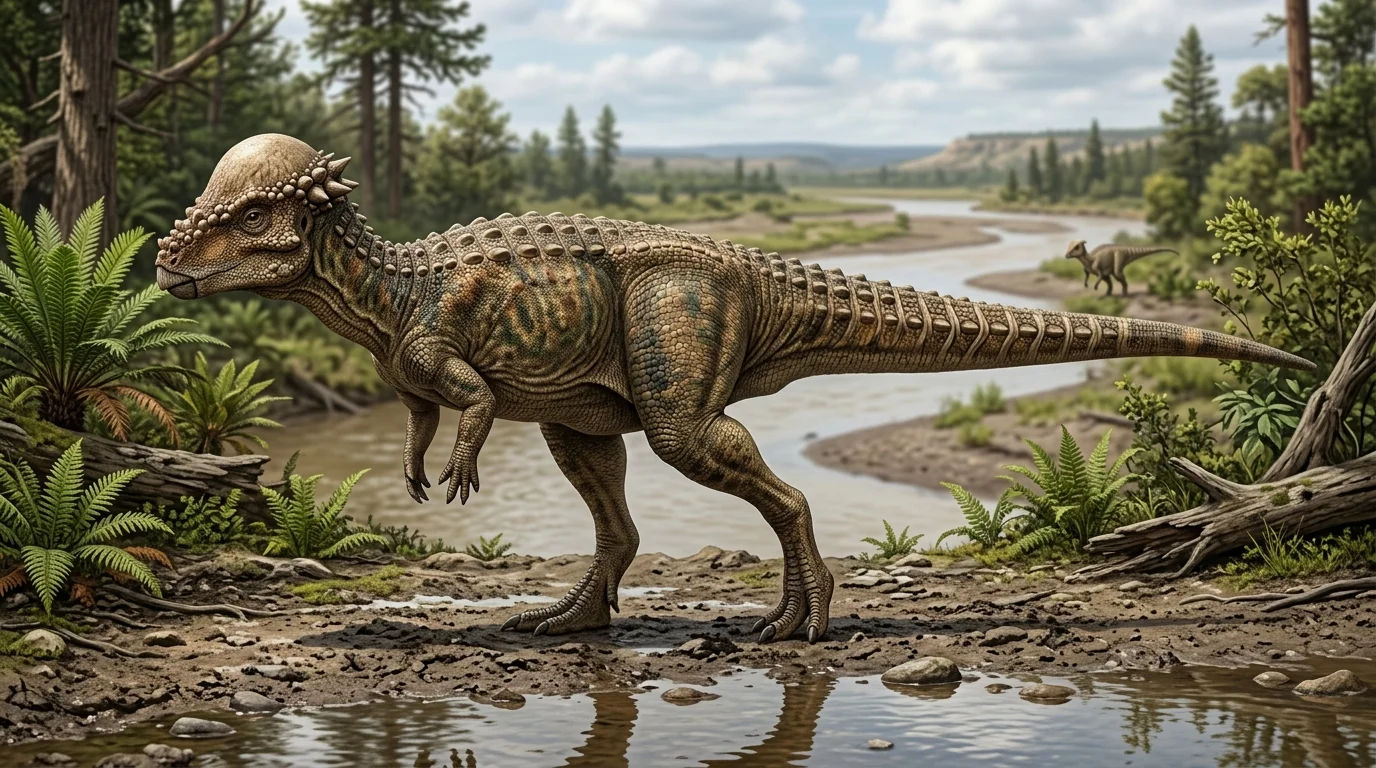
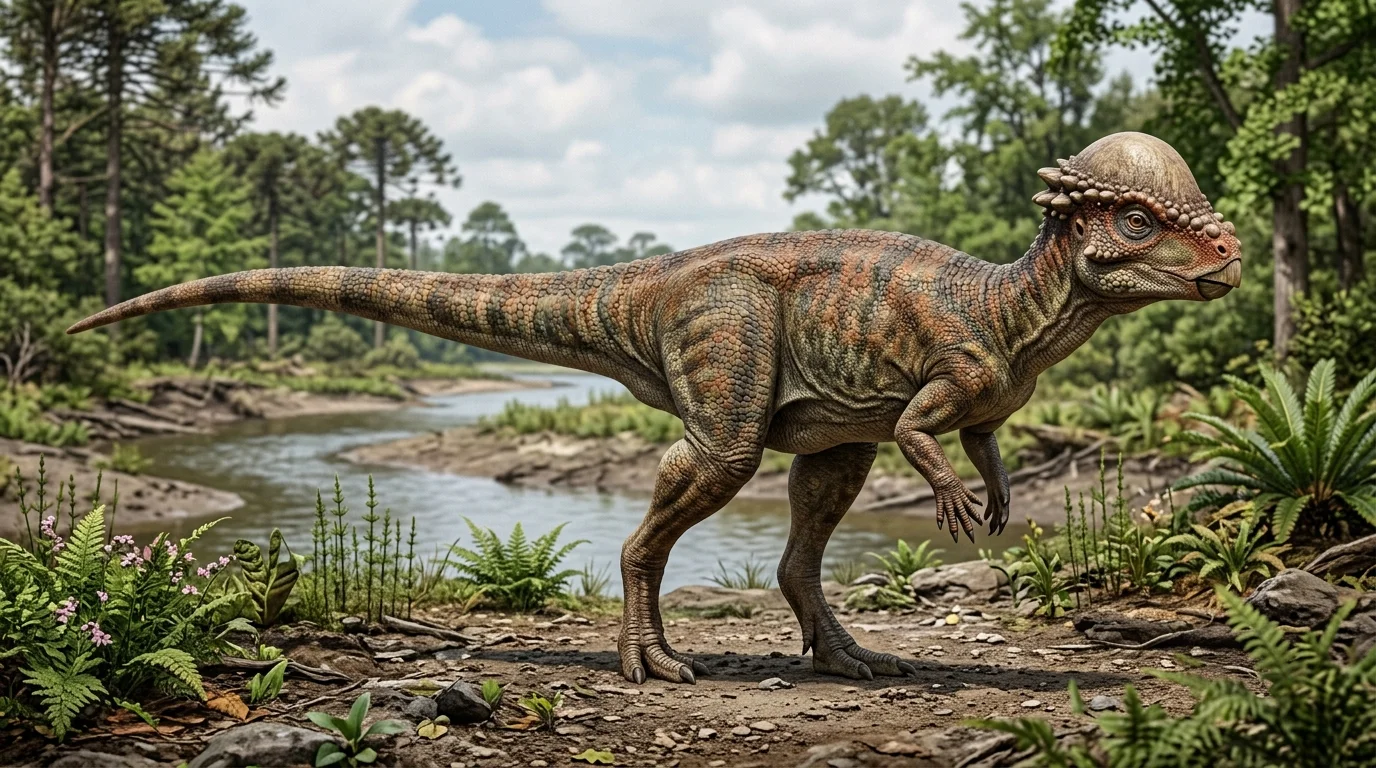
Scientific reconstruction of Prenocephale (Prenocephale prenes Maryańska & Osmólska, 1974) in its native Geological period: Cretaceous Period.
Image Credit: AI-generated scientific paleoart reconstruction synthesized from species-specific osteological profiles and peer-reviewed descriptions. (AI-Generated / Open Educational Media (DinoOrigin Spec))
Phylogenetic classification of Prenocephale prenes Maryańska & Osmólska, 1974 based on peer-reviewed cladistic analyses of diagnostic skeletal synapomorphies.
| Taxonomic Rank | Taxon / Clade | Diagnostic Context |
|---|---|---|
| Kingdom | Animalia | Monophyletic prehistoric clade |
| Phylum | Chordata | Monophyletic prehistoric clade |
| Clade | Dinosauria | Monophyletic prehistoric clade |
| Order | Ornithischia (Bird-Hipped Dinosaurs) | Characterized by a pelvis with a backwards-pointing pubis parallel to the ischium. |
| Infraorder | Pachycephalosauria | Bipedal ornithischians with extremely thickened skull domes reinforced by dense cortical bone. |
| Genus | Prenocephale | Monophyletic prehistoric clade |
| Species | Prenocephale prenes Maryańska & Osmólska, 1974 | Specific authority designation |
Prenocephale was a small, high-domed pachycephalosaur that roamed the river valleys of Late Cretaceous Mongolia. Measuring over two meters in length, its tall, rounded skull dome lacked the open supratemporal fenestrae seen in more primitive relatives, creating an uninterrupted solid bone structure.
A line of sharp bony tubercles and small horns encircled the back and sides of its skull dome, serving for both species recognition and visual intimidation.
Agile biped with a prominent high skull dome, ring of small hornlets, slender limbs, and stiffened tail.
Anatomical dimensions relative to an average adult human (1.8 m / 6 ft tall)
Tender leaves, fruits, seeds, and insects ground with small serrated cheek teeth.
Small, agile pachycephalosaur possessing a fully domed skull bordered by small bony tubercles. In the Late Cretaceous Nemegt Formation of Mongolia, Prenocephale coexisted with ostrich-mimic ornithomimids like Gallimimus and giant theropods including Tarbosaurus.
Forest margins, riparian channels, and floodplain meadows of the Nemegt Basin.
Remarkably complete articulated holotype skull and postcranial elements in Warsaw.
Discovered during the Polish-Mongolian Paleontological Expeditions by Teresa Maryańska and Halszka Osmólska.
The longest and final period of the Mesozoic Era, characterized by the rise of flowering plants, ceratopsians, hadrosaurs, tyrannosaurids, and concluding with the Chicxulub asteroid impact.
During the Mesozoic Era, continental drift progressively reconfigured land bridges, atmospheric currents, and regional precipitation regimes. Fossils of Prenocephale evidence its adaptation to the paleoenvironments of Asia.
Renowned for the exceptionally preserved feathered dinosaurs of Liaoning, China and the Cretaceous dune habitats of the Gobi Desert in Mongolia.
The anatomical architecture of Prenocephale serves as a crucial benchmark in vertebrate paleontology, illustrating key adaptive radiations within Pachycephalosauria.
Scientifically verified answers based on peer-reviewed paleontological evidence.
Prenocephale lived during the Cretaceous Period Period, approximately 70–66 Ma (million years ago). This places it within the Mesozoic Era.
Paleontological estimates place Prenocephale at a length of 2–2.4 m (6.6–7.9 ft), a hip/standing height of 0.9–1.1 m (3.0–3.6 ft), and a body mass of 30–50 kg (66–110 lbs).
Classified as a herbivore, Prenocephale specialized in consuming Tender leaves, fruits, seeds, and insects ground with small serrated cheek teeth..
Fossil specimens of Prenocephale have been recovered from Nemegt Formation, Gobi Desert, Mongolia, with notable historic specimens documented in 1971. Discovered during the Polish-Mongolian Paleontological Expeditions by Teresa Maryańska and Halszka Osmólska.
Authoritative citations establishing the factual taxonomy, biometrics, and anatomy of Prenocephale.
Maryańska, T., & Osmólska, H. (1974). Pachycephalosauria, a new suborder of dinosaurian reptiles. Palaeontologia Polonica, 30, 45-102.
Curated & Verified: 2026-09-24Deposited in Mesozoic sedimentary strata preserving skeletal remains, teeth, or trace trackways.
Prenocephale provides critical insights into the evolutionary radiation of Pachycephalosauria. Holotypes and fossil evidence indicate: Remarkably complete articulated holotype skull and postcranial elements in Warsaw.
PachycephalosauriaPachycephalosaurus wyomingensis Gilmore, 1931
A bipedal ornithischian known for its 25-centimeter thick solid bone skull dome surrounded by bony knobs and spikes.
PachycephalosauriaStegoceras validum Lambe, 1902
A small, bipedal pachycephalosaur from Alberta featuring an extremely thick, solid skull dome.