Stegosaurus stenops Marsh, 1887
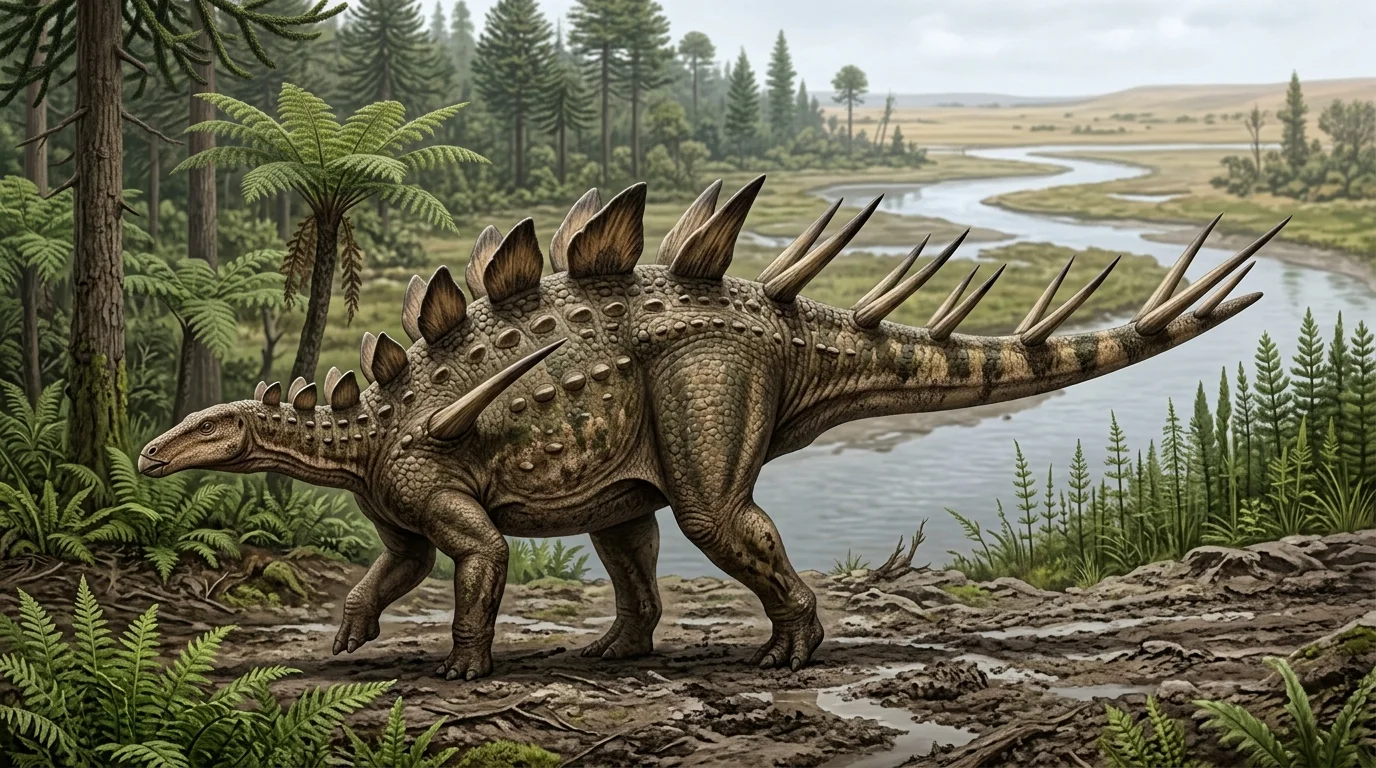
An iconic armored herbivore of the Late Jurassic with two alternating rows of vertical dorsal plates and a four-spiked tail thagomizer.

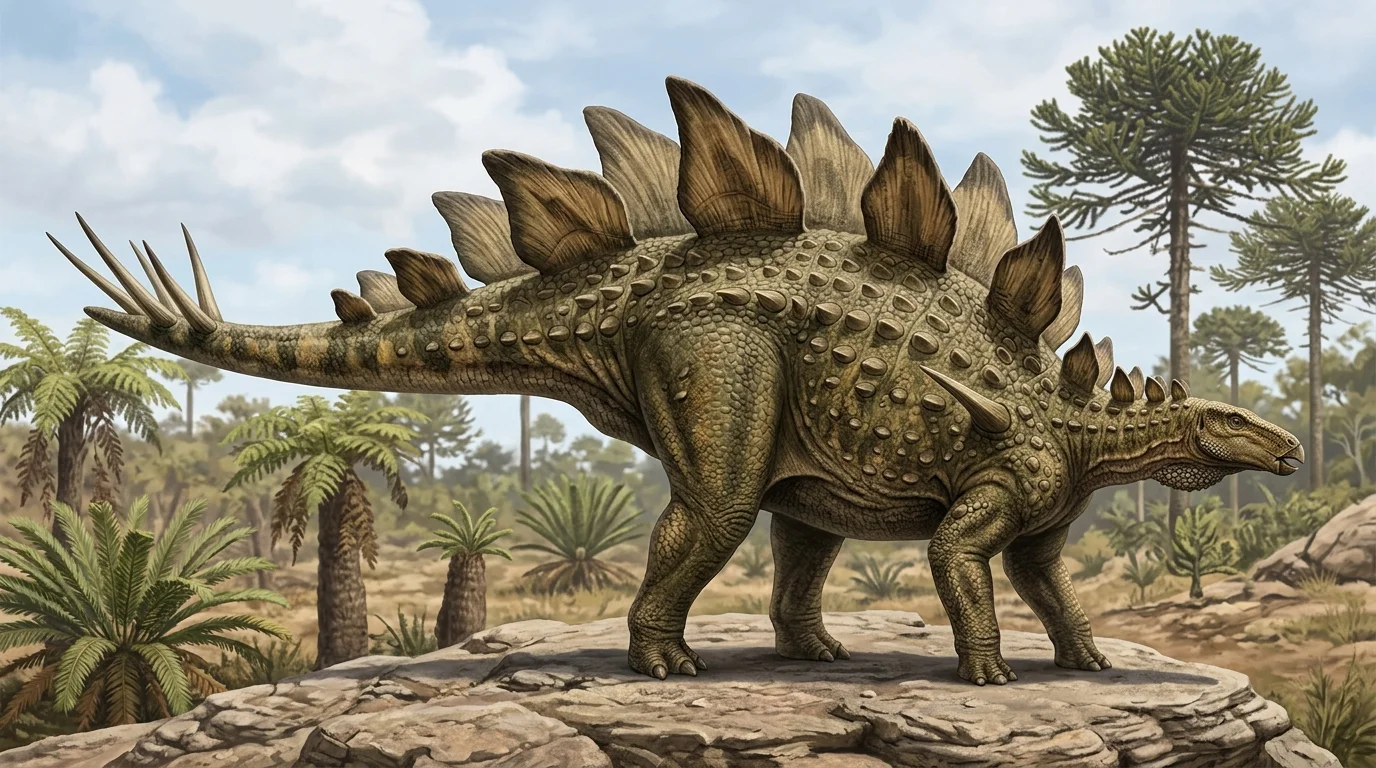
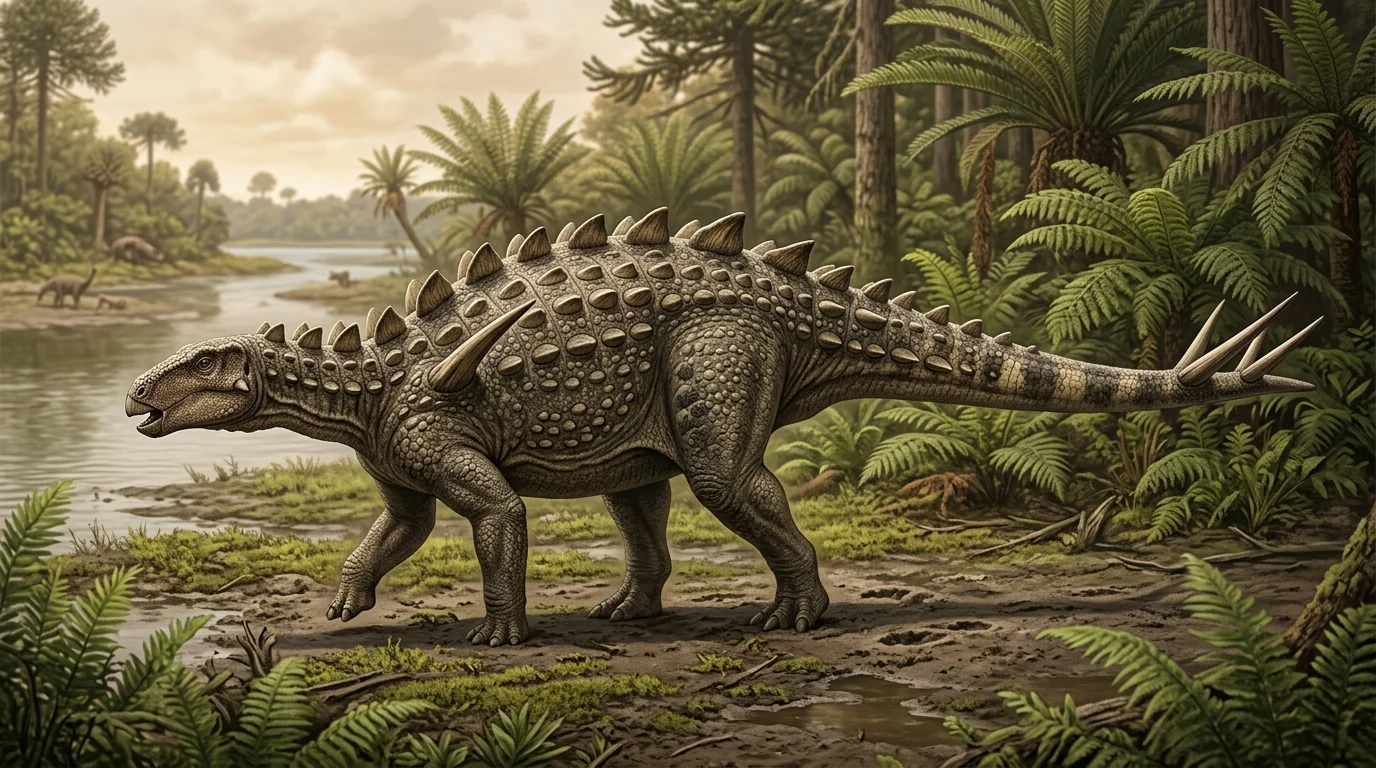
Scientific reconstruction of Stegosaurus (Stegosaurus stenops Marsh, 1887) in its native Geological period: Jurassic Period.
Image Credit: AI-generated scientific paleoart reconstruction synthesized from species-specific osteological profiles and peer-reviewed descriptions. (AI-Generated / Open Educational Media (DinoOrigin Spec))
Phylogenetic classification of Stegosaurus stenops Marsh, 1887 based on peer-reviewed cladistic analyses of diagnostic skeletal synapomorphies.
| Taxonomic Rank | Taxon / Clade | Diagnostic Context |
|---|---|---|
| Kingdom | Animalia | Monophyletic prehistoric clade |
| Phylum | Chordata | Monophyletic prehistoric clade |
| Clade | Dinosauria | Monophyletic prehistoric clade |
| Order | Ornithischia (Bird-Hipped Dinosaurs) | Characterized by a pelvis with a backwards-pointing pubis parallel to the ischium. |
| Infraorder | Stegosauria | Quadrupedal herbivores distinguished by two rows of alternating dorsal plates and caudal tail spikes (thagomizers). |
| Genus | Stegosaurus | Monophyletic prehistoric clade |
| Species | Stegosaurus stenops Marsh, 1887 | Specific authority designation |
Stegosaurus stenops is the definitive plated herbivore of the Late Jurassic Period (~155 to 150 million years ago), belonging to Stegosauria (armored and plated dinosaurs). Characterized by a narrow head, short forelimbs, an arched back, and two alternating vertical rows of large bony dermal plates along its spine, Stegosaurus reached adult lengths of 7 to 9 meters and weights between 3,000 and 5,000 kg.
Locomotion and Speed: Stegosaurus walked on all four columnar limbs, with hindlimbs significantly longer than its forelimbs. Biomechanical gait simulations and trackway analyses indicate a slow, deliberate quadrupedal gait with estimated walking speeds constrained to approximately 6–8 km/h. Running was anatomically restricted by short forelimb extension and pelvic osteology.
Scientific Significance: Stegosaurus provides vital insights into the evolution of dermal armor and osteoderm vascularization. Microscopic thin-section osteology demonstrates that its dorsal plates were embedded in the skin rather than fused to the vertebral column, equipped with extensive vascular channels that supported both visual display and thermoregulatory heat dissipation.
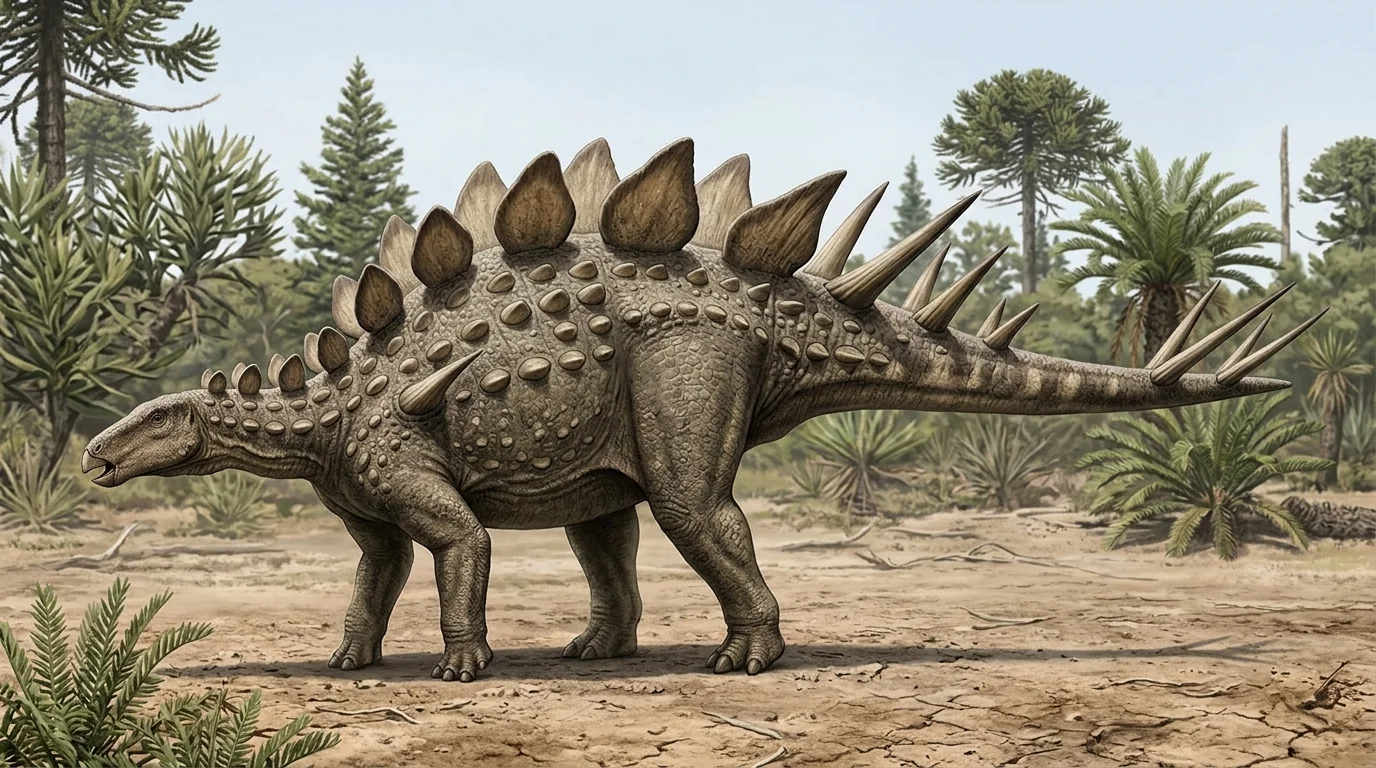
Heavily built quadruped with 17 broad alternating vertical dermal plates along the spine, an armored gular throat patch, and four terminal tail spikes.
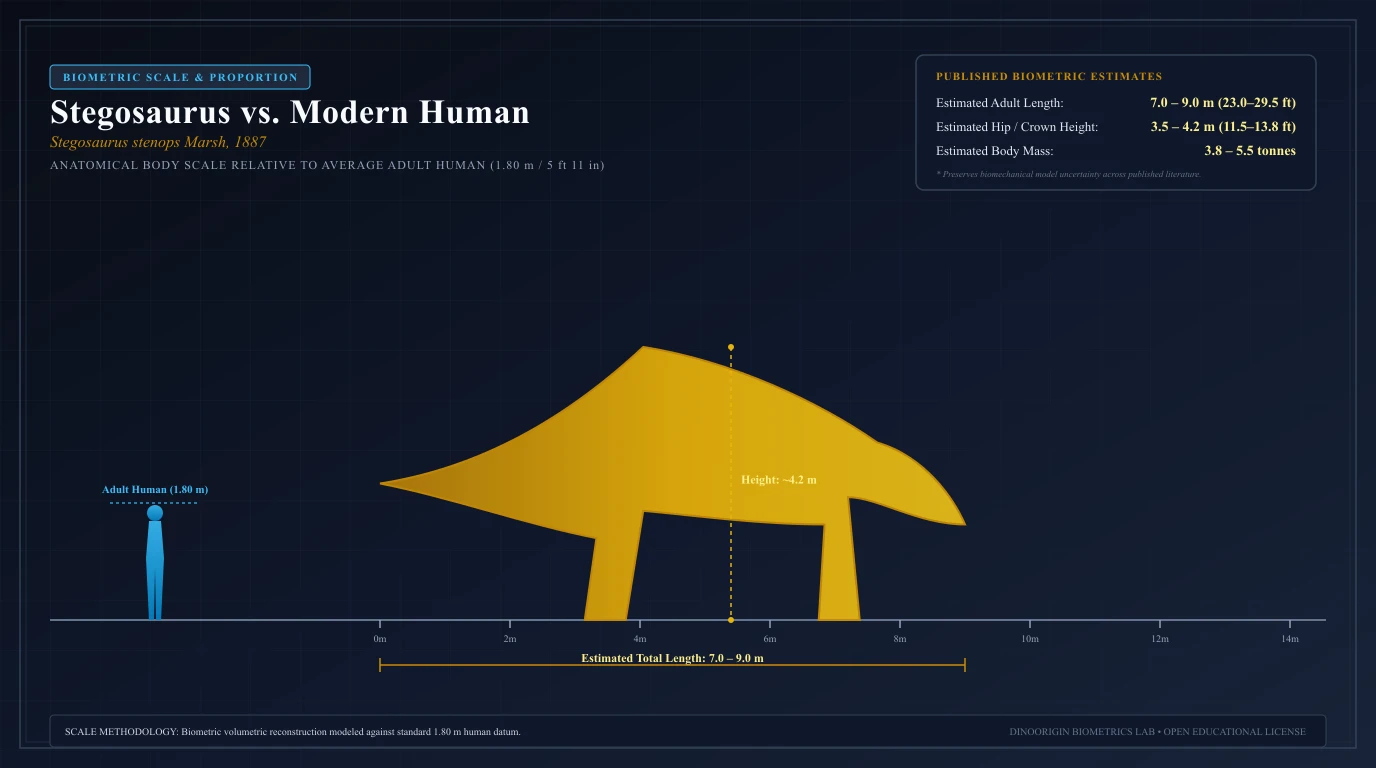
Anatomical dimensions relative to an average adult human (1.8 m / 6 ft tall)
Low-growing foliage such as mosses, ferns, horsetails, and cycad shoots, processed by simple triangular leaf-shaped teeth.
Operating as a low-to-medium tier browser, Stegosaurus cropped ferns, cycads, and horsetails with its toothless rhamphotheca (keratinous beak) and small serrated cheek teeth. At the terminus of its tail, four elongated bony spikes—colloquially named the 'thagomizer'—served as lethal defensive weaponry. Fossil evidence includes an Allosaurus tail vertebra pierced with a puncture matching the exact dimensions of a Stegosaurus thagomizer spike, demonstrating active defensive tail-striking in life.
Semi-arid savannahs, fern meadows, and conifer woodlands of the Morrison Formation.
Documented by numerous specimens from the Morrison Formation of Wyoming, Colorado, and Utah. Material spans O. C. Marsh's 1887 descriptions to exceptionally complete, articulated skeletons such as NHMUK PV R36730 ('Sophie', ~85% complete), which preserves an intact skull, plates, and articulated postcranial elements.

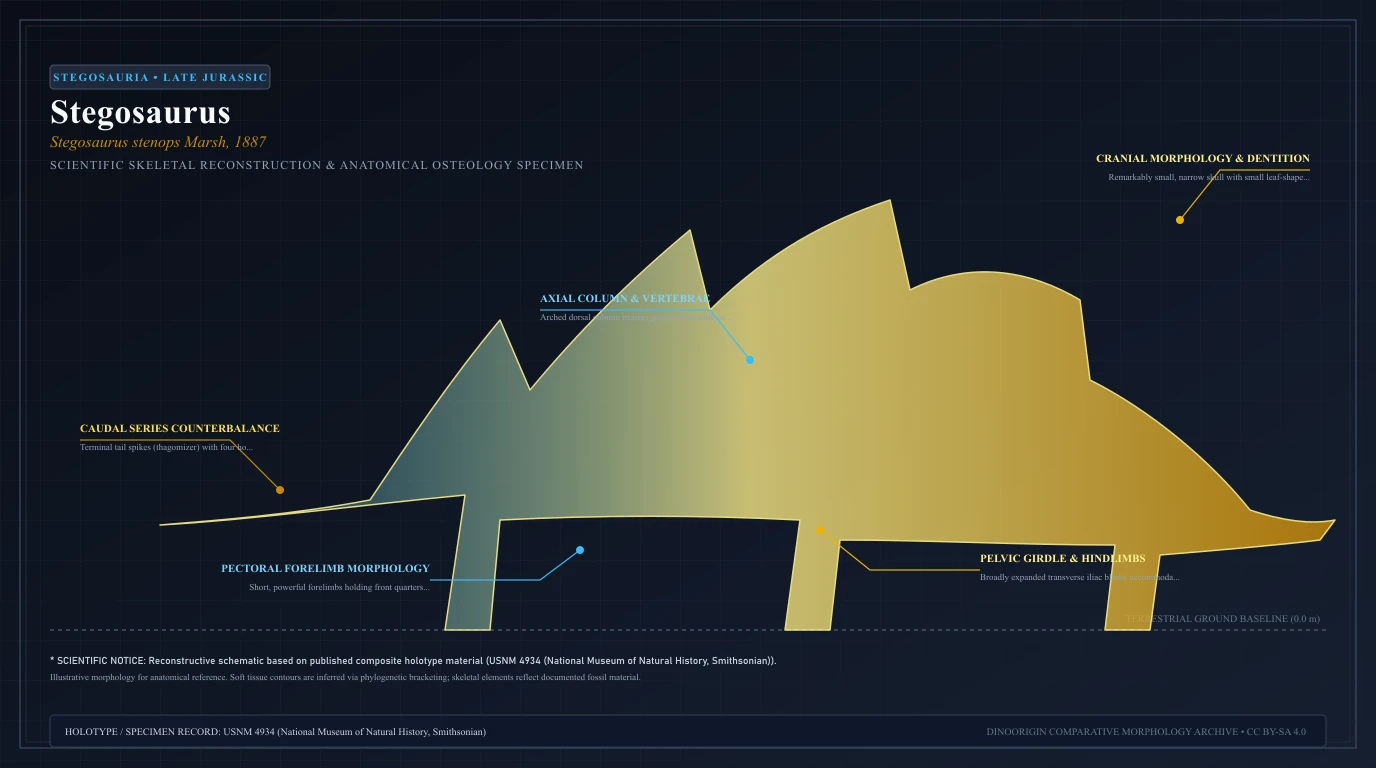
Anatomical skeletal reconstruction of Stegosaurus (Stegosaurus stenops Marsh, 1887) illustrating cranial fenestrae, vertebral column, and appendicular proportions based on composite fossil material.
Named by Othniel Charles Marsh during the Bone Wars; Marsh initially hypothesized the plates formed a shingle-like roof.
Marked by lush greenhouse climates, the breakup of Pangaea, and the evolutionary explosion of sauropods, plated stegosaurs, and apex megalosauroid and allosauroid theropods.
During the Mesozoic Era, continental drift progressively reconfigured land bridges, atmospheric currents, and regional precipitation regimes. Fossils of Stegosaurus evidence its adaptation to the paleoenvironments of North America.
Home to the fossil-rich Morrison Formation of the Late Jurassic and the Hell Creek and Dinosaur Park Formations of the Late Cretaceous.
The anatomical architecture of Stegosaurus serves as a crucial benchmark in vertebrate paleontology, illustrating key adaptive radiations within Stegosauria.
Scientifically verified answers based on peer-reviewed paleontological evidence.
Stegosaurus lived during the Jurassic Period Period, approximately 155–150 Ma (million years ago). This places it within the Mesozoic Era.
Paleontological estimates place Stegosaurus at a length of 7–9 m (23.0–29.5 ft), a hip/standing height of 3.5–4.2 m (11.5–13.8 ft), and a body mass of 3.8–5.5 metric tons (8,378–12,125 lbs).
Classified as a herbivore, Stegosaurus specialized in consuming Low-growing foliage such as mosses, ferns, horsetails, and cycad shoots, processed by simple triangular leaf-shaped teeth..
Fossil specimens of Stegosaurus have been recovered from Morrison, Colorado, United States, with notable historic specimens documented in 1877. Named by Othniel Charles Marsh during the Bone Wars; Marsh initially hypothesized the plates formed a shingle-like roof.
Authoritative citations establishing the factual taxonomy, biometrics, and anatomy of Stegosaurus.
Maidment, S. C. R., Brassey, C., & Barrett, P. M. (2015). The postcranial skeleton of an exceptionally complete individual of the plated dinosaur Stegosaurus stenops (Dinosauria: Thyreophora) from the Upper Jurassic Morrison Formation of Wyoming, U.S.A.. PLoS ONE, 10(10), e0138352. https://doi.org/10.1371/journal.pone.0138352
Curated & Verified: 2026-09-24
Comparative size scale of Stegosaurus relative to a 1.8-meter adult human, illustrating an estimated length of 7.0–9.0 m and height of 3.5–4.2 m (preserving model uncertainty).
Deposited in Mesozoic sedimentary strata preserving skeletal remains, teeth, or trace trackways.
Stegosaurus provides critical insights into the evolutionary radiation of Stegosauria. Holotypes and fossil evidence indicate: Documented by numerous specimens from the Morrison Formation of Wyoming, Colorado, and Utah. Material spans O. C. Marsh's 1887 descriptions to exceptionally complete, articulated skeletons such as NHMUK PV R36730 ('Sophie', ~85% complete), which preserves an intact skull, plates, and articulated postcranial elements.
Marsh, O. C. (1887). Principal characters of American Jurassic dinosaurs. Part IX. The skull and dermal armour of Stegosaurus. American Journal of Science, 34(203), 413-417. https://doi.org/10.2475/ajs.s3-34.203.413
StegosauriaHesperosaurus mjosi Carpenter et al., 2001
A Late Jurassic stegosaurid from Wyoming featuring wide, oval dorsal plates and a short, deep skull.
StegosauriaHuayangosaurus taibaii Dong et al., 1982
One of the most primitive known stegosaurs, retaining premaxillary teeth and spike-like shoulder armor.
StegosauriaKentrosaurus aethiopicus Hennig, 1915
A spiky East African stegosaur equipped with dermal plates along its neck and long sharp spikes along its back and hips.