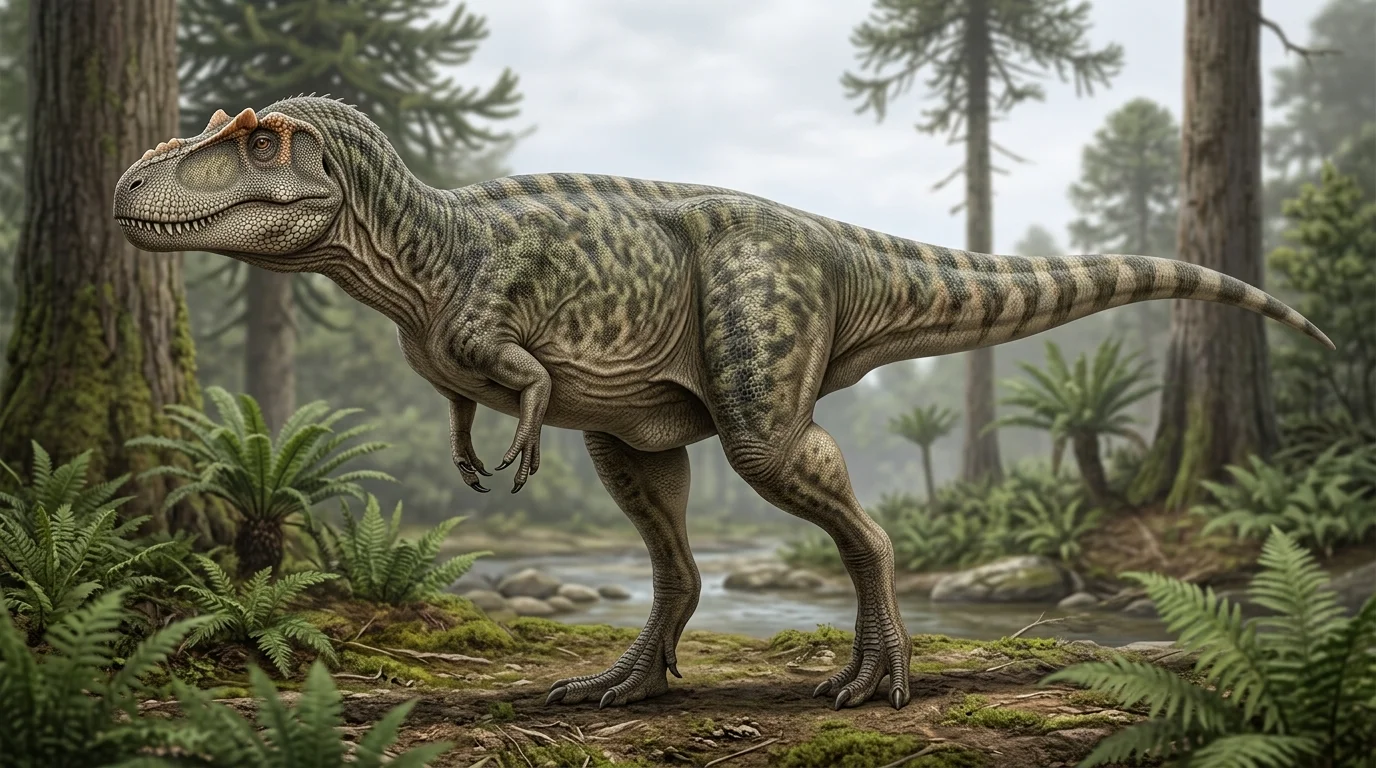
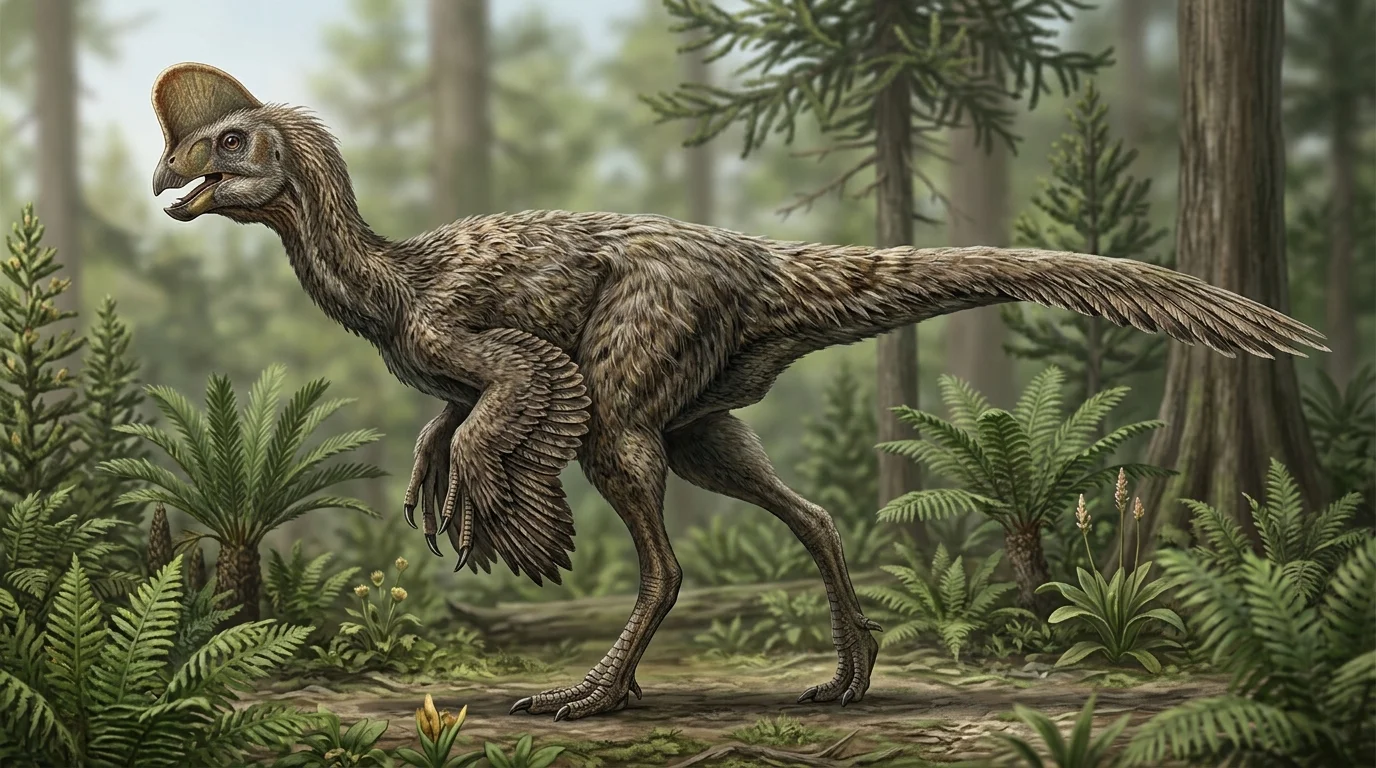
Bipedal saurischian dinosaurs, historically dominated by carnivores and including the avian lineage.
Genus
Velociraptor
Monophyletic prehistoric clade
Species
Velociraptor mongoliensis Osborn, 1924
Specific authority designation
Anatomy & Physical Characteristics
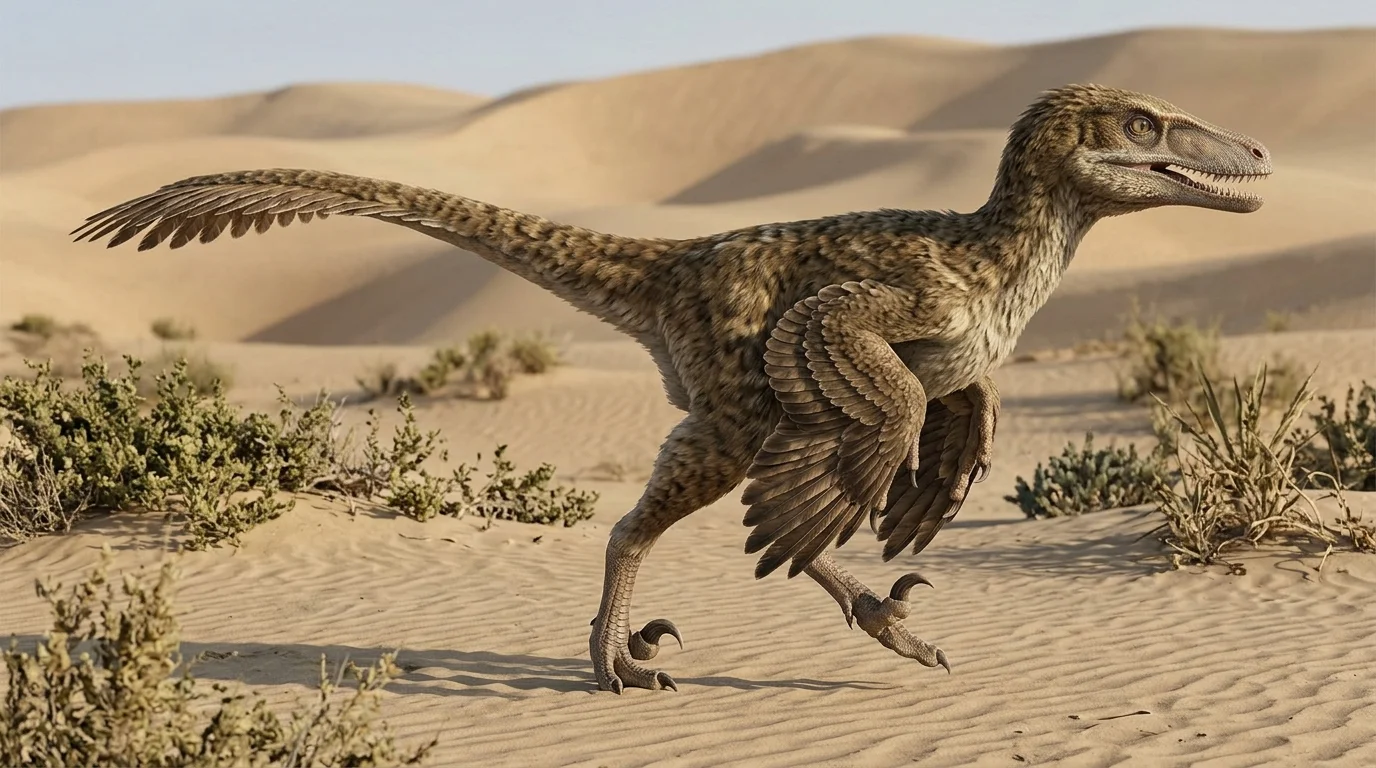
Velociraptor mongoliensis was a slender dromaeosaurid theropod measuring approximately 2 meters in length and weighing an estimated 15 to 20 kg. Inhabiting the dune paleoenvironments of the Gobi Desert during the late Cretaceous Period (~75 to 71 million years ago), Velociraptor belongs to the feathered maniraptoran branch of Theropoda. It possessed an elongated, low skull with an upturned snout, recurved teeth, and a stiffened tail reinforced by interlocking bony rod-like tendons.
Locomotion and Speed:
Velociraptor possessed cursorial locomotion adaptations, featuring elongated lower leg bones and slender metatarsals. Biomechanical gait models estimate agile running speeds, though precise numerical velocity figures are unmeasured and model-dependent. Locomotor simulations indicate that its rigid tail acted as a dynamic inertial stabilizer, allowing rapid direction changes during sudden dashes.
Scientific Significance:
Velociraptor provides pivotal morphological evidence linking non-avian theropods directly to modern birds. In 2007, paleontologists identified direct osteological evidence of quill knobs (ulnar papillae) on specimen IGM 100/981, confirming the presence of vaned, pennaceous feathers. Its second pes digit bore a specialized, hyperextensible sickle claw primarily adapted for pinning, restraining, and puncturing struggling prey.
Diagnostic Morphological Traits
Slender, feathered bipedal theropod with a long, stiffened rod-like tail, wing feathers on forelimbs, and elevated second pedal unguals.
Comparative Scale & Biometrics
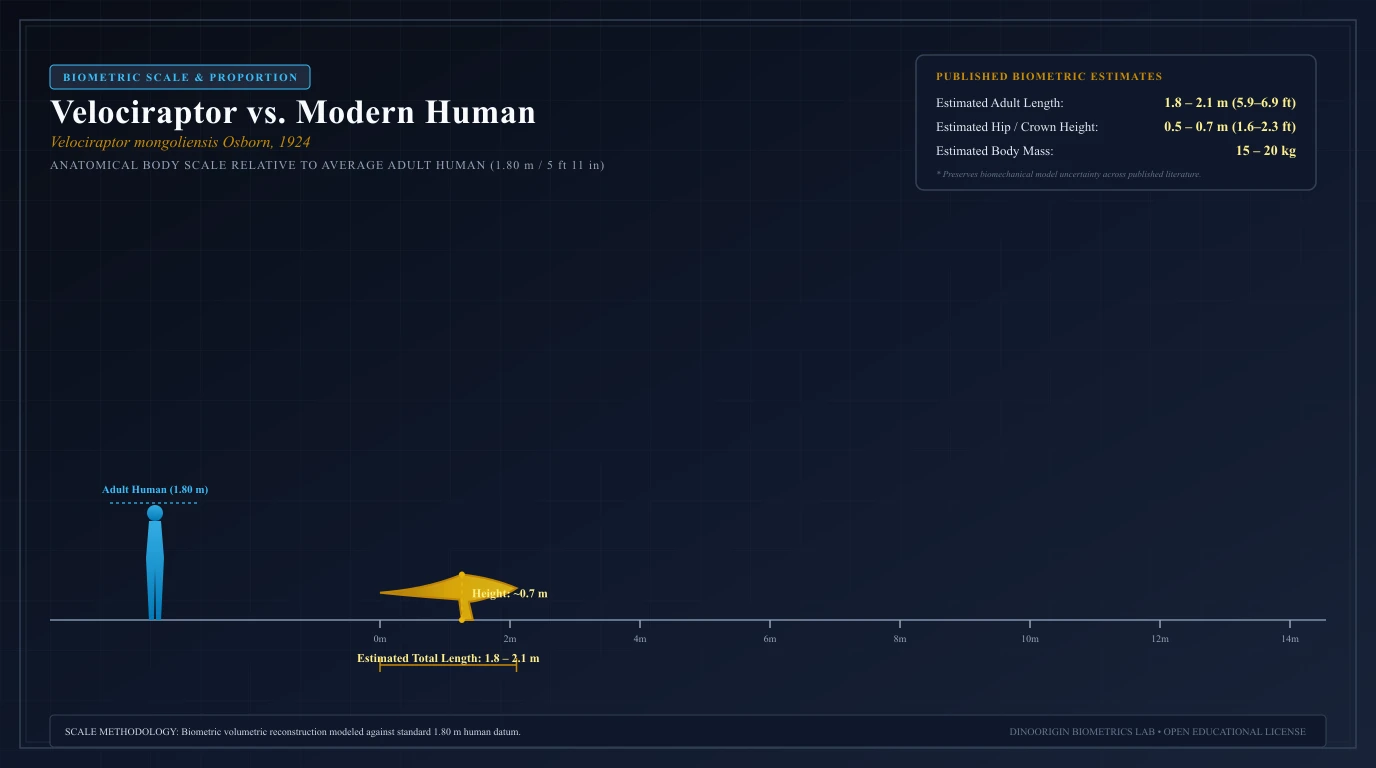
Anatomical dimensions relative to an average adult human (1.8 m / 6 ft tall)
Small mammals, squamates, juvenile ceratopsians (Protoceratops), and avian dinosaurs.
Paleobiology & Behavior
Direct behavioral evidence is immortalized in the world-renowned 'Fighting Dinosaurs' fossil (MPC-D 100/25), in which an articulated Velociraptor was buried by a sudden sand collapse while locked in combat with a herbivorous Protoceratops. Its claws were clamped onto the prey's frill and snout while its body was held in the ceratopsian's jaws. Pack-hunting behaviors popularized in media lack unambiguous fossil trackway or bonebed support, with modern interpretations favoring solitary foraging or opportunistic multi-predator feeding.
Habitat & Ecological Biome
Prehistoric Depositional Setting
Arid to semi-arid sand dune fields and ephemeral oasis watercourses of the Djadochta Formation.
Fossil Evidence & Specimen Records
Preserved Skeletal Material & Bonebeds
Documented by numerous articulated and associated specimens from the Djadokhta Formation of Mongolia. Key material includes the AMNH 6515 holotype skull and partial skeleton excavated in 1923, as well as exceptionally preserved three-dimensional skeletons in fine eolian sandstones exhibiting intact skulls, quill knobs, and ossified tendons.
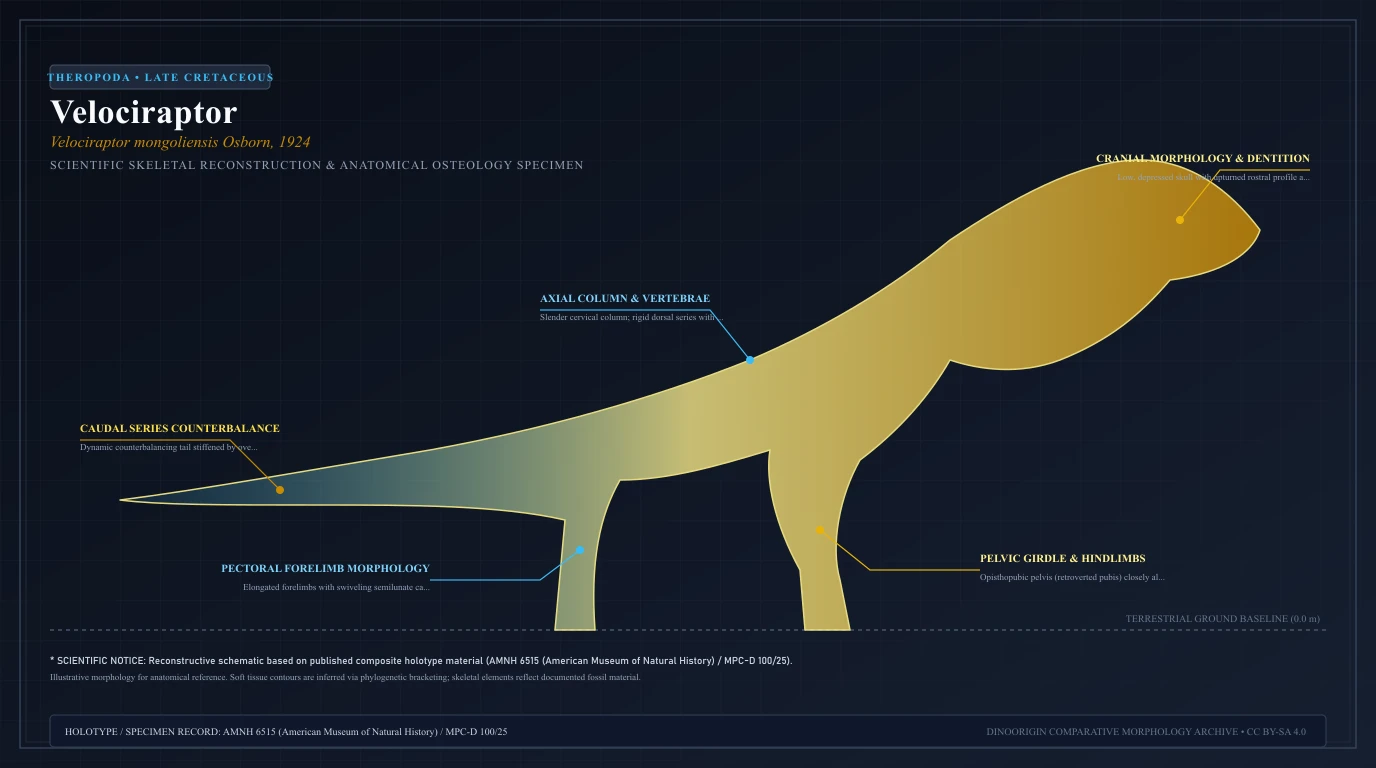
Anatomical Osteology & Skeletal Reconstruction
Anatomical skeletal reconstruction of Velociraptor (Velociraptor mongoliensis Osborn, 1924) illustrating cranial fenestrae, vertebral column, and appendicular proportions based on composite fossil material.
Discovery & Taxonomic Naming History
Year of Discovery / Description1923
Type Specimen Locality & FormationFlaming Cliffs, Omnogov, Mongolia
Found by Peter Kaisen during the Central Asiatic Expeditions of the American Museum of Natural History; described by Henry Fairfield Osborn.
Cretaceous Period PeriodTemporal Interval: 75–71 Ma (million years ago)
The longest and final period of the Mesozoic Era, characterized by the rise of flowering plants, ceratopsians, hadrosaurs, tyrannosaurids, and concluding with the Chicxulub asteroid impact.
During the Mesozoic Era, continental drift progressively reconfigured land bridges, atmospheric currents, and regional precipitation regimes. Fossils of Velociraptor evidence its adaptation to the paleoenvironments of Asia.
Paleogeographic RealmAsia (Asia)
Renowned for the exceptionally preserved feathered dinosaurs of Liaoning, China and the Cretaceous dune habitats of the Gobi Desert in Mongolia.
Fossil Discovery Locality
Scientific Significance & Evolutionary Impact
The anatomical architecture of Velociraptor serves as a crucial benchmark in vertebrate paleontology, illustrating key adaptive radiations within Theropoda.
Phylogenetic Placement: Informs cladistic debates concerning the divergence, skull biomechanics, and skeletal evolution of Cretaceous Period fauna.
Paleoecological Guild: Documents trophic specialization (Carnivore) and predator-prey dynamics across its regional ecosystem.
Taphonomic Record: Documented by numerous articulated and associated specimens from the Djadokhta Formation of Mongolia. Key material includes the AMNH 6515 holotype skull and partial skeleton excavated in 1923, as well as exceptionally preserved three-dimensional skeletons in fine eolian sandstones exhibiting intact skulls, quill knobs, and ossified tendons.
Frequently Asked Questions About Velociraptor
Scientifically verified answers based on peer-reviewed paleontological evidence.
Q1.When did Velociraptor live?
Velociraptor lived during the Cretaceous Period Period, approximately 75–71 Ma (million years ago). This places it within the Mesozoic Era.
Q2.How big was Velociraptor?
Paleontological estimates place Velociraptor at a length of 1.8–2.1 m (5.9–6.9 ft), a hip/standing height of 0.5–0.7 m (1.6–2.3 ft), and a body mass of 15–20 kg (33–44 lbs).
Q3.What was the diet of Velociraptor?
Classified as a carnivore, Velociraptor specialized in consuming Small mammals, squamates, juvenile ceratopsians (Protoceratops), and avian dinosaurs..
Q4.Where were Velociraptor fossils discovered?
Fossil specimens of Velociraptor have been recovered from Flaming Cliffs, Omnogov, Mongolia, with notable historic specimens documented in 1923. Found by Peter Kaisen during the Central Asiatic Expeditions of the American Museum of Natural History; described by Henry Fairfield Osborn.
Academic Literature & Peer-Reviewed References
Authoritative citations establishing the factual taxonomy, biometrics, and anatomy of Velociraptor.
Comparative size scale of Velociraptor relative to a 1.8-meter adult human, illustrating an estimated length of 1.8–2.1 m and height of 0.5–0.7 m (preserving model uncertainty).
Flaming Cliffs, Omnogov, Mongolia
Deposited in Mesozoic sedimentary strata preserving skeletal remains, teeth, or trace trackways.
Q5.What makes Velociraptor scientifically significant?
Velociraptor provides critical insights into the evolutionary radiation of Theropoda. Holotypes and fossil evidence indicate: Documented by numerous articulated and associated specimens from the Djadokhta Formation of Mongolia. Key material includes the AMNH 6515 holotype skull and partial skeleton excavated in 1923, as well as exceptionally preserved three-dimensional skeletons in fine eolian sandstones exhibiting intact skulls, quill knobs, and ossified tendons.
Turner, A. H., Makovicky, P. J., & Norell, M. A. (2007). Feather quill knobs in the dinosaur Velociraptor. Science, 317(5845), 1721.