Acrocanthosaurus atokensis Stovall & Langston, 1950
A high-spined North American apex predator famous for hunting sauropods across Early Cretaceous river valleys.

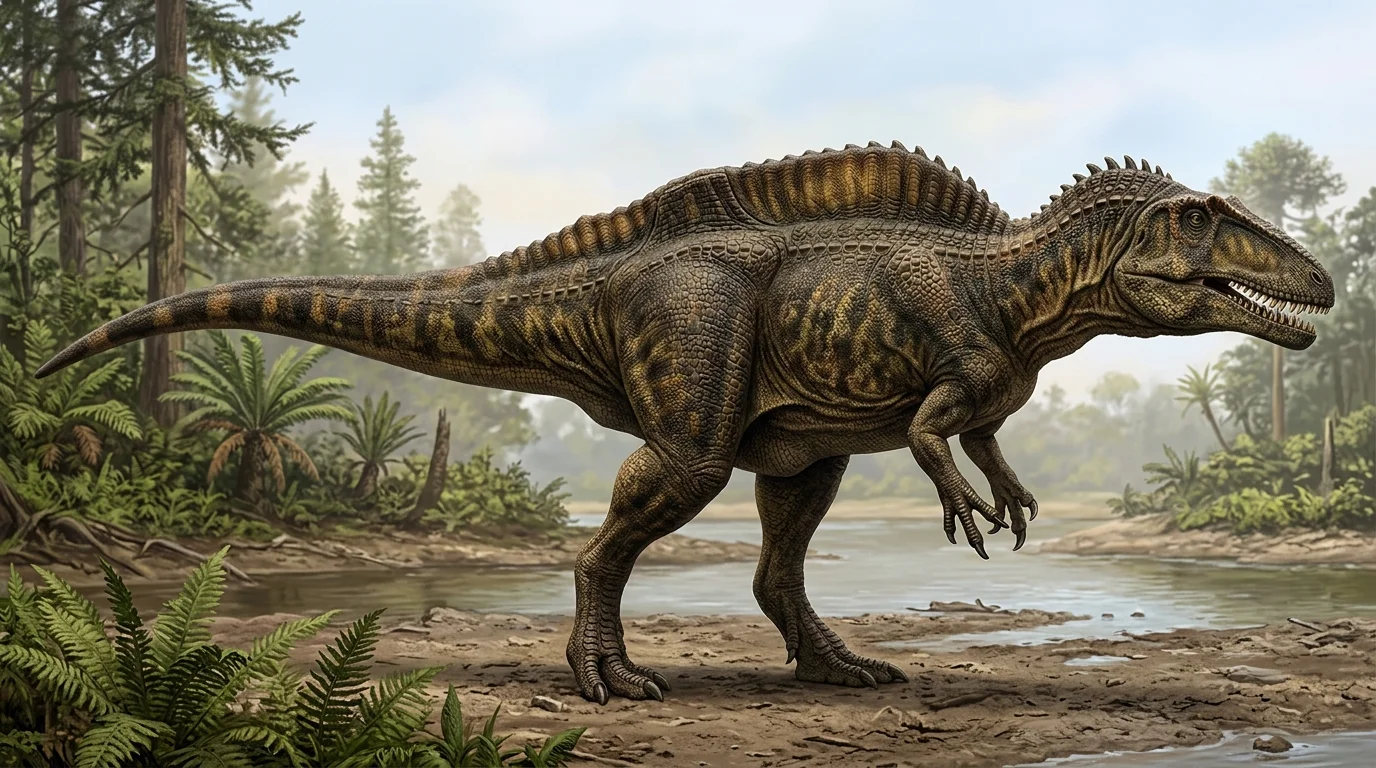
Scientific reconstruction of Acrocanthosaurus (Acrocanthosaurus atokensis Stovall & Langston, 1950) in its native Geological period: Cretaceous Period.
Image Credit: AI-generated scientific paleoart reconstruction synthesized from species-specific osteological profiles and peer-reviewed descriptions. (AI-Generated / Open Educational Media (DinoOrigin Spec))
Phylogenetic classification of Acrocanthosaurus atokensis Stovall & Langston, 1950 based on peer-reviewed cladistic analyses of diagnostic skeletal synapomorphies.
| Taxonomic Rank | Taxon / Clade | Diagnostic Context |
|---|---|---|
| Kingdom | Animalia | Monophyletic prehistoric clade |
| Phylum | Chordata | Monophyletic prehistoric clade |
| Clade | Dinosauria | Monophyletic prehistoric clade |
| Order | Saurischia (Lizard-Hipped Dinosaurs) | Characterized ancestrally by a triradiate pelvis with an anteriorly pointing pubis. |
| Suborder | Theropoda | Bipedal saurischian dinosaurs, historically dominated by carnivores and including the avian lineage. |
| Genus | Acrocanthosaurus | Monophyletic prehistoric clade |
| Species | Acrocanthosaurus atokensis Stovall & Langston, 1950 | Specific authority designation |
Paleontological Profile: Acrocanthosaurus atokensis was an apex predator of Early Cretaceous North America. Reaching lengths up to 11.5 meters and weighing over 6 metric tons, it was characterized by tall neural spines along its vertebral column that rose up to 2.5 times the centrum height. Rather than supporting a thin sail, these spines anchored massive epaxial back and neck musculature inferred to have stabilized the head and neck during feeding and physical exertion when dealing with large herbivores like Sauroposeidon and Tenontosaurus.
Fossil Evidence & Trackways: Discovered in the Antlers Formation of Oklahoma and Twin Mountains Formation of Texas, Acrocanthosaurus is represented by well-preserved skeletons including "Fran" (NCSM 14345). In addition, trackways in the Glen Rose Formation along the Paluxy River in Texas preserve large theropod footprints that have been interpreted by researchers as evidence consistent with predator-prey tracking or interaction with sauropods, though direct predation cannot be confirmed from trackways alone.
Acrocanthosaurus was the undisputed apex predator of Early Cretaceous North America. Reaching up to 11.5 meters in length, it was distinguished by tall neural spines along its neck, back, and tail that reached up to 2.5 times the height of the vertebrae.
These spines supported massive muscle ridges and connective tissue, anchoring powerful back and neck muscles used to grapple with giant sauropods, as famously recorded in the Paluxy River fossil trackways in Texas.
Heavy bipedal carnivore with a thick muscular dorsal ridge running from neck to tail and a long, low skull.
Anatomical dimensions relative to an average adult human (1.8 m / 6 ft tall)
Hunted sauropods like Sauroposeidon and ornithopods like Tenontosaurus.
Apex pursuit predator that shared the Early Cretaceous coastal plain ecosystem with contemporary dromaeosaurids like Deinonychus and large ornithopods like Tenontosaurus. Trackway assemblages and body fossils indicate it operated as the dominant carnivore across these ancient river deltas.
Broad coastal river deltas, tidal mudflats, and open floodplain forests.
Spectacular complete specimen 'Fran' (NCSM 14345) mounted at the North Carolina Museum of Natural Sciences.
Excavated by J. Willis Stovall and Wann Langston Jr.; described in 1950.
The longest and final period of the Mesozoic Era, characterized by the rise of flowering plants, ceratopsians, hadrosaurs, tyrannosaurids, and concluding with the Chicxulub asteroid impact.
During the Mesozoic Era, continental drift progressively reconfigured land bridges, atmospheric currents, and regional precipitation regimes. Fossils of Acrocanthosaurus evidence its adaptation to the paleoenvironments of North America.
Home to the fossil-rich Morrison Formation of the Late Jurassic and the Hell Creek and Dinosaur Park Formations of the Late Cretaceous.
The anatomical architecture of Acrocanthosaurus serves as a crucial benchmark in vertebrate paleontology, illustrating key adaptive radiations within Theropoda.
Scientifically verified answers based on peer-reviewed paleontological evidence.
Acrocanthosaurus atokensis was one of the largest theropods in North American history, reaching adult lengths between 10.0 and 11.5 meters (33 to 38 feet), standing 3.4 to 4.0 meters (11 to 13 feet) tall, and weighing an estimated 4,500 to 6,500 kg (4.5 to 6.5 metric tons).
The neural spines along the vertebrae of Acrocanthosaurus rose up to 2.5 times the height of the vertebral centra. Biomechanical and histological studies show they anchored massive epaxial back and neck musculature, providing stabilizing power to absorb vertical and lateral stresses when grappling with large, struggling prey.
Acrocanthosaurus was a large carnivorous theropod suited for preying on contemporary Early Cretaceous herbivores, including sauropods (such as Sauroposeidon) and ornithopods (such as Tenontosaurus). In the Glen Rose Formation of the Paluxy River, Texas, trackways showing large theropod footprints alongside sauropod paths have frequently been interpreted as evidence consistent with predator-prey interaction or tracking behavior, though trackways cannot definitively prove active predation.
Authoritative citations establishing the factual taxonomy, biometrics, and anatomy of Acrocanthosaurus.
Stovall, J. W., & Langston, W. (1950). Acrocanthosaurus atokensis, a new genus and species of Lower Cretaceous Theropoda from Oklahoma. The American Midland Naturalist, 43(3), 696-728. https://doi.org/10.2307/2421859
Curated & Verified: 2026-09-24Deposited in Mesozoic sedimentary strata preserving skeletal remains, teeth, or trace trackways.
Fossils of Acrocanthosaurus have been recovered primarily from the Antlers Formation of Atoka County, Oklahoma (where J. Willis Stovall and Wann Langston Jr. excavated the type specimens) and the Twin Mountains Formation of Texas. An extraordinarily complete specimen nicknamed 'Fran' (NCSM 14345) is permanently exhibited at the North Carolina Museum of Natural Sciences.
Acrocanthosaurus lived during the Early Cretaceous Period (Aptian to early Albian stages, approximately 113 to 110 million years ago), dominating coastal floodplain ecosystems and river deltas along the ancient Western Interior Seaway millions of years before Tyrannosaurus rex evolved.
TheropodaAlbertosaurus sarcophagus Osborn, 1905
A fleet-footed, gracile tyrannosaurid from the Late Cretaceous of western Canada known from prominent multi-individual bonebed associations.
TheropodaAnzu wyliei Lamanna et al., 2014
The 'Chicken from Hell', a gigantic, crested caenagnathid oviraptorosaur from the Hell Creek Formation.
TheropodaAustralovenator wintonensis Hocknull et al., 2009
The 'cheetah of its time', a lightning-fast megaraptoran predator from the mid-Cretaceous of Australia.