Deinonychus antirrhopus Ostrom, 1969
The agile dromaeosaurid whose discovery catalyzed the modern Dinosaur Renaissance and established the dinosaur-bird evolutionary link.

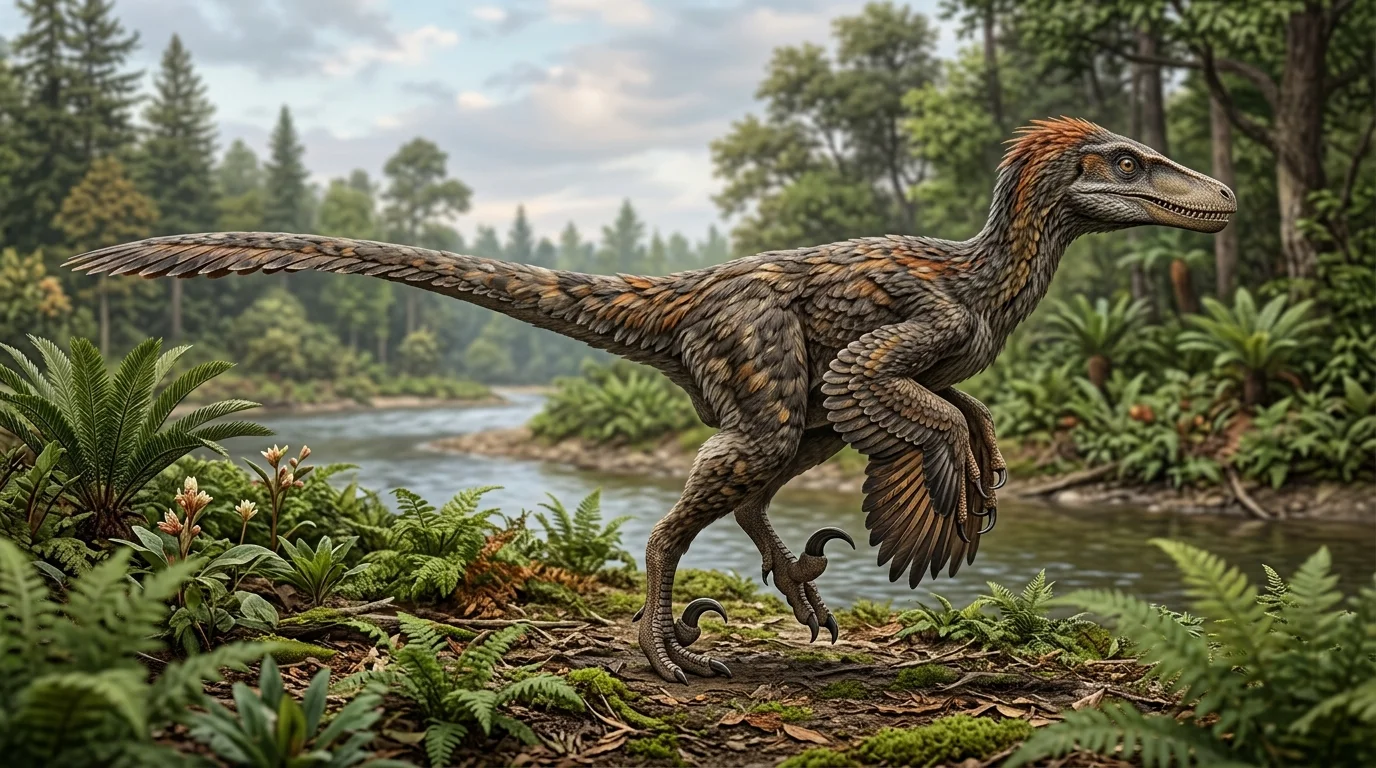
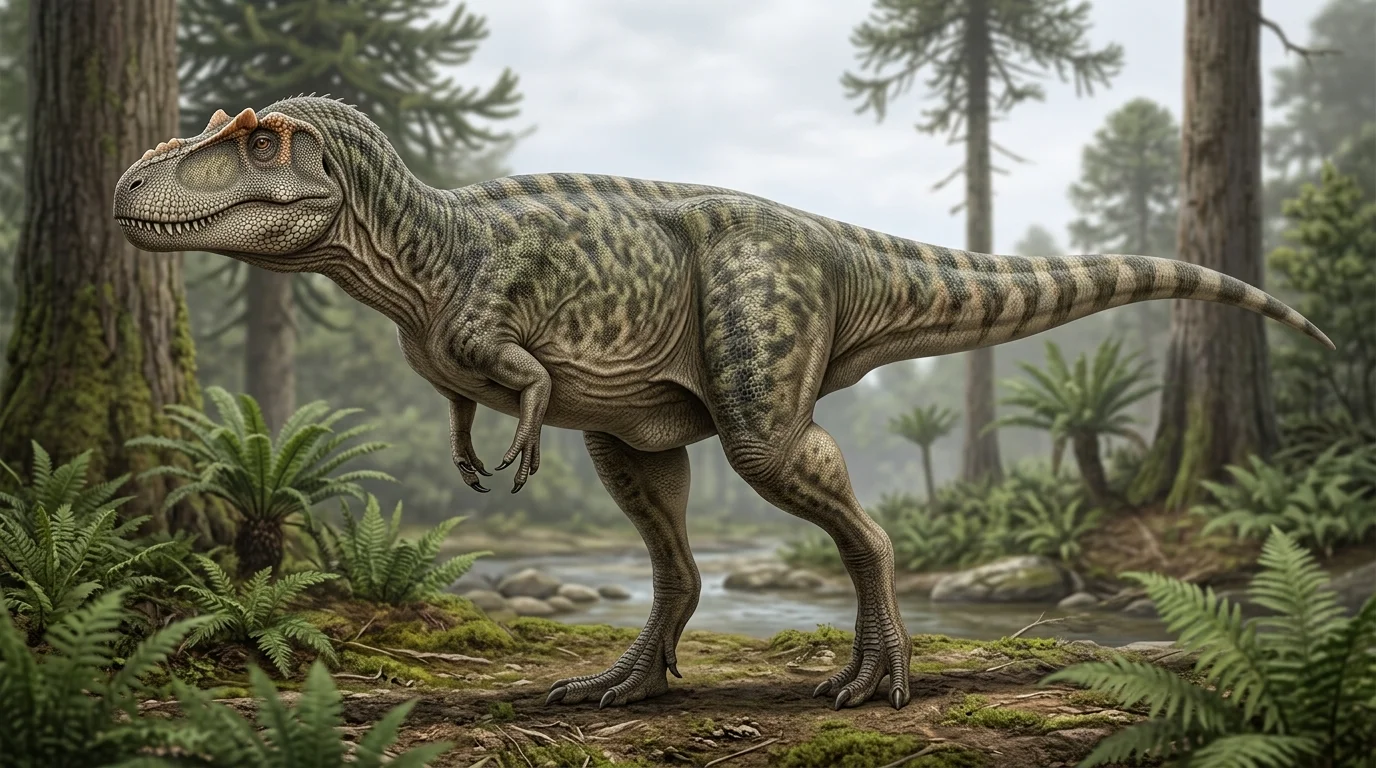
Scientific reconstruction of Deinonychus (Deinonychus antirrhopus Ostrom, 1969) in its native Geological period: Cretaceous Period.
Image Credit: AI-generated scientific paleoart reconstruction synthesized from species-specific osteological profiles and peer-reviewed descriptions. (AI-Generated / Open Educational Media (DinoOrigin Spec))
Phylogenetic classification of Deinonychus antirrhopus Ostrom, 1969 based on peer-reviewed cladistic analyses of diagnostic skeletal synapomorphies.
| Taxonomic Rank | Taxon / Clade | Diagnostic Context |
|---|---|---|
| Kingdom | Animalia | Monophyletic prehistoric clade |
| Phylum | Chordata | Monophyletic prehistoric clade |
| Clade | Dinosauria | Monophyletic prehistoric clade |
| Order | Saurischia (Lizard-Hipped Dinosaurs) | Characterized ancestrally by a triradiate pelvis with an anteriorly pointing pubis. |
| Suborder | Theropoda | Bipedal saurischian dinosaurs, historically dominated by carnivores and including the avian lineage. |
| Genus | Deinonychus | Monophyletic prehistoric clade |
| Species | Deinonychus antirrhopus Ostrom, 1969 | Specific authority designation |
Deinonychus antirrhopus ('terrible claw with counterbalance') was a medium-sized dromaeosaurid theropod that lived during the Early Cretaceous. Discovered by John Ostrom in Montana in 1964, Deinonychus fundamentally changed 20th-century paleontology, demonstrating that dinosaurs were active, warm-blooded, agile animals with close evolutionary ties to birds.
Possessing a heavily ossified rod-stiffened tail for rapid counterbalancing while pivoting, large stereoscopic eyes, grasping three-clawed forelimbs, and a 12-centimeter sickle-shaped killing claw on the second pedal digit, Deinonychus was an agile, highly specialized predator.
Feathered, muscular bipedal predator with large eyes, a horizontally held stiffened tail, and large pedal sickle claws held clear of the ground.
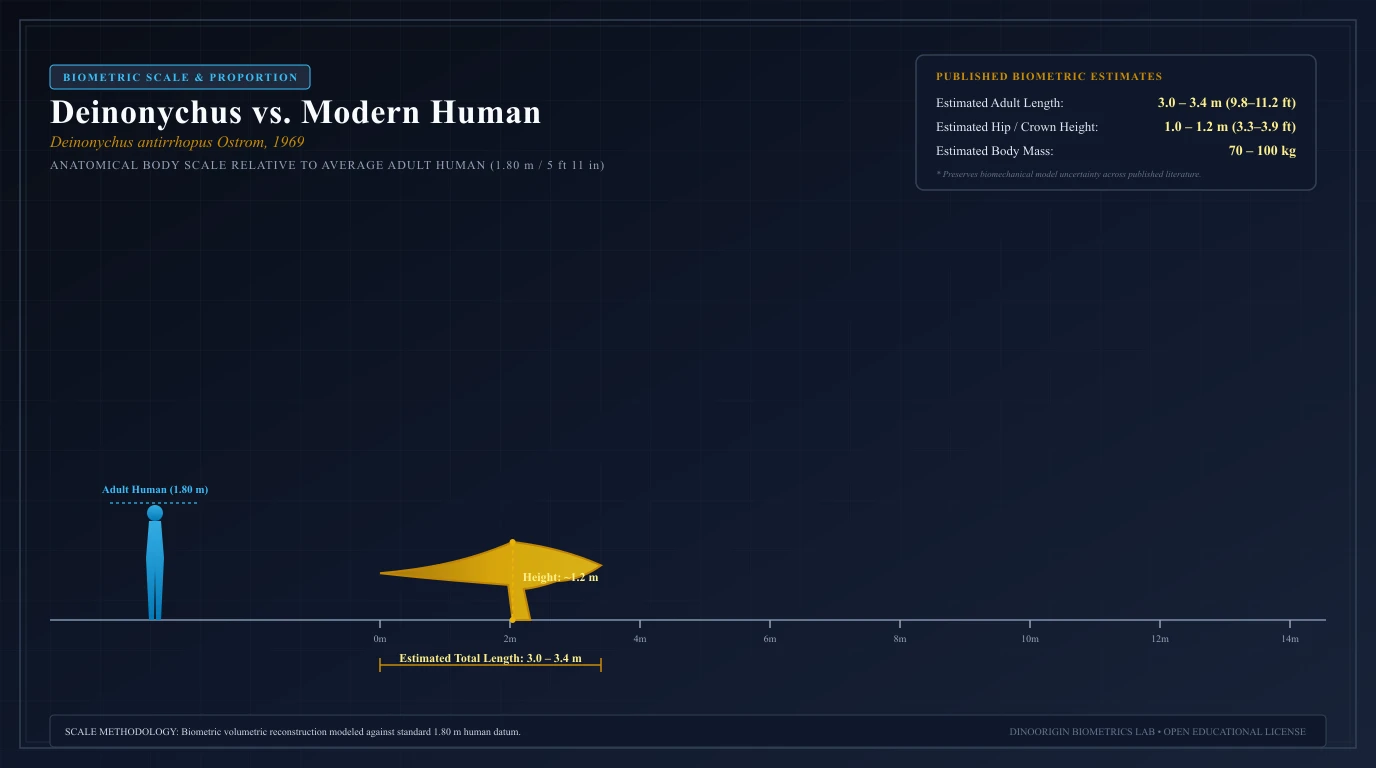
Anatomical dimensions relative to an average adult human (1.8 m / 6 ft tall)

Comparative size scale of Deinonychus relative to a 1.8-meter adult human, illustrating an estimated length of 3.0–3.4 m and height of 1.0–1.2 m (preserving model uncertainty).
Medium-sized ornithopods (Tenontosaurus tilletti), small lizards, and early mammals.
Agile predatory dromaeosaurid armed with large sickle-shaped second pes claws used to grip struggling prey. In the Cloverly Formation, multiple Deinonychus skeletons are preserved in direct association with large carcasses of the ornithopod Tenontosaurus, while coexisting with apex allosauroids like Acrocanthosaurus.
Subtropical to temperate river valleys, floodplain forests, and coastal marshes of the Cloverly Formation.
Multiple articulated individuals found associated with Tenontosaurus skeletons (YPM 5205 holotype).

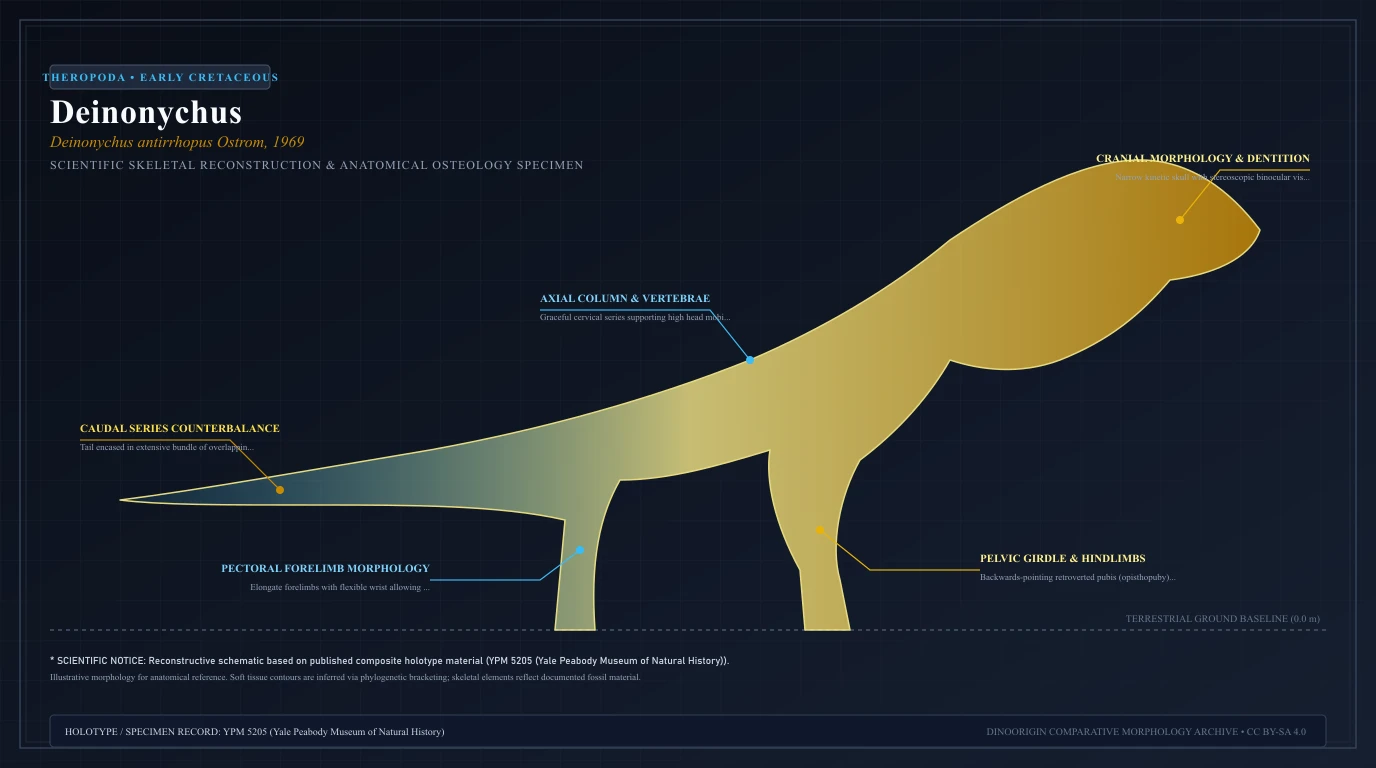
Anatomical skeletal reconstruction of Deinonychus (Deinonychus antirrhopus Ostrom, 1969) illustrating cranial fenestrae, vertebral column, and appendicular proportions based on composite fossil material.
Discovered by John Ostrom; Ostrom's 1969 monograph triggered the famous Dinosaur Renaissance.
The longest and final period of the Mesozoic Era, characterized by the rise of flowering plants, ceratopsians, hadrosaurs, tyrannosaurids, and concluding with the Chicxulub asteroid impact.
During the Mesozoic Era, continental drift progressively reconfigured land bridges, atmospheric currents, and regional precipitation regimes. Fossils of Deinonychus evidence its adaptation to the paleoenvironments of North America.
Home to the fossil-rich Morrison Formation of the Late Jurassic and the Hell Creek and Dinosaur Park Formations of the Late Cretaceous.
The anatomical architecture of Deinonychus serves as a crucial benchmark in vertebrate paleontology, illustrating key adaptive radiations within Theropoda.
Scientifically verified answers based on peer-reviewed paleontological evidence.
Deinonychus lived during the Cretaceous Period Period, approximately 115–108 Ma (million years ago). This places it within the Mesozoic Era.
Paleontological estimates place Deinonychus at a length of 3–3.4 m (9.8–11.2 ft), a hip/standing height of 1–1.2 m (3.3–3.9 ft), and a body mass of 70–100 kg (154–220 lbs).
Classified as a carnivore, Deinonychus specialized in consuming Medium-sized ornithopods (Tenontosaurus tilletti), small lizards, and early mammals..
Fossil specimens of Deinonychus have been recovered from Cloverly Formation, Montana, United States, with notable historic specimens documented in 1964. Discovered by John Ostrom; Ostrom's 1969 monograph triggered the famous Dinosaur Renaissance.
Authoritative citations establishing the factual taxonomy, biometrics, and anatomy of Deinonychus.
Ostrom, J. H. (1969). Osteology of Deinonychus antirrhopus, an unusual theropod from the Lower Cretaceous of Montana. Peabody Museum of Natural History Bulletin, 30, 1-165.
Curated & Verified: 2026-09-24Deposited in Mesozoic sedimentary strata preserving skeletal remains, teeth, or trace trackways.
Deinonychus provides critical insights into the evolutionary radiation of Theropoda. Holotypes and fossil evidence indicate: Multiple articulated individuals found associated with Tenontosaurus skeletons (YPM 5205 holotype).
Roach, B. T., & Brinkman, D. L. (2007). A reevaluation of cooperative pack hunting and gregariousness in Deinonychus antirrhopus and other nonavian theropods. Bulletin of the Peabody Museum of Natural History, 48(1), 103-138. https://doi.org/10.3374/0079-032X(2007)48[103:AROCPH]2.0.CO;2
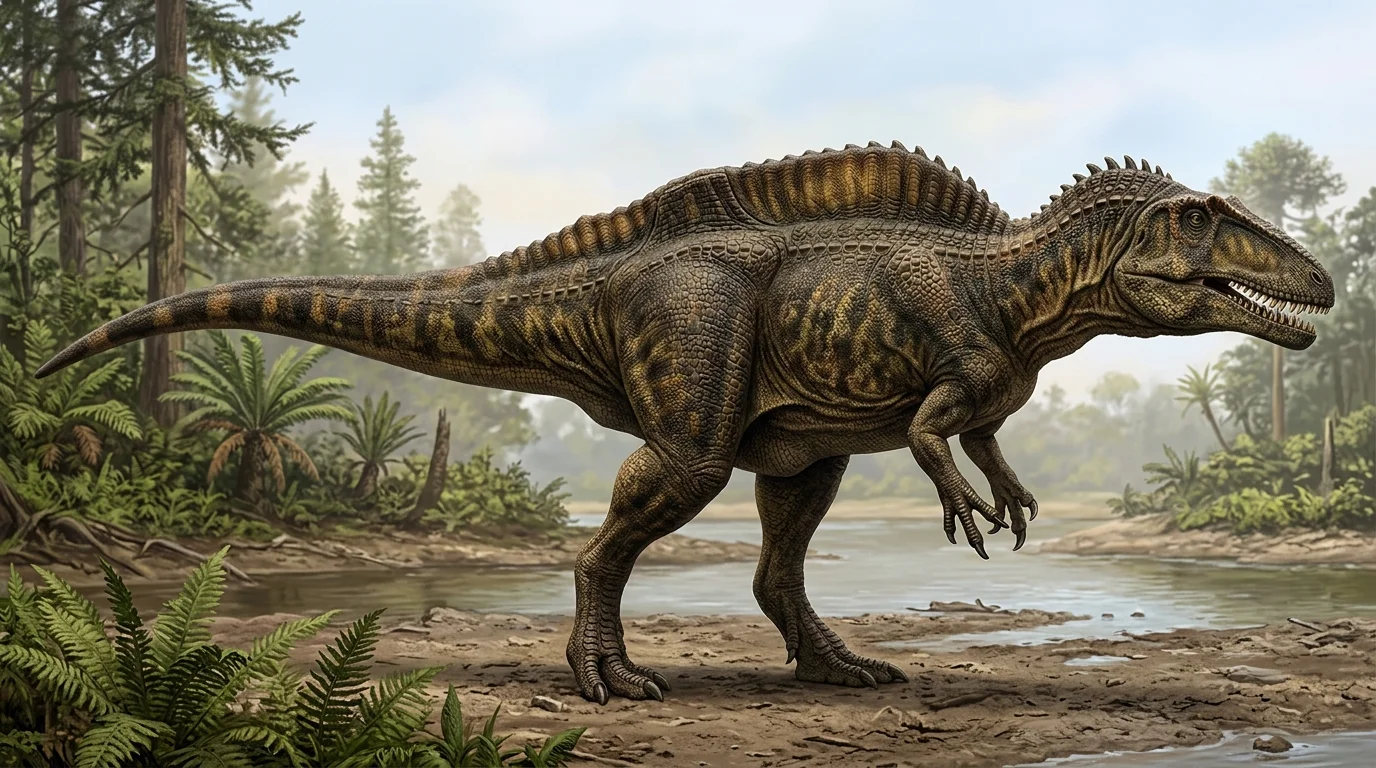
TheropodaAcrocanthosaurus atokensis Stovall & Langston, 1950
A high-spined North American apex predator famous for hunting sauropods across Early Cretaceous river valleys.
TheropodaAlbertosaurus sarcophagus Osborn, 1905
A fleet-footed, gracile tyrannosaurid from the Late Cretaceous of western Canada known from prominent multi-individual bonebed associations.
TheropodaAnzu wyliei Lamanna et al., 2014
The 'Chicken from Hell', a gigantic, crested caenagnathid oviraptorosaur from the Hell Creek Formation.