Caudipteryx zoui Ji et al., 1998
A ground-dwelling basal oviraptorosaur from Liaoning, China preserving true vaned feathers and gastroliths.

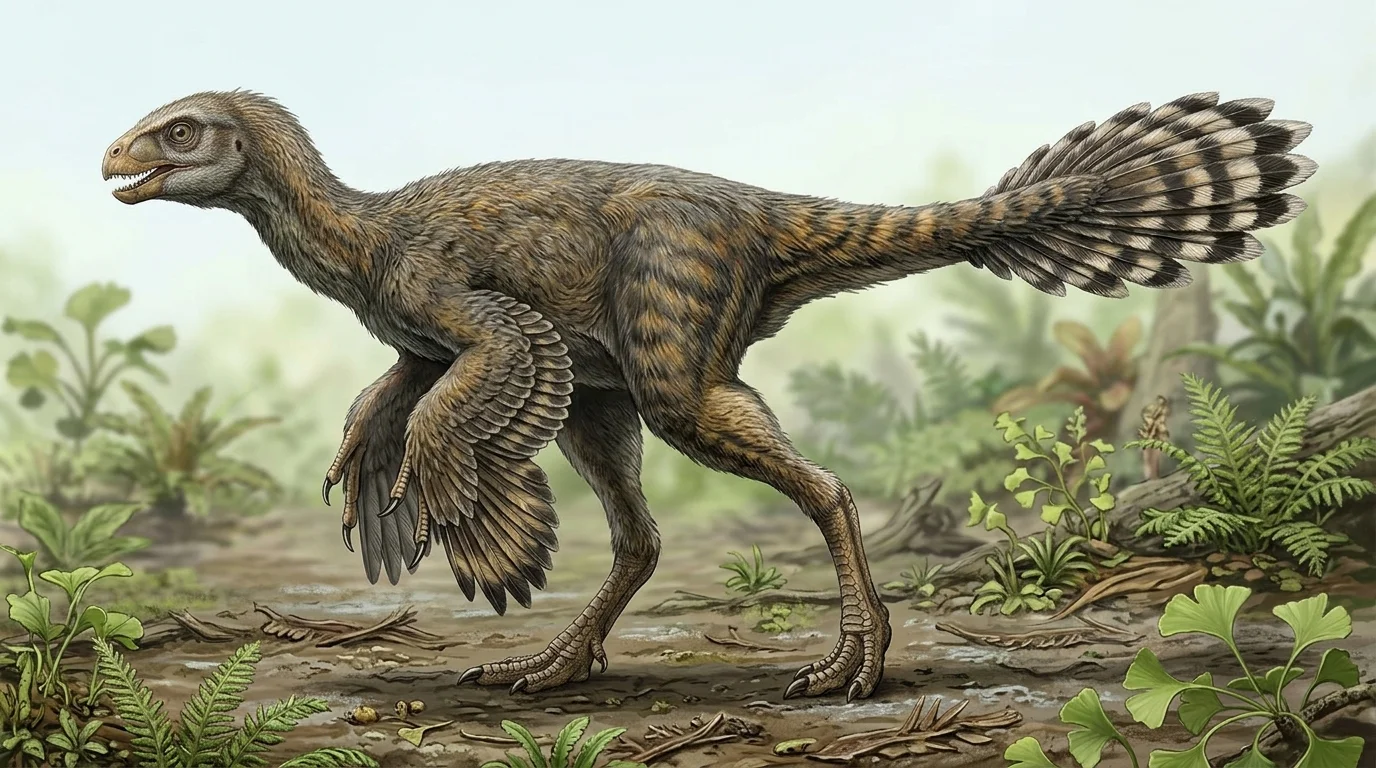
Scientific reconstruction of Caudipteryx (Caudipteryx zoui Ji et al., 1998) in its native Geological period: Cretaceous Period.
Image Credit: AI-generated scientific paleoart reconstruction synthesized from species-specific osteological profiles and peer-reviewed descriptions. (AI-Generated / Open Educational Media (DinoOrigin Spec))
Phylogenetic classification of Caudipteryx zoui Ji et al., 1998 based on peer-reviewed cladistic analyses of diagnostic skeletal synapomorphies.
| Taxonomic Rank | Taxon / Clade | Diagnostic Context |
|---|---|---|
| Kingdom | Animalia | Monophyletic prehistoric clade |
| Phylum | Chordata | Monophyletic prehistoric clade |
| Clade | Dinosauria | Monophyletic prehistoric clade |
| Order | Saurischia (Lizard-Hipped Dinosaurs) | Characterized ancestrally by a triradiate pelvis with an anteriorly pointing pubis. |
| Suborder | Theropoda | Bipedal saurischian dinosaurs, historically dominated by carnivores and including the avian lineage. |
| Genus | Caudipteryx | Monophyletic prehistoric clade |
| Species | Caudipteryx zoui Ji et al., 1998 | Specific authority designation |
Caudipteryx ('tail feather') was a ground-breaking discovery in the late 1990s that confirmed true symmetrical, vaned pennaceous feathers were present on non-avian dinosaurs incapable of flight. Measuring around one meter long, it bore a prominent fan of feathers on the end of its short tail and long wings.
Inside its abdominal cavity, paleontologists found a gizzard filled with rounded gastrolith stones, proving it used stomach stones to grind tough plant matter.
Small biped with a short boxy skull, toothless lower jaw, winged forelimbs, and a conspicuous tail plumage fan.
Anatomical dimensions relative to an average adult human (1.8 m / 6 ft tall)
Seeds, shoots, and small invertebrates ground in an internal gastrolith gizzard.
Fast-running ground-dwelling omnivore utilizing gastroliths in its gizzard to grind plant material and seeds. Preserved in the volcanic lacustrine beds of the Jehol Biota, Caudipteryx coexisted alongside other feathered maniraptorans including Sinornithosaurus and four-winged Microraptor.
Temperate conifer-dominated woodlands and volcanic lakeshore floodplains.
Multiple complete articulated skeletons with preserved pennaceous feathers and gizzard gastroliths.
Described by Ji Qiang, Philip Currie, Mark Norell, and Ji Shu'an in 1998.
The longest and final period of the Mesozoic Era, characterized by the rise of flowering plants, ceratopsians, hadrosaurs, tyrannosaurids, and concluding with the Chicxulub asteroid impact.
During the Mesozoic Era, continental drift progressively reconfigured land bridges, atmospheric currents, and regional precipitation regimes. Fossils of Caudipteryx evidence its adaptation to the paleoenvironments of Asia.
Renowned for the exceptionally preserved feathered dinosaurs of Liaoning, China and the Cretaceous dune habitats of the Gobi Desert in Mongolia.
The anatomical architecture of Caudipteryx serves as a crucial benchmark in vertebrate paleontology, illustrating key adaptive radiations within Theropoda.
Scientifically verified answers based on peer-reviewed paleontological evidence.
Caudipteryx lived during the Cretaceous Period Period, approximately 125–124 Ma (million years ago). This places it within the Mesozoic Era.
Paleontological estimates place Caudipteryx at a length of 0.8–1 m (2.6–3.3 ft), a hip/standing height of 0.45–0.55 m (1.5–1.8 ft), and a body mass of 3–5 kg (7–11 lbs).
Classified as a omnivore, Caudipteryx specialized in consuming Seeds, shoots, and small invertebrates ground in an internal gastrolith gizzard..
Fossil specimens of Caudipteryx have been recovered from Yixian Formation, Sihetun, Liaoning, China, with notable historic specimens documented in 1997. Described by Ji Qiang, Philip Currie, Mark Norell, and Ji Shu'an in 1998.
Authoritative citations establishing the factual taxonomy, biometrics, and anatomy of Caudipteryx.
Ji, Q., Currie, P. J., Norell, M. A., & Ji, S.-A. (1998). Two feathered dinosaurs from northeastern China. Nature, 393(6687), 753-761. https://doi.org/10.1038/31635
Curated & Verified: 2026-09-24Deposited in Mesozoic sedimentary strata preserving skeletal remains, teeth, or trace trackways.
Caudipteryx provides critical insights into the evolutionary radiation of Theropoda. Holotypes and fossil evidence indicate: Multiple complete articulated skeletons with preserved pennaceous feathers and gizzard gastroliths.
TheropodaAcrocanthosaurus atokensis Stovall & Langston, 1950
A high-spined North American apex predator famous for hunting sauropods across Early Cretaceous river valleys.
TheropodaAlbertosaurus sarcophagus Osborn, 1905
A fleet-footed, gracile tyrannosaurid from the Late Cretaceous of western Canada known from prominent multi-individual bonebed associations.
TheropodaAnzu wyliei Lamanna et al., 2014
The 'Chicken from Hell', a gigantic, crested caenagnathid oviraptorosaur from the Hell Creek Formation.