Bipedal saurischian dinosaurs, historically dominated by carnivores and including the avian lineage.
Genus
Coelophysis
Monophyletic prehistoric clade
Species
Coelophysis bauri Cope, 1887
Specific authority designation
Anatomy & Physical Characteristics
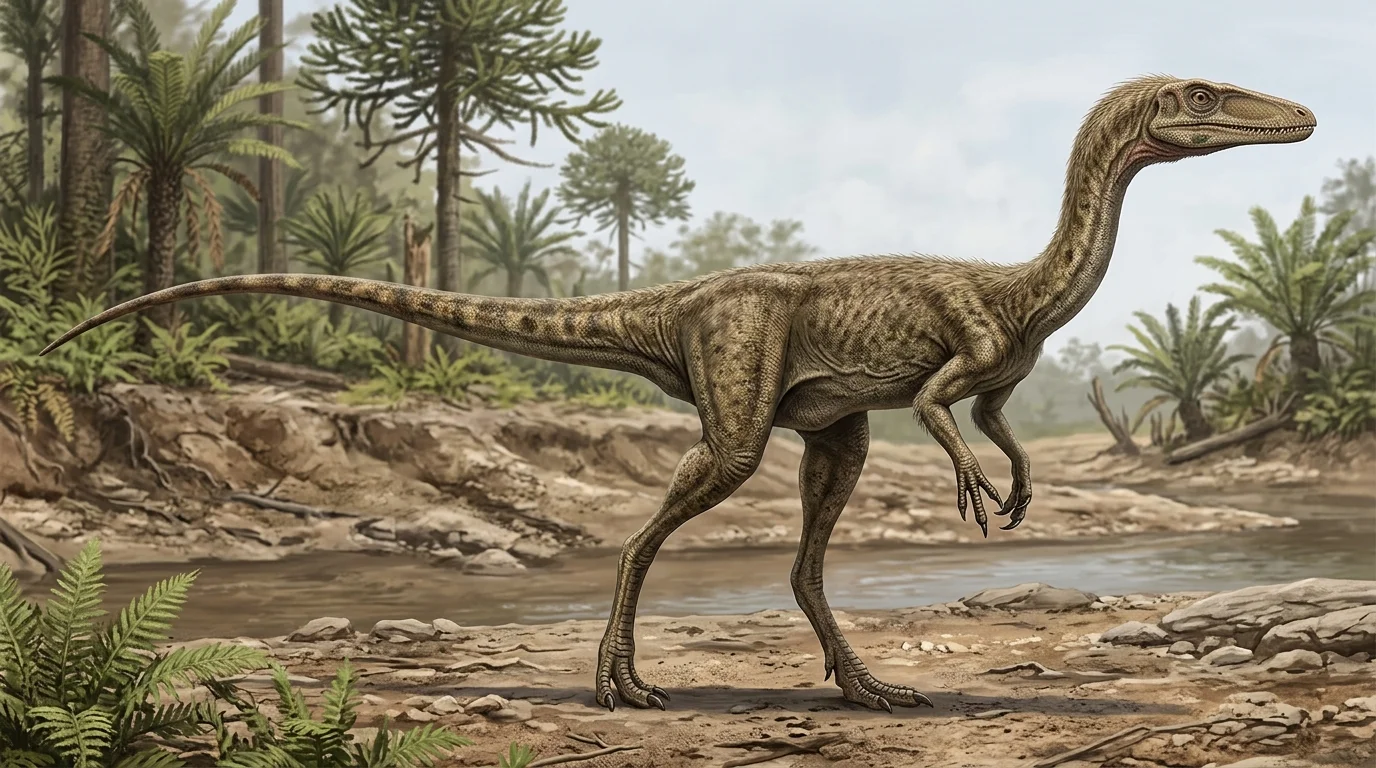
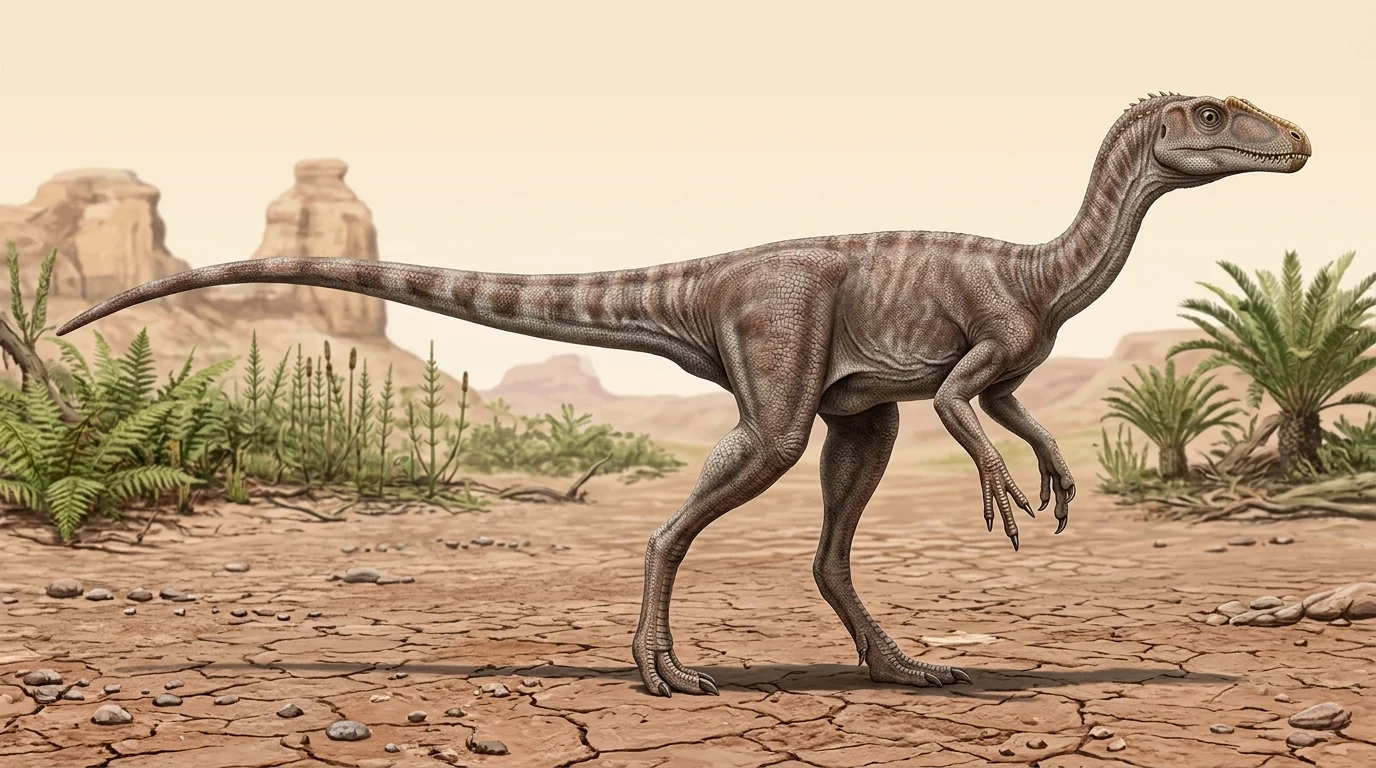
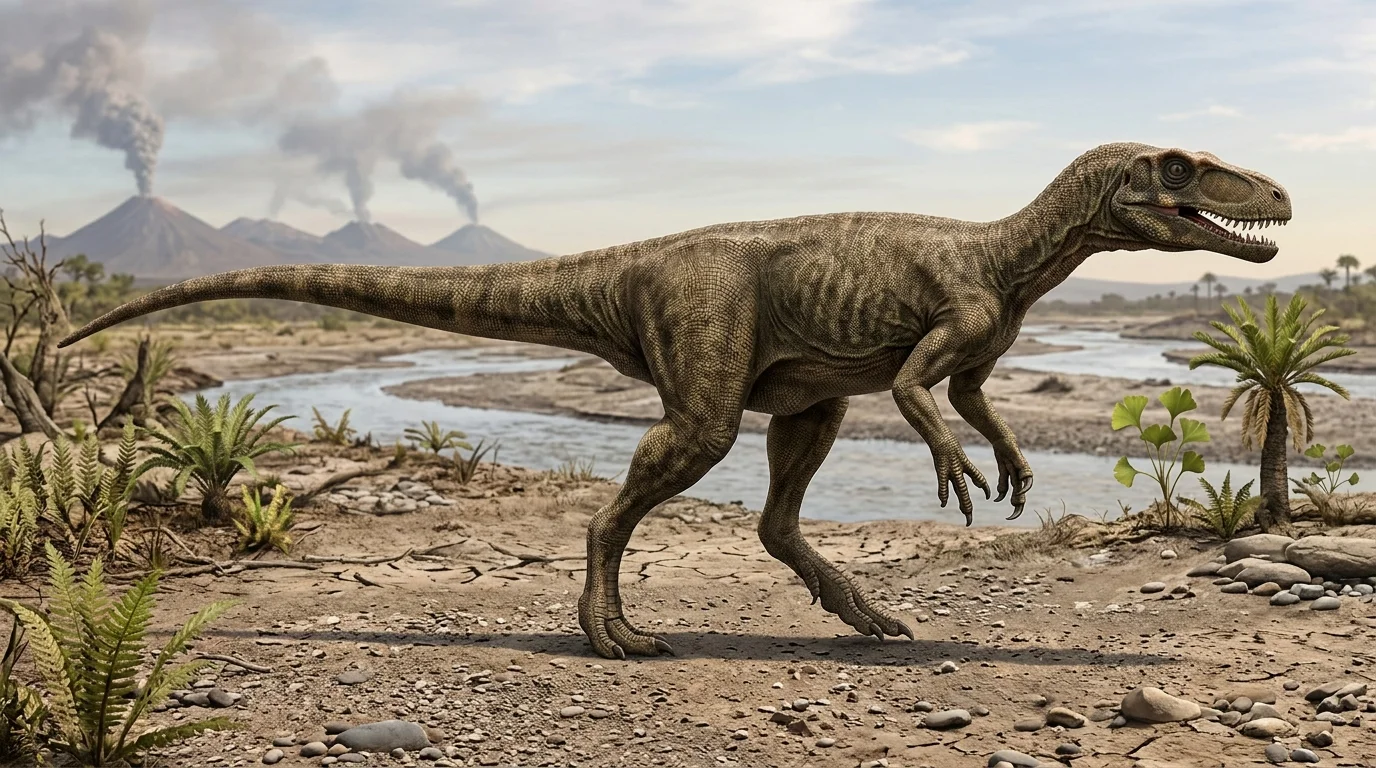
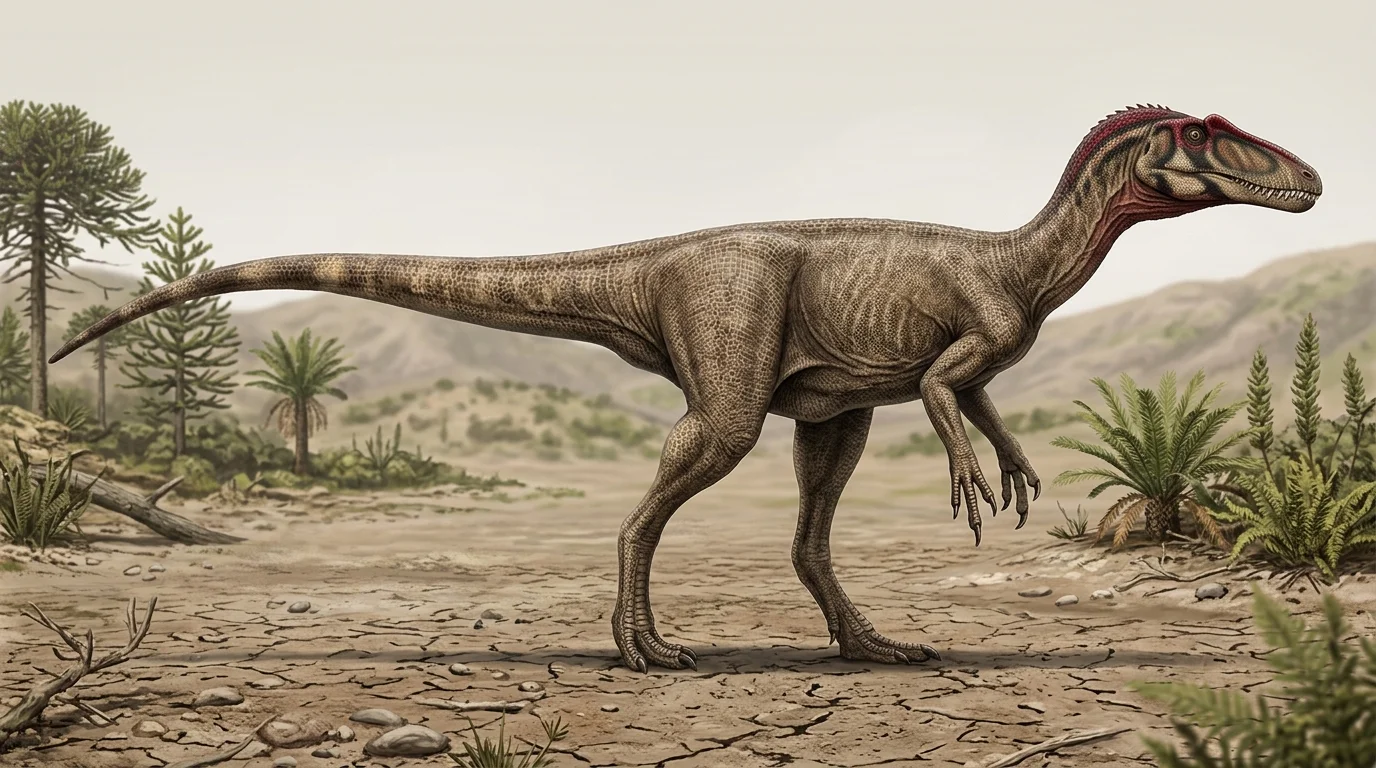
Coelophysis is one of the earliest and best-understood theropod dinosaurs. Characterized by its light, hollow-boned frame and elongated skull, it was an agile pursuit predator capable of rapid turns and high burst speeds.
Fossils discovered in immense concentrations at the Chinle Formation's Ghost Ranch bonebed indicate that Coelophysis may have gathered in gregarious groups or suffered mass mortality during severe flash flood events. Early hypotheses of cannibalism were later disproven when suspected juvenile bones in adult abdominal cavities were identified as small crocodylomorphs (Hesperosuchus).
Diagnostic Morphological Traits
Slender biped with a long s-curved neck, narrow pointed snouts, and narrow grasping forelimbs with three functional clawed digits.
Comparative Scale & Biometrics
Anatomical dimensions relative to an average adult human (1.8 m / 6 ft tall)
Small vertebrates, early synapsids, and insects, gripped with slender curved, blade-like serrated teeth.
Paleobiology & Behavior
Highly gregarious small theropod that hunted small reptiles and invertebrates in pack or flock arrangements. Known from hundreds of articulated skeletons at Ghost Ranch, Coelophysis shared its Late Triassic Chinle habitat with early basal saurischians such as Chindesaurus.
Habitat & Ecological Biome
Prehistoric Depositional Setting
Semi-arid seasonal river basins and open conifer woodlands.
Fossil Evidence & Specimen Records
Preserved Skeletal Material & Bonebeds
Hundreds of complete articulated skeletons excavated from the Ghost Ranch quarry in 1947.
Discovery & Taxonomic Naming History
Year of Discovery / Description1881
Type Specimen Locality & FormationChinle Formation, New Mexico, United States
Initially identified by David Baldwin and described by paleontologist Edward Drinker Cope in 1887.
Triassic Period PeriodTemporal Interval: 228–201.3 Ma (million years ago)
The dawn of the Mesozoic Era. Dinosaurs first emerged in the Late Triassic following the catastrophic Permian-Triassic extinction event, initially occupying modest niches alongside crurotarsan archosaurs.
During the Mesozoic Era, continental drift progressively reconfigured land bridges, atmospheric currents, and regional precipitation regimes. Fossils of Coelophysis evidence its adaptation to the paleoenvironments of North America.
Paleogeographic RealmNorth America (North America)
Home to the fossil-rich Morrison Formation of the Late Jurassic and the Hell Creek and Dinosaur Park Formations of the Late Cretaceous.
Fossil Discovery Locality
Scientific Significance & Evolutionary Impact
The anatomical architecture of Coelophysis serves as a crucial benchmark in vertebrate paleontology, illustrating key adaptive radiations within Theropoda.
Phylogenetic Placement: Informs cladistic debates concerning the divergence, skull biomechanics, and skeletal evolution of Triassic Period fauna.
Paleoecological Guild: Documents trophic specialization (Carnivore) and predator-prey dynamics across its regional ecosystem.
Taphonomic Record: Hundreds of complete articulated skeletons excavated from the Ghost Ranch quarry in 1947.
Frequently Asked Questions About Coelophysis
Scientifically verified answers based on peer-reviewed paleontological evidence.
Q1.When did Coelophysis live?
Coelophysis lived during the Triassic Period Period, approximately 228–201.3 Ma (million years ago). This places it within the Mesozoic Era.
Q2.How big was Coelophysis?
Paleontological estimates place Coelophysis at a length of 2.5–3 m (8.2–9.8 ft), a hip/standing height of 0.8–1 m (2.6–3.3 ft), and a body mass of 15–25 kg (33–55 lbs).
Q3.What was the diet of Coelophysis?
Classified as a carnivore, Coelophysis specialized in consuming Small vertebrates, early synapsids, and insects, gripped with slender curved, blade-like serrated teeth..
Q4.Where were Coelophysis fossils discovered?
Fossil specimens of Coelophysis have been recovered from Chinle Formation, New Mexico, United States, with notable historic specimens documented in 1881. Initially identified by David Baldwin and described by paleontologist Edward Drinker Cope in 1887.
Academic Literature & Peer-Reviewed References
Authoritative citations establishing the factual taxonomy, biometrics, and anatomy of Coelophysis.
Deposited in Mesozoic sedimentary strata preserving skeletal remains, teeth, or trace trackways.
Q5.What makes Coelophysis scientifically significant?
Coelophysis provides critical insights into the evolutionary radiation of Theropoda. Holotypes and fossil evidence indicate: Hundreds of complete articulated skeletons excavated from the Ghost Ranch quarry in 1947.
Cope, E. D. (1887). The dinosaurian genus Coelurus. The American Naturalist, 21(4), 367-369. https://doi.org/10.1086/274465
An early predatory dinosaur from the Late Triassic Ischigualasto Formation of Argentina whose precise phylogenetic position near the root of Saurischia remains debated.