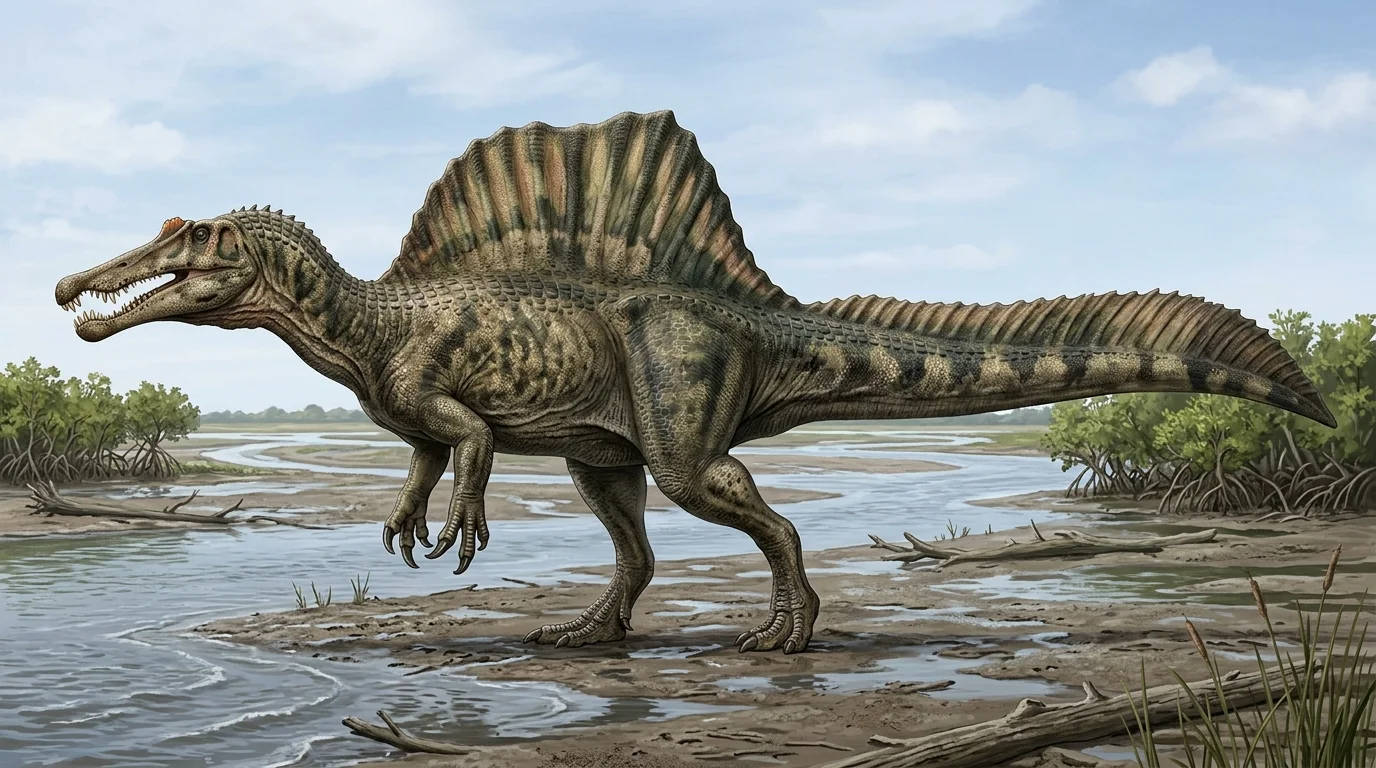
Spinosaurus aegyptiacus Stromer, 1915
A giant sail-backed theropod possessing anatomical specializations associated with riparian ecosystems, with its aquatic locomotion subject to ongoing scientific debate.

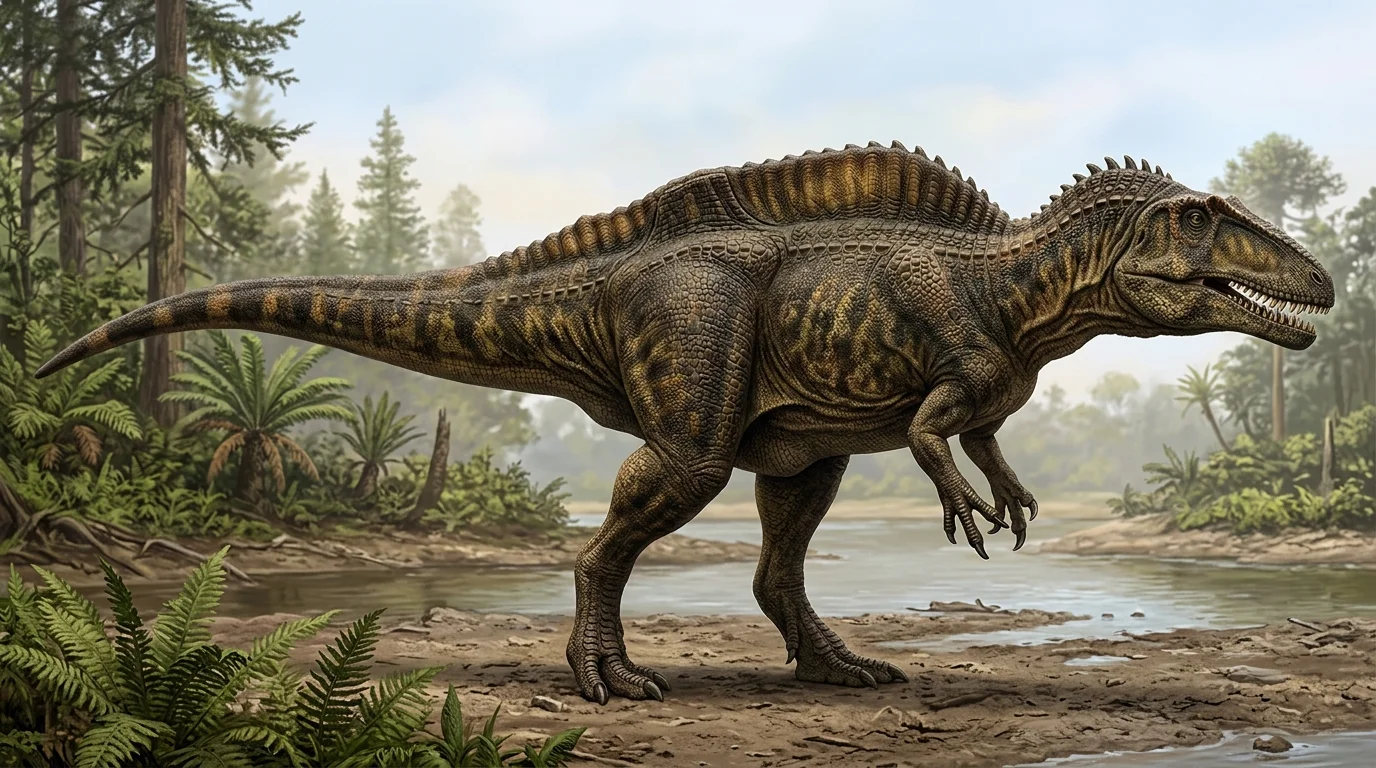
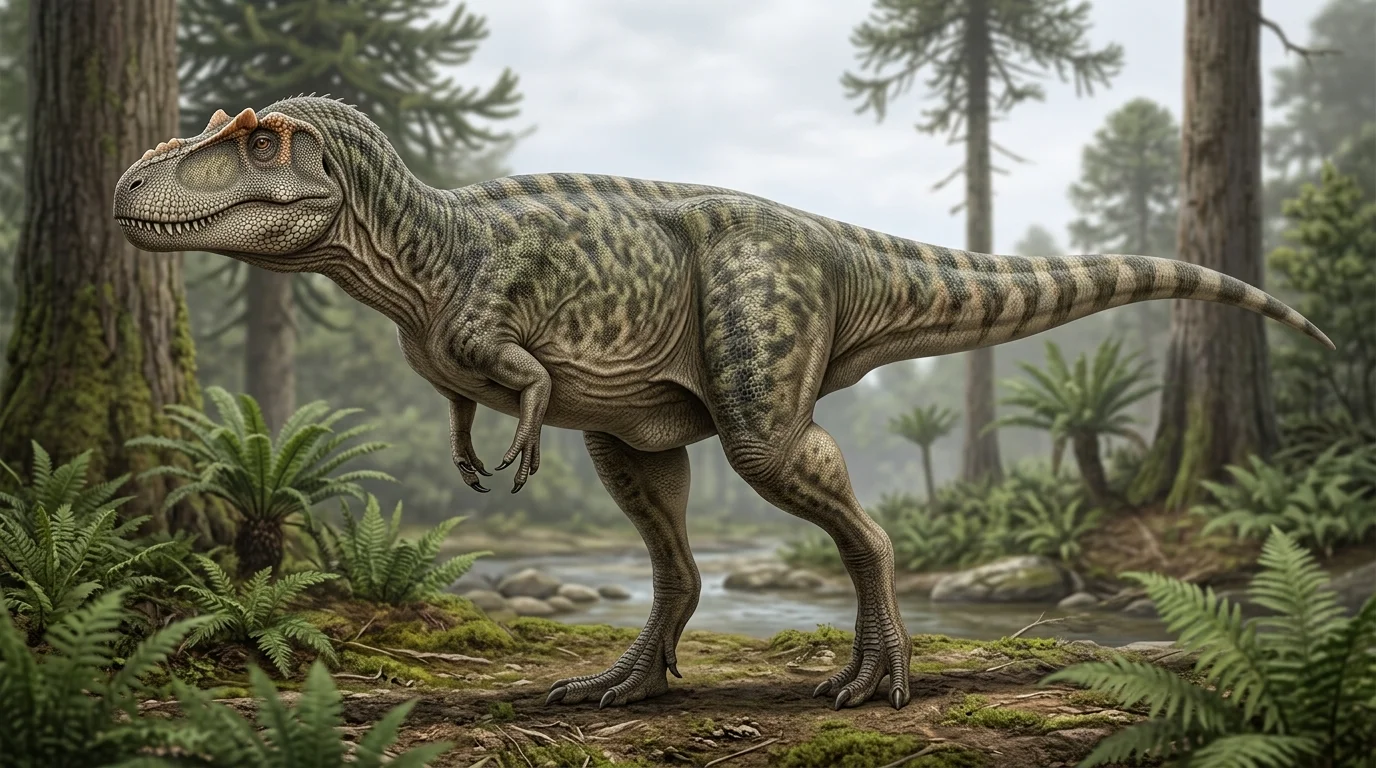
Scientific reconstruction of Spinosaurus (Spinosaurus aegyptiacus Stromer, 1915) in its native Geological period: Cretaceous Period.
Image Credit: AI-generated scientific paleoart reconstruction synthesized from species-specific osteological profiles and peer-reviewed descriptions. (AI-Generated / Open Educational Media (DinoOrigin Spec))
Phylogenetic classification of Spinosaurus aegyptiacus Stromer, 1915 based on peer-reviewed cladistic analyses of diagnostic skeletal synapomorphies.
| Taxonomic Rank | Taxon / Clade | Diagnostic Context |
|---|---|---|
| Kingdom | Animalia | Monophyletic prehistoric clade |
| Phylum | Chordata | Monophyletic prehistoric clade |
| Clade | Dinosauria | Monophyletic prehistoric clade |
| Order | Saurischia (Lizard-Hipped Dinosaurs) | Characterized ancestrally by a triradiate pelvis with an anteriorly pointing pubis. |
| Suborder | Theropoda | Bipedal saurischian dinosaurs, historically dominated by carnivores and including the avian lineage. |
| Genus | Spinosaurus | Monophyletic prehistoric clade |
| Species | Spinosaurus aegyptiacus Stromer, 1915 | Specific authority designation |
Spinosaurus aegyptiacus is among the longest known carnivorous theropods, reaching estimated lengths of 14 meters. Inhabiting the river delta and mangrove wetlands of North Africa during the Cretaceous Period (~99 to 93.5 million years ago), Spinosaurus possessed distinct semi-aquatic anatomical adaptations within Theropoda. These include retracted external nares (nostrils positioned high on the rostrum), conical unserrated teeth suited for seizing slippery aquatic prey, and tall vertebral neural spines forming a dorsal sail.
Locomotion and Biomechanics: Locomotion and propulsion in Spinosaurus remain the subject of competing scientific interpretations. Discoveries of a paddle-like tail supported by elongated neural and haemal spines led to hydrodynamic models proposing subaqueous pursuit swimming. Conversely, subsequent biomechanical modeling, center-of-mass simulations, and buoyancy analyses argue that Spinosaurus had limited submergence control, reconstructing it as a shoreline wader or ambush predator that navigated shallow margins with deliberate, slow terrestrial locomotion.
Scientific Significance: Spinosaurus challenges traditional models of theropod ecology by documenting how non-avian dinosaurs adapted to coastal and riparian paleoenvironments. Furthermore, its osteology exhibits pachyosteosclerosis (bony densification that provides ballast), demonstrating convergent physiological evolution with modern semi-aquatic mammals and reptiles.
Extremely long-snouted theropod with a dorsal neural sail standing up to 1.6 meters tall, robust forelimbs with recurved manual unguals, and a paddle-like tail.
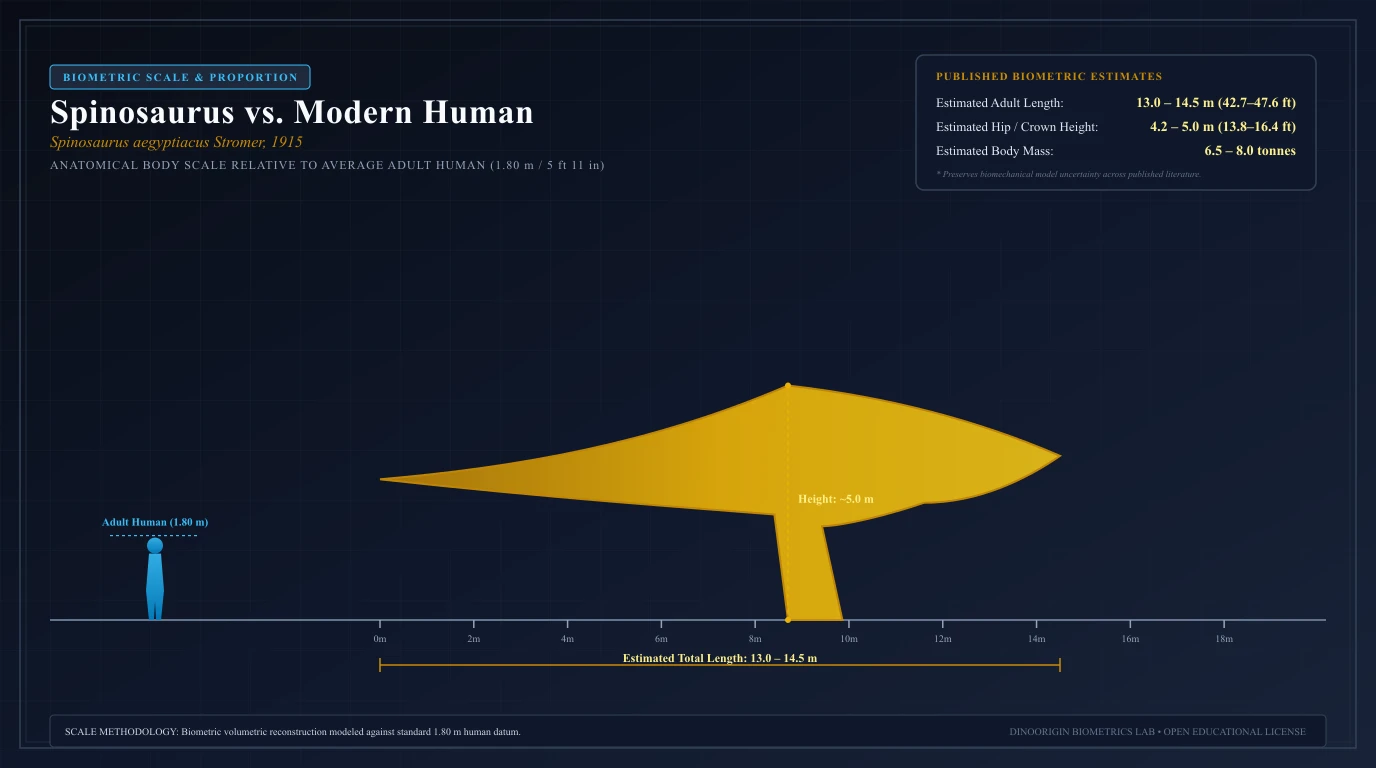
Anatomical dimensions relative to an average adult human (1.8 m / 6 ft tall)
Predominantly large fish (Onchopristis, Mawsonia) supplemented opportunistically by pterosaurs and terrestrial vertebrates.
Dietary and taphonomic evidence indicates Spinosaurus was a specialized aquatic and river-margin predator, consuming giant sarcopterygian fish (such as Onchopristis and mawsoniid coelacanths) alongside terrestrial carcasses. Direct evidence from isolated jaw neurovascular foramina indicates pressure-sensing capabilities analogous to modern crocodylians, used to detect water vibrations. Whether hunting involved active diving or shoreline wading remains actively debated among vertebrate paleontologists.
Tidal flats, mangrove estuaries, and broad braided river channels of the prehistoric Kem Kem and Bahariya basins.
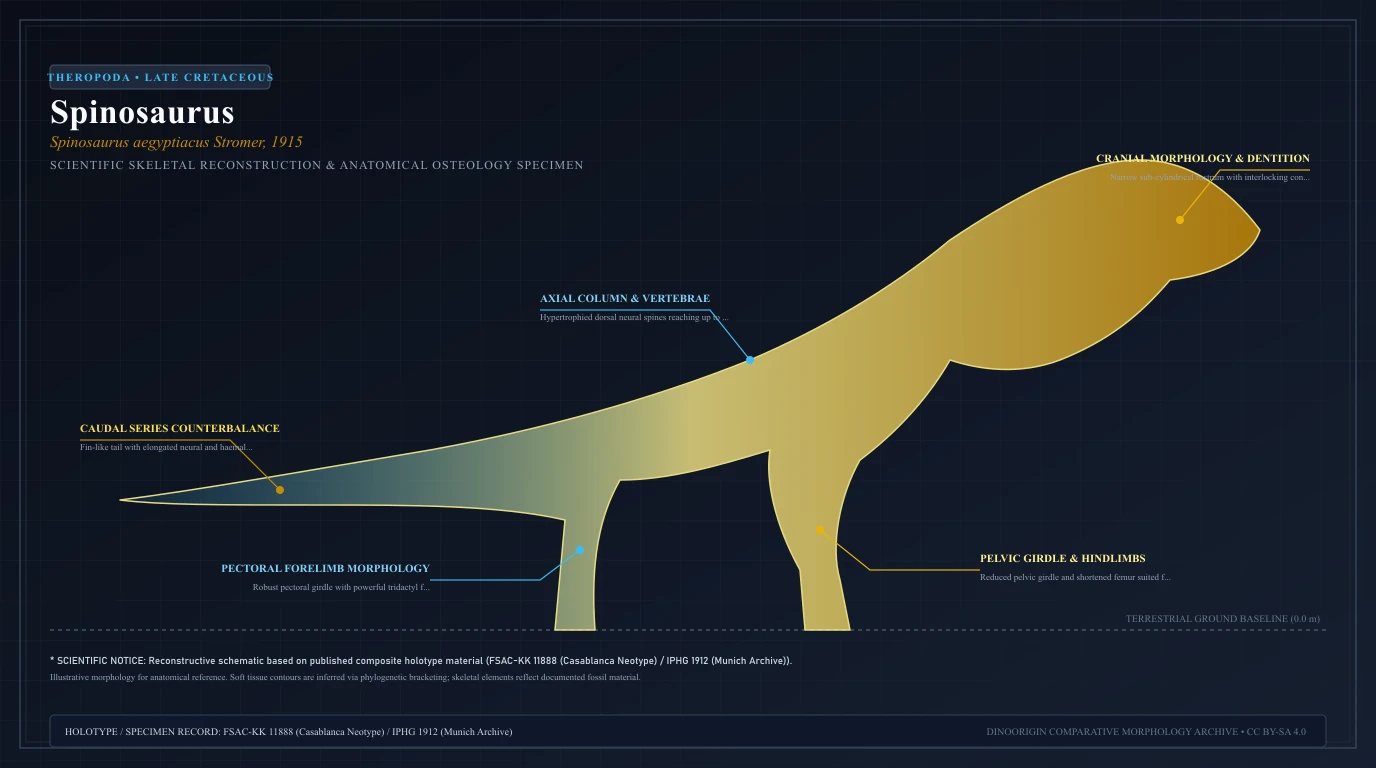
The 1912 Egyptian holotype skeleton described by Ernst Stromer was destroyed by allied bombing in Munich during World War II. Modern understanding relies on newly excavated neotype material and associated partial postcrania (including FSAC-KK 11880 from the Kem Kem Group of Morocco), preserving articulated cranial rostrums, neural spines, pelvic bones, and paddle-like caudal vertebrae.

Anatomical skeletal reconstruction of Spinosaurus (Spinosaurus aegyptiacus Stromer, 1915) illustrating cranial fenestrae, vertebral column, and appendicular proportions based on composite fossil material.
Holotype discovered by Richard Markgraf and described by Ernst Stromer in 1915; destroyed during the bombing of Munich in 1944. Neotype described by Ibrahim et al. in 2014.
The longest and final period of the Mesozoic Era, characterized by the rise of flowering plants, ceratopsians, hadrosaurs, tyrannosaurids, and concluding with the Chicxulub asteroid impact.
During the Mesozoic Era, continental drift progressively reconfigured land bridges, atmospheric currents, and regional precipitation regimes. Fossils of Spinosaurus evidence its adaptation to the paleoenvironments of Africa.
Featuring the Bahariya and Kem Kem deltaic systems of North Africa, home to colossal riverine theropods and unique freshwater ecosystems.
The anatomical architecture of Spinosaurus serves as a crucial benchmark in vertebrate paleontology, illustrating key adaptive radiations within Theropoda.
Scientifically verified answers based on peer-reviewed paleontological evidence.
Spinosaurus lived during the Cretaceous Period Period, approximately 99–93.5 Ma (million years ago). This places it within the Mesozoic Era.
Paleontological estimates place Spinosaurus at a length of 13–14.5 m (42.7–47.6 ft), a hip/standing height of 4.2–5 m (13.8–16.4 ft), and a body mass of 6.5–8.0 metric tons (14,330–17,637 lbs).
Classified as a piscivore, Spinosaurus specialized in consuming Predominantly large fish (Onchopristis, Mawsonia) supplemented opportunistically by pterosaurs and terrestrial vertebrates..
Fossil specimens of Spinosaurus have been recovered from Bahariya Oasis, Egypt, with notable historic specimens documented in 1912. Holotype discovered by Richard Markgraf and described by Ernst Stromer in 1915; destroyed during the bombing of Munich in 1944. Neotype described by Ibrahim et al. in 2014.
Authoritative citations establishing the factual taxonomy, biometrics, and anatomy of Spinosaurus.
Ibrahim, N., et al. (2020). Tail-propelled aquatic locomotion in a theropod dinosaur. Nature, 581(7807), 171-174.
Curated & Verified: 2024-07-20
Comparative size scale of Spinosaurus relative to a 1.8-meter adult human, illustrating an estimated length of 13.0–14.5 m and height of 4.2–5.0 m (preserving model uncertainty).
Deposited in Mesozoic sedimentary strata preserving skeletal remains, teeth, or trace trackways.
Spinosaurus provides critical insights into the evolutionary radiation of Theropoda. Holotypes and fossil evidence indicate: The 1912 Egyptian holotype skeleton described by Ernst Stromer was destroyed by allied bombing in Munich during World War II. Modern understanding relies on newly excavated neotype material and associated partial postcrania (including FSAC-KK 11880 from the Kem Kem Group of Morocco), preserving articulated cranial rostrums, neural spines, pelvic bones, and paddle-like caudal vertebrae.
Sereno, P. C., Myhrvold, N. P., Henderson, D. M., et al. (2022). Spinosaurus is not an aquatic dinosaur. eLife, 11, e80092. https://doi.org/10.7554/eLife.80092
Stromer, E. (1915). Ergebnisse der Forschungsreisen Prof. E. Stromers in den Wüsten Ägyptens. II. Wirbeltier-Reste der Baharîje-Stufe (unterstes Cenoman). 3. Das Original des Theropoden Spinosaurus aegyptiacus nov. gen., nov. spec.. Abhandlungen der Königlich Bayerischen Akademie der Wissenschaften, Mathematisch-physikalische Klasse, 28(3), 1-32.
Curated & Verified: 2026-09-24
TheropodaAcrocanthosaurus atokensis Stovall & Langston, 1950
A high-spined North American apex predator famous for hunting sauropods across Early Cretaceous river valleys.
TheropodaAlbertosaurus sarcophagus Osborn, 1905
A fleet-footed, gracile tyrannosaurid from the Late Cretaceous of western Canada known from prominent multi-individual bonebed associations.
TheropodaAnzu wyliei Lamanna et al., 2014
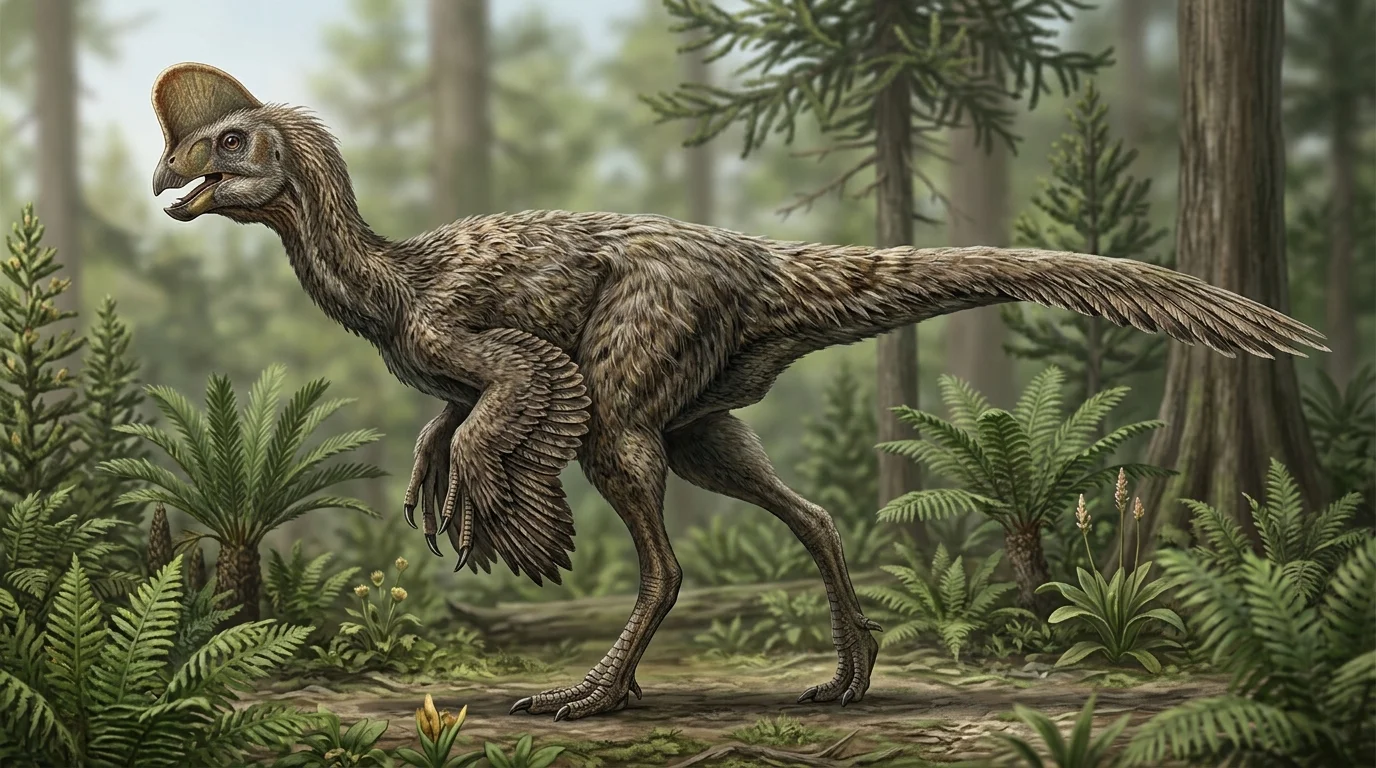
The 'Chicken from Hell', a gigantic, crested caenagnathid oviraptorosaur from the Hell Creek Formation.