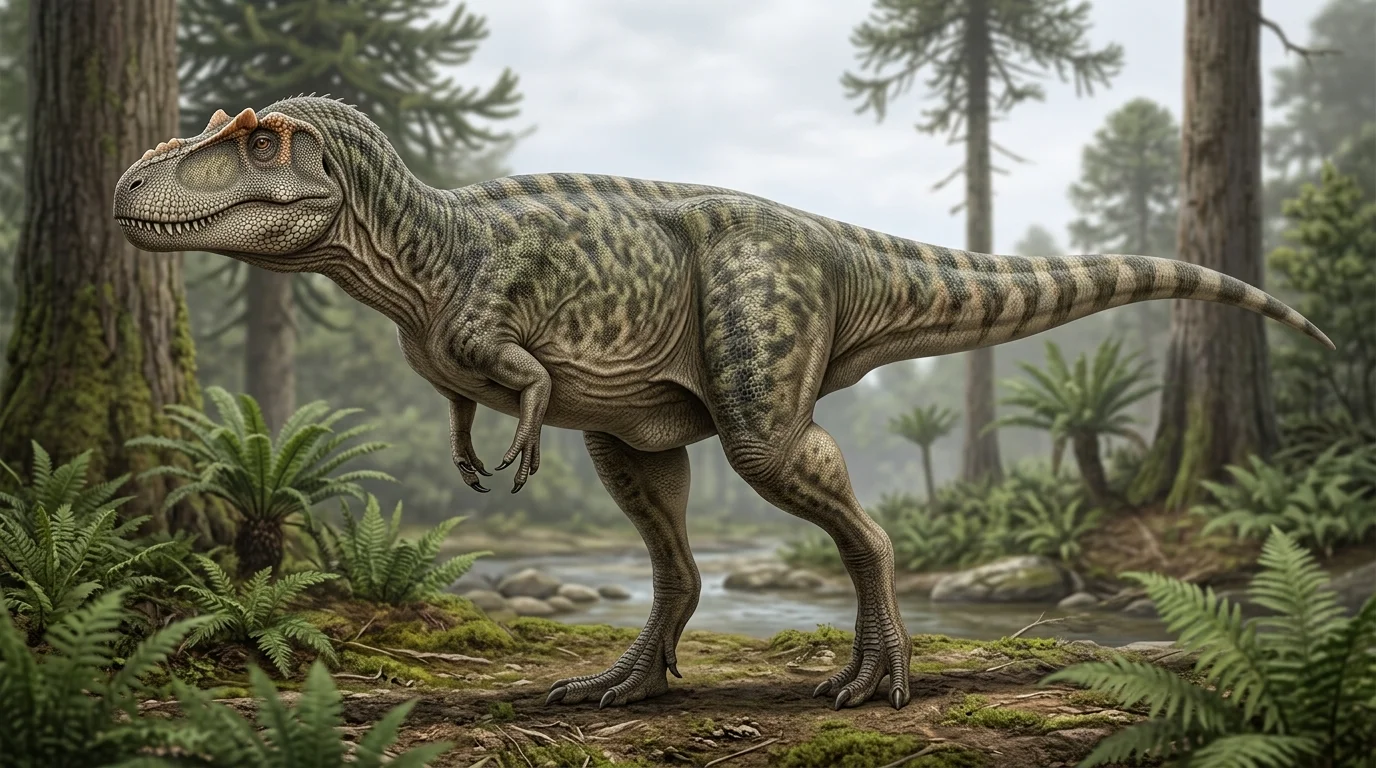
Bipedal saurischian dinosaurs, historically dominated by carnivores and including the avian lineage.
Genus
Tyrannosaurus rex
Monophyletic prehistoric clade
Species
Tyrannosaurus rex Osborn, 1905
Specific authority designation
Anatomy & Physical Characteristics
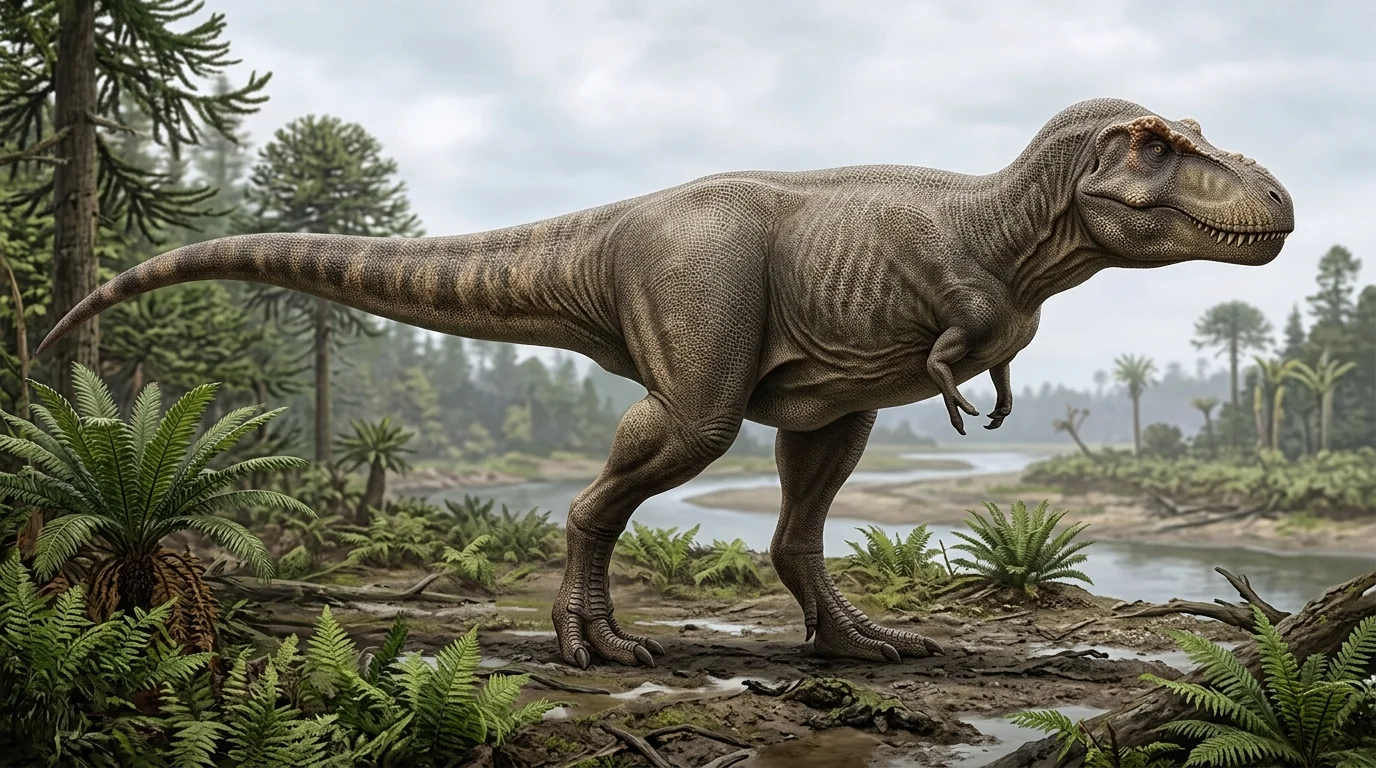
Tyrannosaurus rex is one of the largest and most extensively studied terrestrial carnivores in Earth's history, belonging to the bipedal carnivorous lineage Theropoda. Inhabiting the humid floodplain river basins of western North America during the late Cretaceous Period (~68 to 66 million years ago), T. rex exerted unprecedented jaw forces. Biomechanical multi-body dynamic analysis estimates maximum adult bite forces between 35,000 and 57,000 Newtons, distributed through robust, banana-shaped teeth adapted to crush cortical bone rather than merely slice flesh.
Locomotion and Speed:
Adult locomotion was heavily constrained by skeletal bone loading. Stress-constrained multi-body dynamic models indicate that true running gaits would have imposed unsustainable mechanical stresses on adult leg bones. Biomechanical simulations estimate adult walking and fast-walking speeds were limited to approximately 18–24 km/h (model-dependent), suggesting that adult T. rex pursued prey through sustained power and endurance rather than high-speed sprinting.
Scientific Significance:
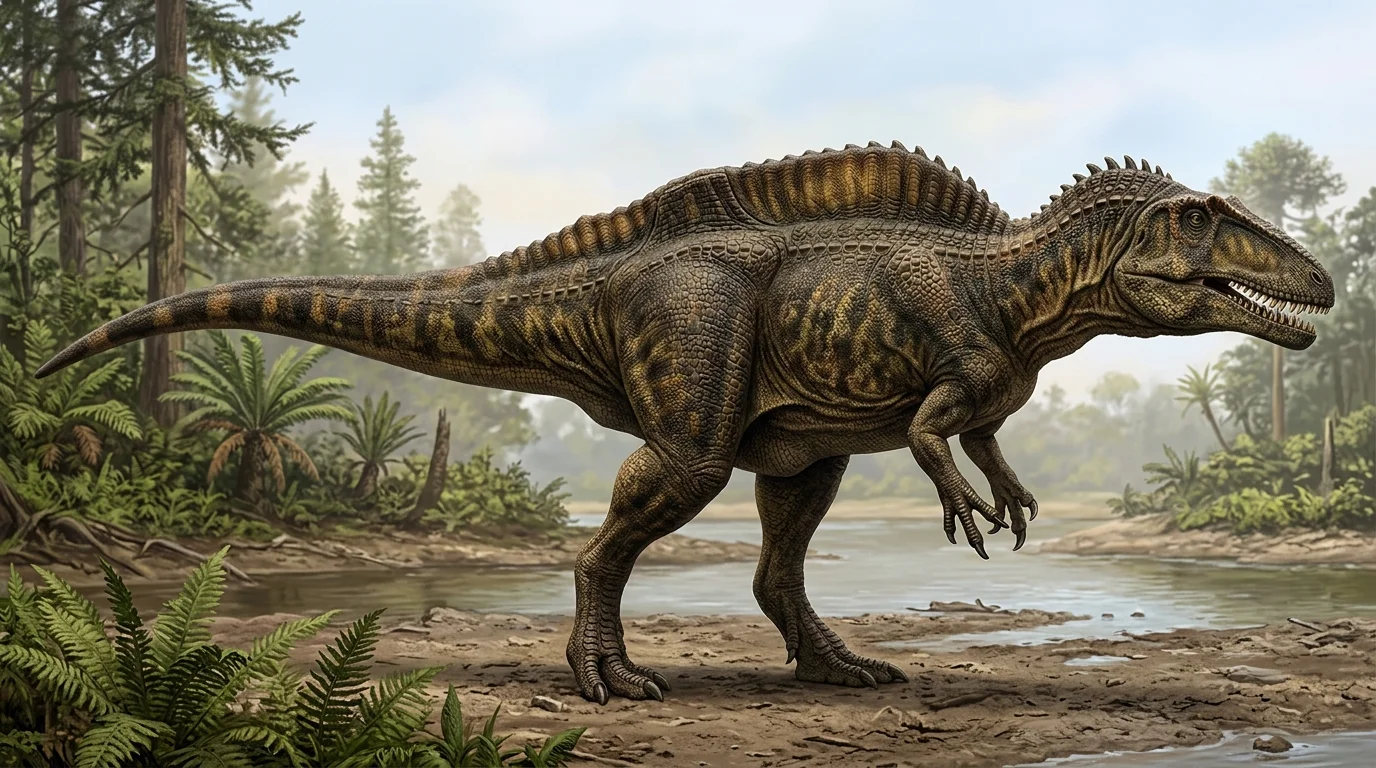
T. rex serves as an anatomical benchmark for apex macropredator evolution, high-resolution ontogenetic studies, and advanced cranial biomechanics. Its fused nasal bones, expanded antorbital fenestra (skull opening in front of the eye socket), and binocular optical centers provide key evidence for sensory specialization in giant theropods. Comparative research continues to explore its evolutionary divergence from contemporary predators, detailed in the T. rex vs Spinosaurus Comparison.
Diagnostic Morphological Traits
Heavily built bipedal theropod with a deep skull exceeding 1.5 meters, prominent brow ridges, robust neck musculature, and counterbalanced by a dense, stiffened tail.
Comparative Scale & Biometrics
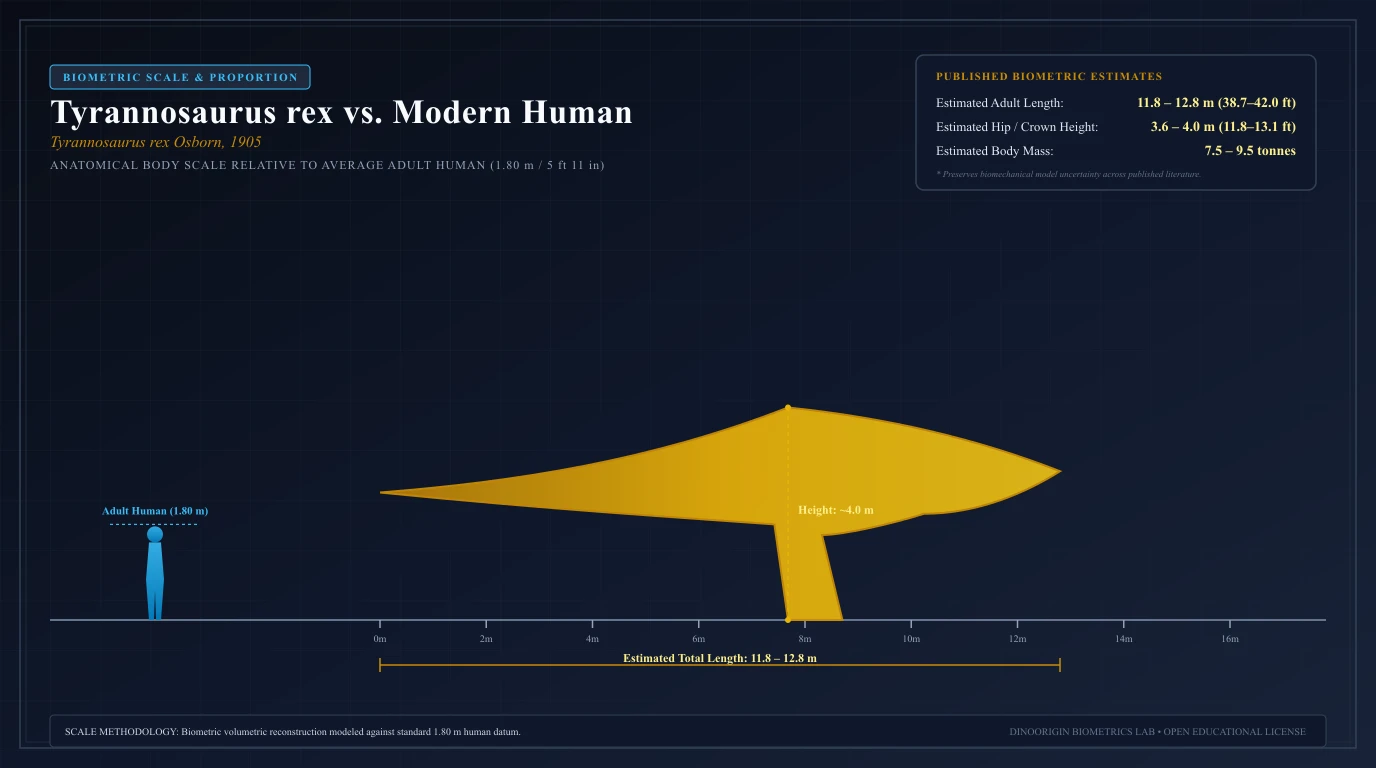
Anatomical dimensions relative to an average adult human (1.8 m / 6 ft tall)
Approx. 7.1× human length
Tyrannosaurus rex (Length)11.8–12.8 m (38.7–42.0 ft)
Exclusively carnivorous. Ingested large herbivorous ornithischians such as Triceratops and Edmontosaurus, pulverizing bone for nutrient-dense marrow.
Paleobiology & Behavior
Direct trace fossil evidence documents active predation and opportunistic scavenging on contemporary herbivorous dinosaurs. Healed puncture wounds matching T. rex dentition have been identified on the caudal vertebrae of Edmontosaurus and the squamosal frill of Triceratops, confirming non-fatal predatory strikes. While multiple-individual bonebeds exist for related tyrannosaurids, evidence for cooperative pack hunting in adult T. rex remains inconclusive, with interpretations varying between gregarious grouping, opportunistic aggregations around carcasses, and solitary territorial behavior.
Habitat & Ecological Biome
Prehistoric Depositional Setting
Lowland coastal floodplains, forested wetlands, and open river valleys with seasonal precipitation.
Fossil Evidence & Specimen Records
Preserved Skeletal Material & Bonebeds
Represented by more than 50 verified specimens across varying ontogenetic stages. These range from Barnum Brown's 1902 holotype (CM 9380) to exceptionally complete, articulated skeletons including FMNH PR 2081 ('Sue', ~90% complete by skeletal element) and RSM P2523.8 ('Scotty'). Isolated teeth, fragmentary skulls, and coprolites containing pulverized bone further enrich the taphonomic record.
Anatomical Osteology & Skeletal Reconstruction
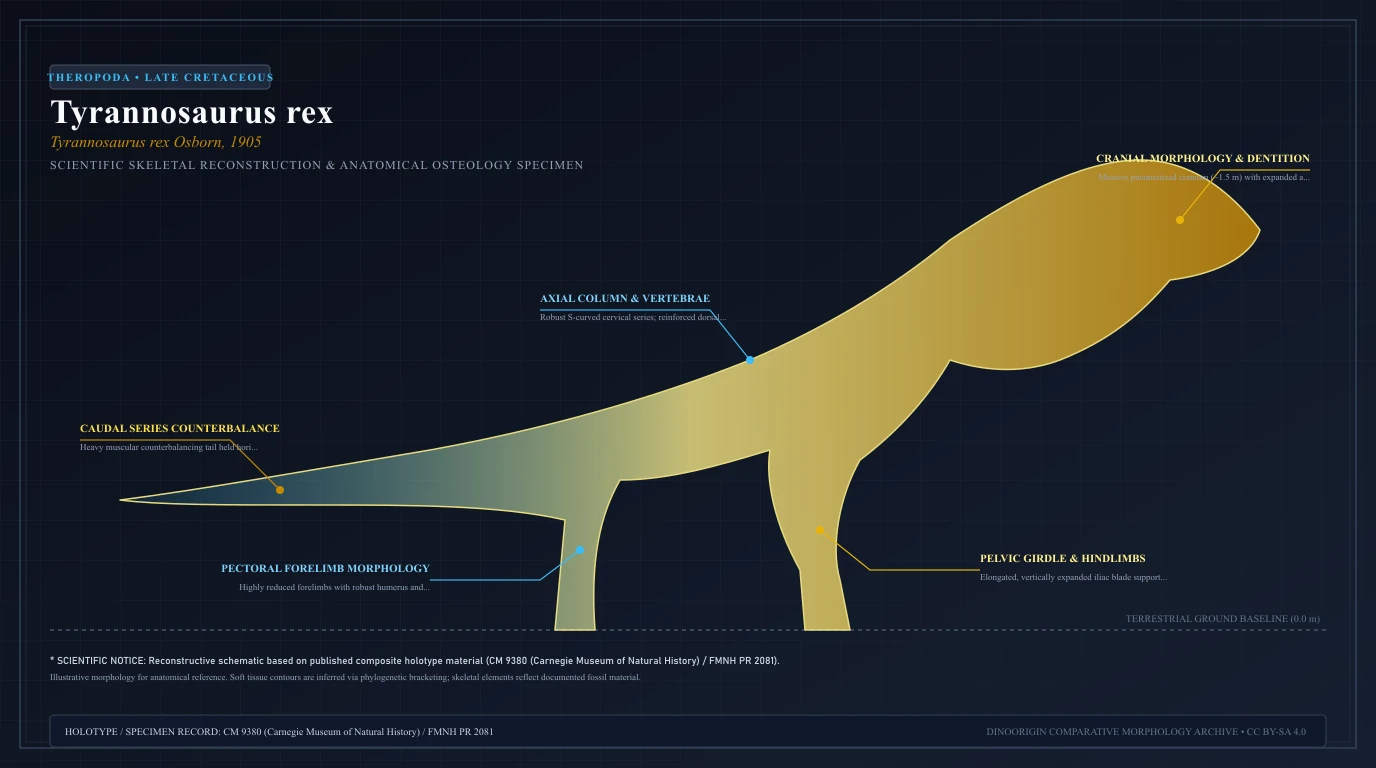
Anatomical skeletal reconstruction of Tyrannosaurus rex (Tyrannosaurus rex Osborn, 1905) illustrating cranial fenestrae, vertebral column, and appendicular proportions based on composite fossil material.
Discovery & Taxonomic Naming History
Year of Discovery / Description1902
Type Specimen Locality & FormationHell Creek Formation, Montana, United States
First recognized specimen discovered by Barnum Brown in 1902; described and formally named by Henry Fairfield Osborn in 1905.
Cretaceous Period PeriodTemporal Interval: 68–66 Ma (million years ago)
The longest and final period of the Mesozoic Era, characterized by the rise of flowering plants, ceratopsians, hadrosaurs, tyrannosaurids, and concluding with the Chicxulub asteroid impact.
During the Mesozoic Era, continental drift progressively reconfigured land bridges, atmospheric currents, and regional precipitation regimes. Fossils of Tyrannosaurus rex evidence its adaptation to the paleoenvironments of North America.
Paleogeographic RealmNorth America (North America)
Home to the fossil-rich Morrison Formation of the Late Jurassic and the Hell Creek and Dinosaur Park Formations of the Late Cretaceous.
Fossil Discovery Locality
Scientific Significance & Evolutionary Impact
The anatomical architecture of Tyrannosaurus rex serves as a crucial benchmark in vertebrate paleontology, illustrating key adaptive radiations within Theropoda.
Phylogenetic Placement: Informs cladistic debates concerning the divergence, skull biomechanics, and skeletal evolution of Cretaceous Period fauna.
Paleoecological Guild: Documents trophic specialization (Carnivore) and predator-prey dynamics across its regional ecosystem.
Taphonomic Record: Represented by more than 50 verified specimens across varying ontogenetic stages. These range from Barnum Brown's 1902 holotype (CM 9380) to exceptionally complete, articulated skeletons including FMNH PR 2081 ('Sue', ~90% complete by skeletal element) and RSM P2523.8 ('Scotty'). Isolated teeth, fragmentary skulls, and coprolites containing pulverized bone further enrich the taphonomic record.
Frequently Asked Questions About Tyrannosaurus rex
Scientifically verified answers based on peer-reviewed paleontological evidence.
Q1.When did Tyrannosaurus rex live?
Tyrannosaurus rex lived during the Cretaceous Period Period, approximately 68–66 Ma (million years ago). This places it within the Mesozoic Era.
Q2.How big was Tyrannosaurus rex?
Paleontological estimates place Tyrannosaurus rex at a length of 11.8–12.8 m (38.7–42.0 ft), a hip/standing height of 3.6–4 m (11.8–13.1 ft), and a body mass of 7.5–9.5 metric tons (16,535–20,944 lbs).
Q3.What was the diet of Tyrannosaurus rex?
Classified as a carnivore, Tyrannosaurus rex specialized in consuming Exclusively carnivorous. Ingested large herbivorous ornithischians such as Triceratops and Edmontosaurus, pulverizing bone for nutrient-dense marrow..
Q4.Where were Tyrannosaurus rex fossils discovered?
Fossil specimens of Tyrannosaurus rex have been recovered from Hell Creek Formation, Montana, United States, with notable historic specimens documented in 1902. First recognized specimen discovered by Barnum Brown in 1902; described and formally named by Henry Fairfield Osborn in 1905.
Academic Literature & Peer-Reviewed References
Authoritative citations establishing the factual taxonomy, biometrics, and anatomy of Tyrannosaurus rex.
Bates, K. T., & Falkingham, P. L. (2012). Estimating maximum bite force in Tyrannosaurus rex using multi-body dynamic analysis. Biology Letters, 8(4), 660-664.
Comparative size scale of Tyrannosaurus rex relative to a 1.8-meter adult human, illustrating an estimated length of 11.8–12.8 m and height of 3.6–4.0 m (preserving model uncertainty).
Hell Creek Formation, Montana, United States
Deposited in Mesozoic sedimentary strata preserving skeletal remains, teeth, or trace trackways.
Q5.What makes Tyrannosaurus rex scientifically significant?
Tyrannosaurus rex provides critical insights into the evolutionary radiation of Theropoda. Holotypes and fossil evidence indicate: Represented by more than 50 verified specimens across varying ontogenetic stages. These range from Barnum Brown's 1902 holotype (CM 9380) to exceptionally complete, articulated skeletons including FMNH PR 2081 ('Sue', ~90% complete by skeletal element) and RSM P2523.8 ('Scotty'). Isolated teeth, fragmentary skulls, and coprolites containing pulverized bone further enrich the taphonomic record.
Sellers, W. I., Pond, S. B., Brassey, C. A., Manning, P. L., & Bates, K. T. (2017). Investigating the running abilities of Tyrannosaurus rex using stress-constrained multibody dynamic analysis. PeerJ, 5, e3420. https://doi.org/10.7717/peerj.3420