Troodon formosus Leidy, 1856
A small, large-brained Late Cretaceous theropod with acute stereoscopic vision and large eyes.

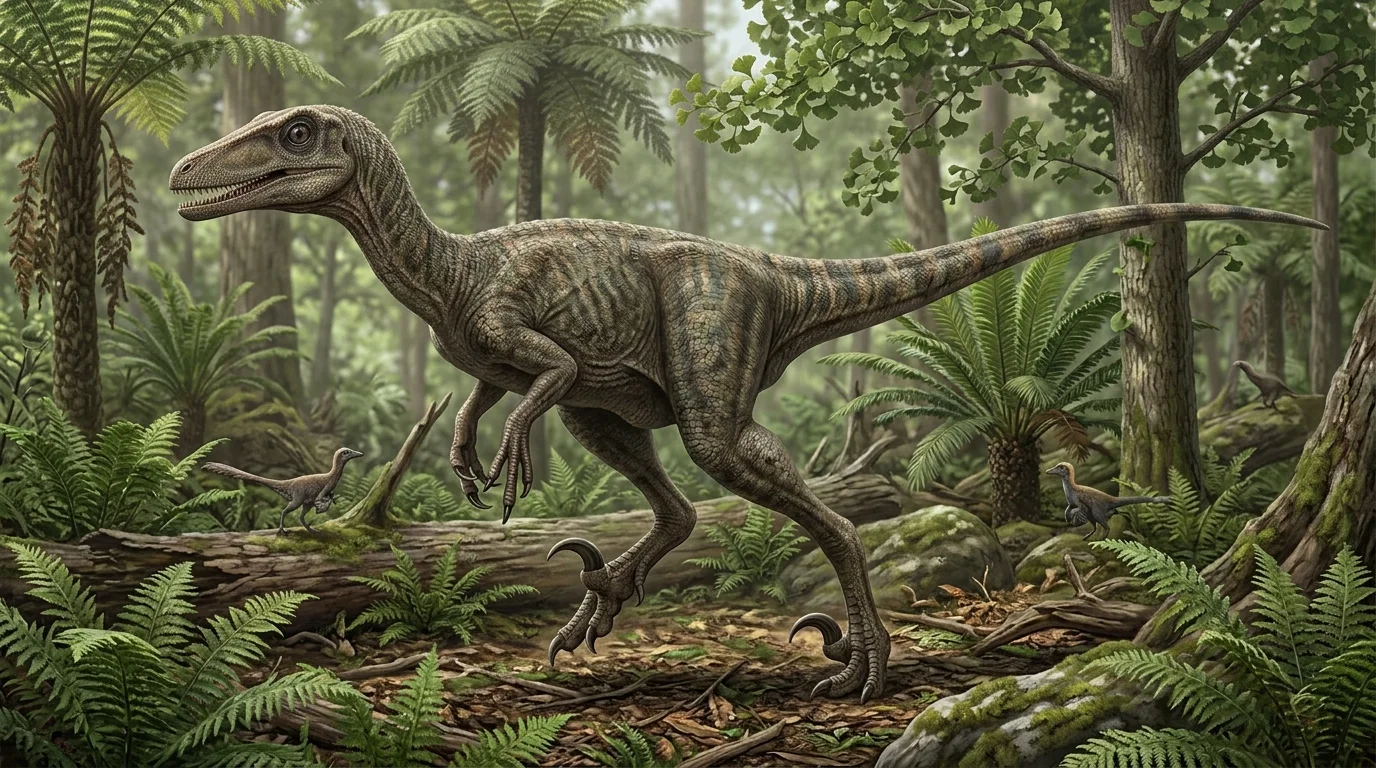
Scientific reconstruction of Troodon (Troodon formosus Leidy, 1856) in its native Geological period: Cretaceous Period.
Image Credit: AI-generated scientific paleoart reconstruction synthesized from species-specific osteological profiles and peer-reviewed descriptions. (AI-Generated / Open Educational Media (DinoOrigin Spec))
Phylogenetic classification of Troodon formosus Leidy, 1856 based on peer-reviewed cladistic analyses of diagnostic skeletal synapomorphies.
| Taxonomic Rank | Taxon / Clade | Diagnostic Context |
|---|---|---|
| Kingdom | Animalia | Monophyletic prehistoric clade |
| Phylum | Chordata | Monophyletic prehistoric clade |
| Clade | Dinosauria | Monophyletic prehistoric clade |
| Order | Saurischia (Lizard-Hipped Dinosaurs) | Characterized ancestrally by a triradiate pelvis with an anteriorly pointing pubis. |
| Suborder | Theropoda | Bipedal saurischian dinosaurs, historically dominated by carnivores and including the avian lineage. |
| Genus | Troodon | Monophyletic prehistoric clade |
| Species | Troodon formosus Leidy, 1856 | Specific authority designation |
Troodon was a small, exceptionally intelligent bird-like theropod from the Late Cretaceous of North America. Renowned for possessing one of the highest encephalization quotients (brain-to-body mass ratios) among non-avian dinosaurs, it had large, forward-facing orbits capable of binocular depth perception.
Its teeth had prominent, hook-like denticles, pointing toward an adaptable omnivorous diet comprising small mammals, lizards, insects, and nutritious plant seeds.
Slender biped with large eyes, a long snout, grasping hands, and retractable sickle claws on the second toes.
Anatomical dimensions relative to an average adult human (1.8 m / 6 ft tall)
Small mammals, lizards, baby dinosaurs, eggs, and seeds.
Small, large-brained maniraptoran theropod with acute stereoscopic vision and serrated teeth adapted for an opportunistic omnivorous diet. In the Two Medicine Formation, Troodon nested in close proximity to hadrosaur colonies such as Maiasaura.
Cool upland forests, coastal plains, and semi-arid river valleys.
Dozens of articulated specimens, complete clutches of eggs, and nesting sites from the Two Medicine Formation.
Initially named from a single tooth by Joseph Leidy; extensive cranial and postcranial skeletons found later.
The longest and final period of the Mesozoic Era, characterized by the rise of flowering plants, ceratopsians, hadrosaurs, tyrannosaurids, and concluding with the Chicxulub asteroid impact.
During the Mesozoic Era, continental drift progressively reconfigured land bridges, atmospheric currents, and regional precipitation regimes. Fossils of Troodon evidence its adaptation to the paleoenvironments of North America.
Home to the fossil-rich Morrison Formation of the Late Jurassic and the Hell Creek and Dinosaur Park Formations of the Late Cretaceous.
The anatomical architecture of Troodon serves as a crucial benchmark in vertebrate paleontology, illustrating key adaptive radiations within Theropoda.
Scientifically verified answers based on peer-reviewed paleontological evidence.
Troodon lived during the Cretaceous Period Period, approximately 77–74 Ma (million years ago). This places it within the Mesozoic Era.
Paleontological estimates place Troodon at a length of 2–2.5 m (6.6–8.2 ft), a hip/standing height of 0.9–1.1 m (3.0–3.6 ft), and a body mass of 40–50 kg (88–110 lbs).
Classified as a omnivore, Troodon specialized in consuming Small mammals, lizards, baby dinosaurs, eggs, and seeds..
Fossil specimens of Troodon have been recovered from Judith River Formation, Montana, United States, with notable historic specimens documented in 1855. Initially named from a single tooth by Joseph Leidy; extensive cranial and postcranial skeletons found later.
Authoritative citations establishing the factual taxonomy, biometrics, and anatomy of Troodon.
Leidy, J. (1856). Notice of remains of extinct reptiles and fishes, discovered by Dr. F. V. Hayden in the Bad Lands of the Judith River, Nebraska Territory. Proceedings of the Academy of Natural Sciences of Philadelphia, 8, 72-73.
Curated & Verified: 2026-09-24Deposited in Mesozoic sedimentary strata preserving skeletal remains, teeth, or trace trackways.
Troodon provides critical insights into the evolutionary radiation of Theropoda. Holotypes and fossil evidence indicate: Dozens of articulated specimens, complete clutches of eggs, and nesting sites from the Two Medicine Formation.
van der Reest, A. J., & Currie, P. J. (2017). Troodontids (Theropoda) from the Dinosaur Park Formation, Alberta, with a description of a unique new taxon: implications for deinonychosaur diversity in North America. Canadian Journal of Earth Sciences, 54(9), 919-935. https://doi.org/10.1139/cjes-2017-0031
TheropodaAcrocanthosaurus atokensis Stovall & Langston, 1950
A high-spined North American apex predator famous for hunting sauropods across Early Cretaceous river valleys.
TheropodaAlbertosaurus sarcophagus Osborn, 1905
A fleet-footed, gracile tyrannosaurid from the Late Cretaceous of western Canada known from prominent multi-individual bonebed associations.
TheropodaAnzu wyliei Lamanna et al., 2014
The 'Chicken from Hell', a gigantic, crested caenagnathid oviraptorosaur from the Hell Creek Formation.