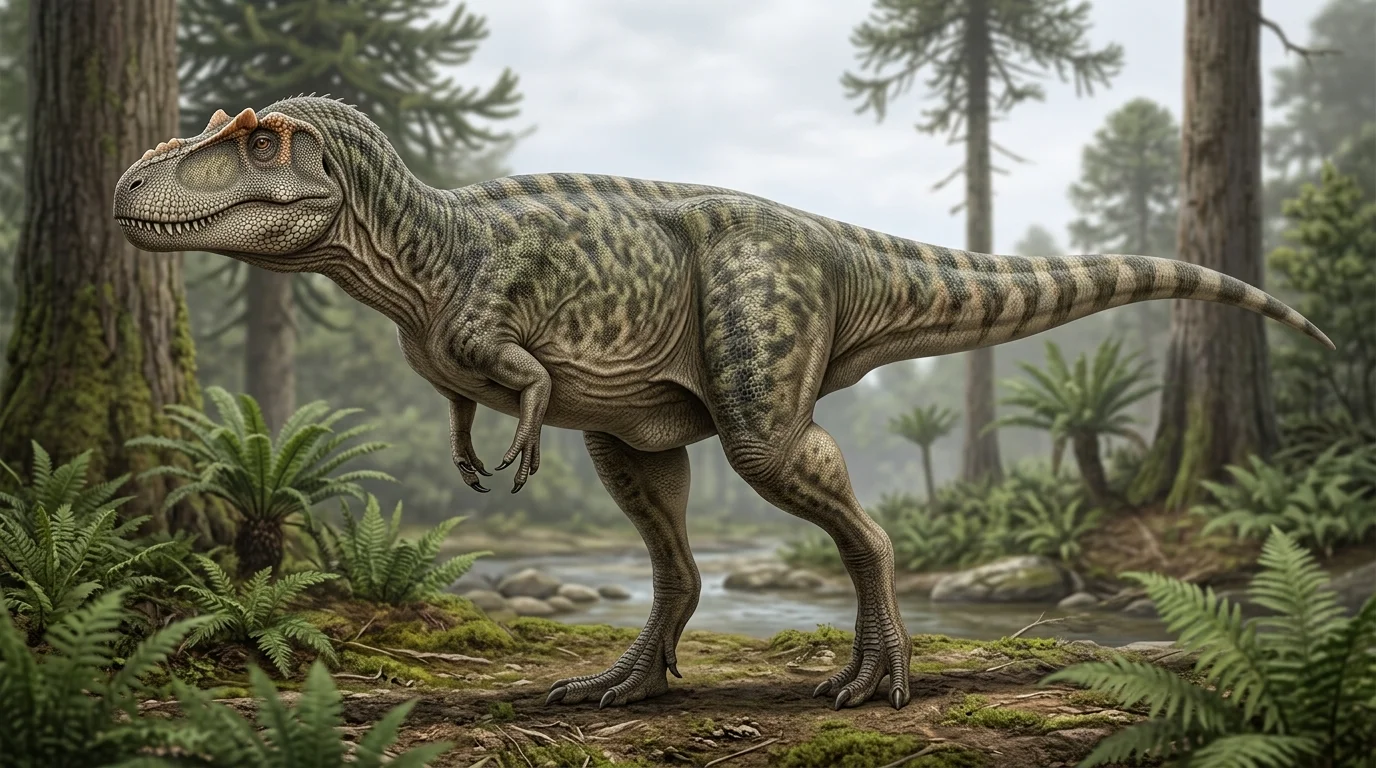
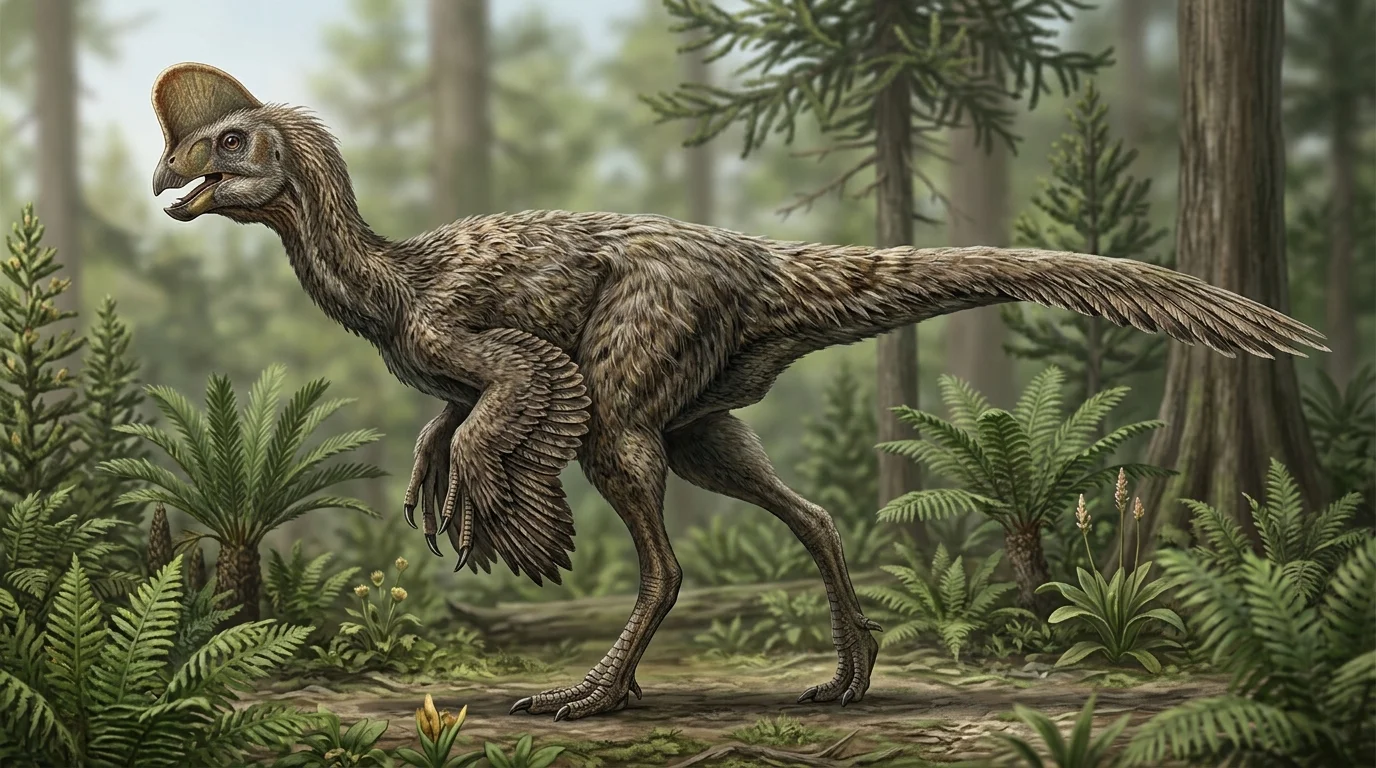
Bipedal saurischian dinosaurs, historically dominated by carnivores and including the avian lineage.
Genus
Baryonyx
Monophyletic prehistoric clade
Species
Baryonyx walkeri Charig & Milner, 1986
Specific authority designation
Anatomy & Physical Characteristics
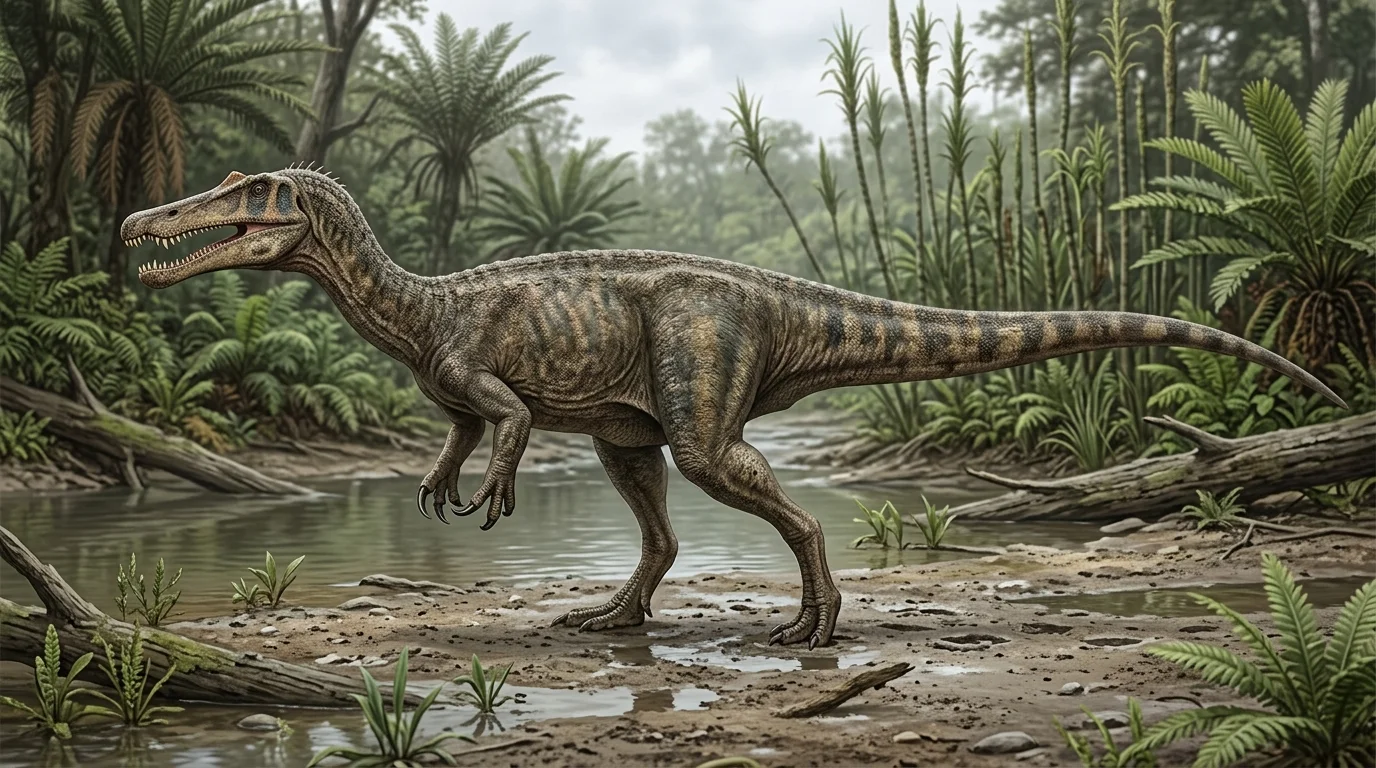
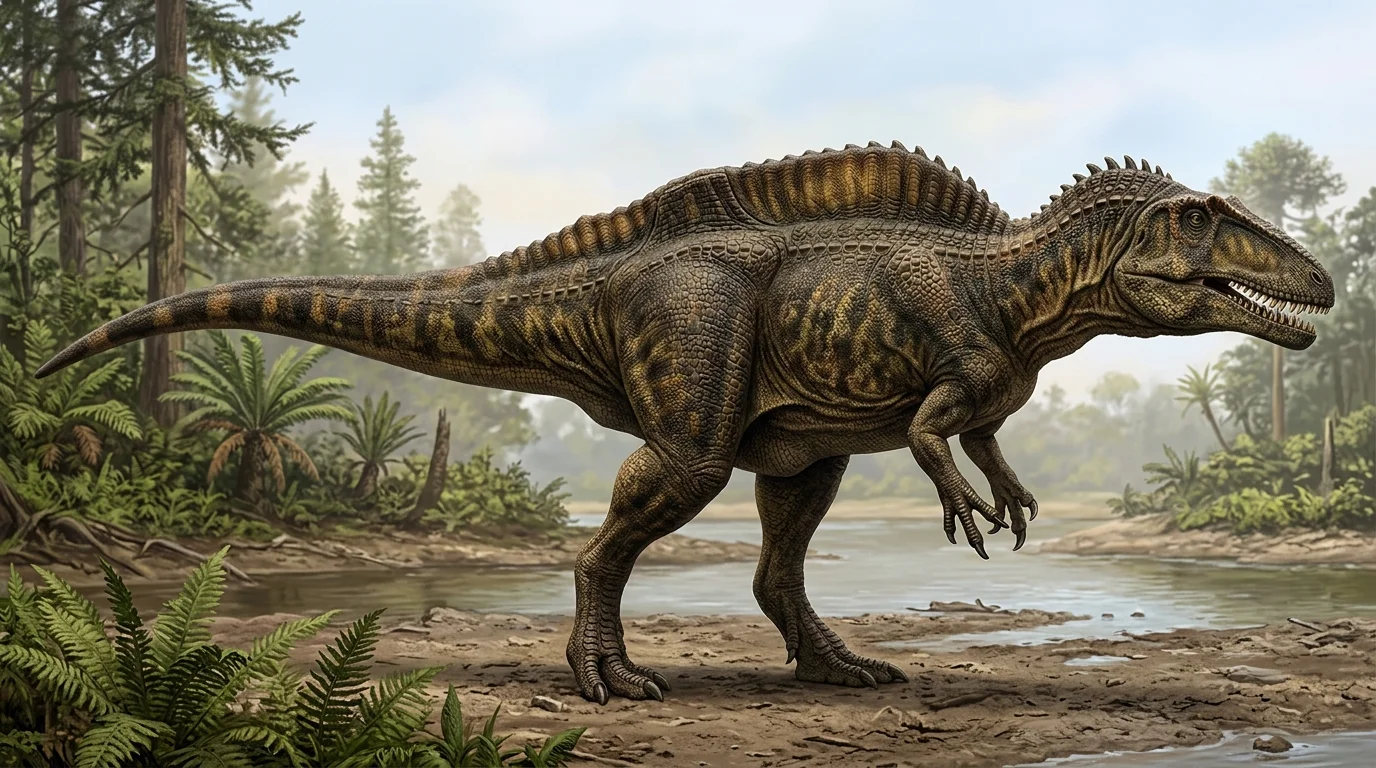
Baryonyx was an extraordinary discovery made in a Surrey brick pit in 1983. Possessing an elongated, crocodile-like snout with 96 finely serrated conical teeth and a subrostral notch, it was specialized for aquatic foraging along Early Cretaceous waterways.
Its massive, 31-centimeter hand claw was likely used as a gaffing hook to impale large prehistoric fish, as confirmed by fossilized acid-etched scales of the giant fish Lepidotes preserved inside its ribcage.
Diagnostic Morphological Traits
Long, low snout with rosettes of conical teeth, robust muscular forelimbs, and a gigantic curved claw on the first finger.
Comparative Scale & Biometrics
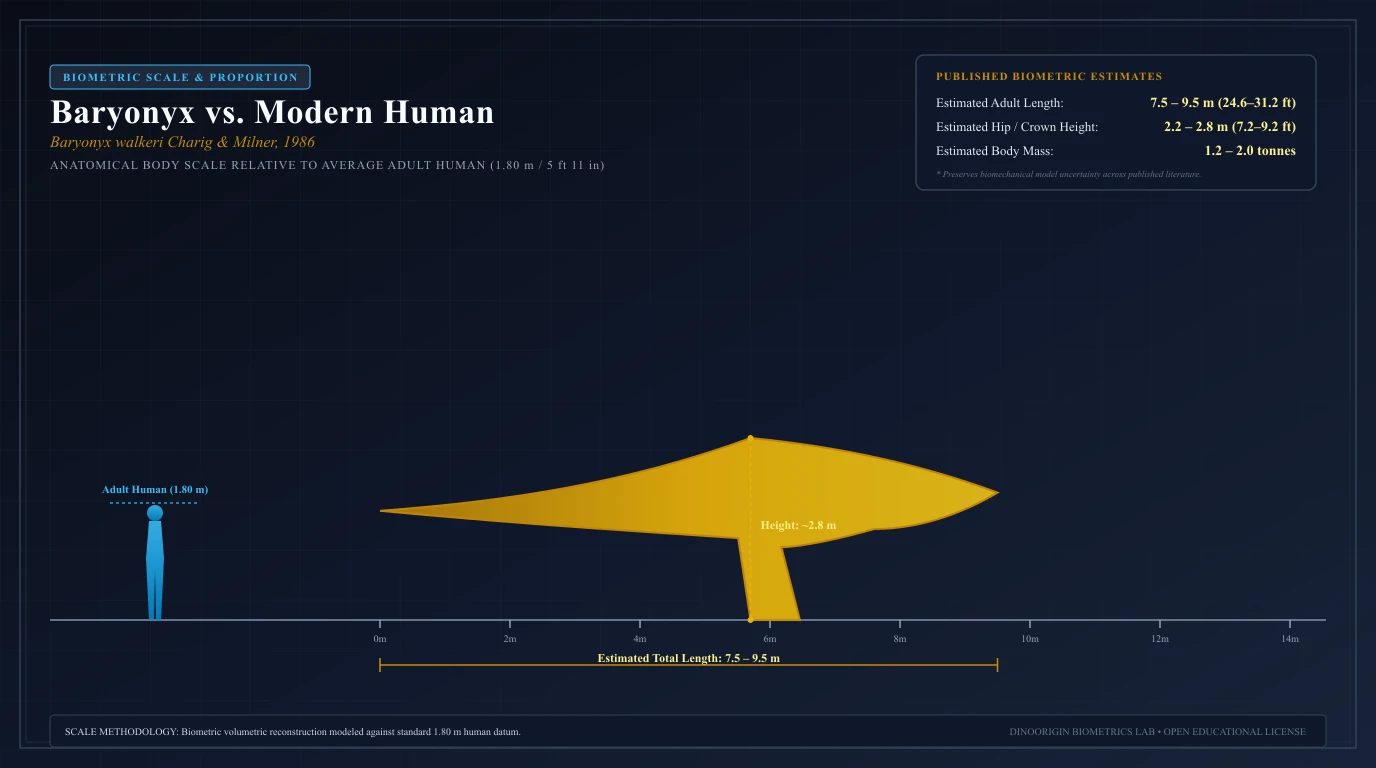
Anatomical dimensions relative to an average adult human (1.8 m / 6 ft tall)
Approx. 5.3× human length
Baryonyx (Length)7.5–9.5 m (24.6–31.2 ft)
Adult Human1.8 m (6.0 ft)
Length
7.5–9.5 m (24.6–31.2 ft)
Height
2.2–2.8 m (7.2–9.2 ft)
Estimated Mass
1.2–2.0 metric tons (2,646–4,409 lbs)
Biometric Human Scale Reference
Comparative size scale of Baryonyx relative to a 1.8-meter adult human, illustrating an estimated length of 7.5–9.5 m and height of 2.2–2.8 m (preserving model uncertainty).
Piscivorous and carnivorous; consumed fish (Lepidotes) and juvenile ornithopods.
Paleobiology & Behavior
Specialized semi-aquatic piscivore and opportunistic carnivore that used its elongated snout and recurved thumb claw to hook large fish. It inhabited the subtropical Wealden floodplain alongside robust herbivorous ornithopods like Iguanodon and closely allied Wessex spinosaurids like Ceratosuchops.
Habitat & Ecological Biome
Prehistoric Depositional Setting
Coastal lagoons, freshwater river deltas, and braided wetlands of the Wealden basin.
Fossil Evidence & Specimen Records
Preserved Skeletal Material & Bonebeds
Nearly complete holotype skeleton with intact skull, massive claws, and stomach contents at NHM London.
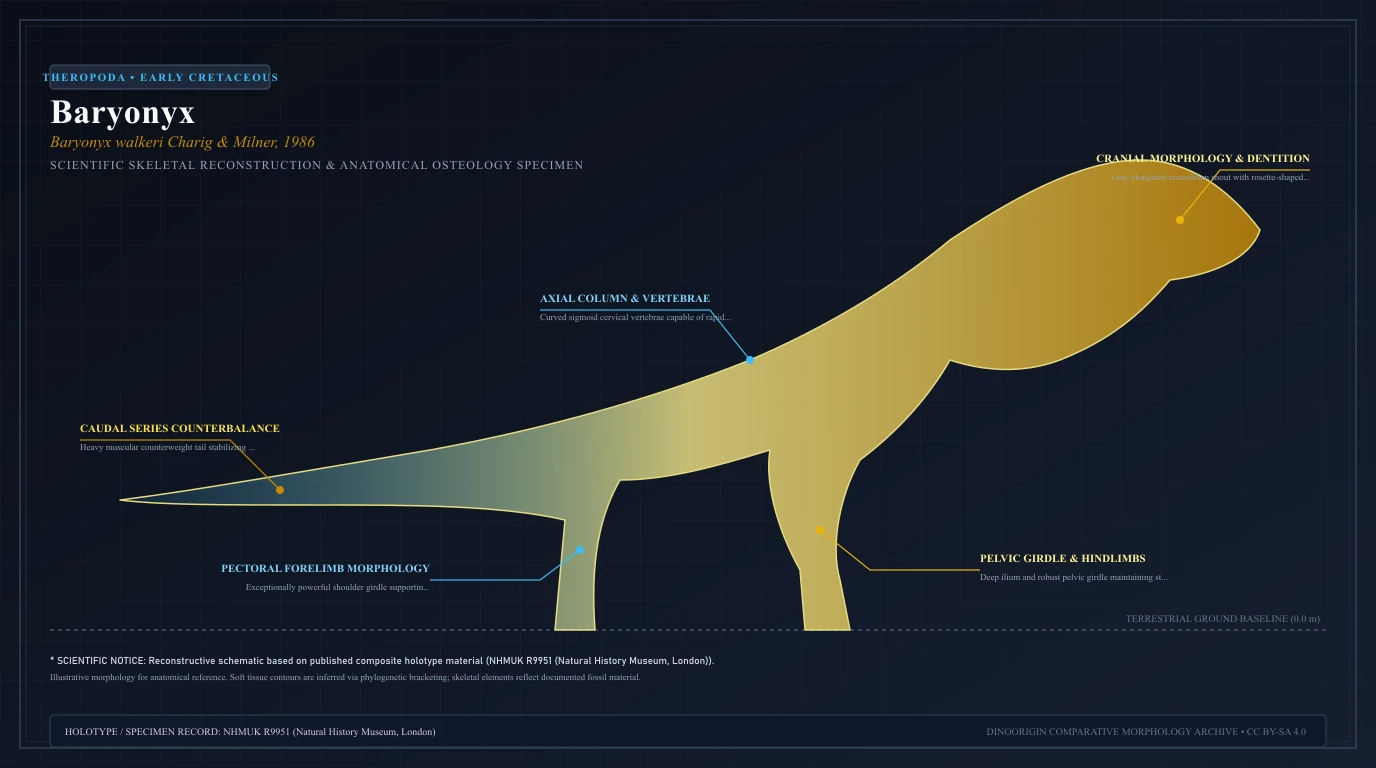
Anatomical Osteology & Skeletal Reconstruction
Anatomical skeletal reconstruction of Baryonyx (Baryonyx walkeri Charig & Milner, 1986) illustrating cranial fenestrae, vertebral column, and appendicular proportions based on composite fossil material.
Discovery & Taxonomic Naming History
Year of Discovery / Description1983
Type Specimen Locality & FormationWeald Clay Formation, Surrey, United Kingdom
Found by amateur collector William J. Walker; studied and described by Alan J. Charig and Angela C. Milner.
Cretaceous Period PeriodTemporal Interval: 130–125 Ma (million years ago)
The longest and final period of the Mesozoic Era, characterized by the rise of flowering plants, ceratopsians, hadrosaurs, tyrannosaurids, and concluding with the Chicxulub asteroid impact.
During the Mesozoic Era, continental drift progressively reconfigured land bridges, atmospheric currents, and regional precipitation regimes. Fossils of Baryonyx evidence its adaptation to the paleoenvironments of Europe.
Paleogeographic RealmEurope (Europe)
During the Mesozoic, Europe was largely an archipelago of islands, resulting in unique insular dwarf species and classic historical fossil discoveries.
Fossil Discovery Locality
Scientific Significance & Evolutionary Impact
The anatomical architecture of Baryonyx serves as a crucial benchmark in vertebrate paleontology, illustrating key adaptive radiations within Theropoda.
Phylogenetic Placement: Informs cladistic debates concerning the divergence, skull biomechanics, and skeletal evolution of Cretaceous Period fauna.
Paleoecological Guild: Documents trophic specialization (Piscivore) and predator-prey dynamics across its regional ecosystem.
Taphonomic Record: Nearly complete holotype skeleton with intact skull, massive claws, and stomach contents at NHM London.
Frequently Asked Questions About Baryonyx
Scientifically verified answers based on peer-reviewed paleontological evidence.
Q1.When did Baryonyx live?
Baryonyx lived during the Cretaceous Period Period, approximately 130–125 Ma (million years ago). This places it within the Mesozoic Era.
Q2.How big was Baryonyx?
Paleontological estimates place Baryonyx at a length of 7.5–9.5 m (24.6–31.2 ft), a hip/standing height of 2.2–2.8 m (7.2–9.2 ft), and a body mass of 1.2–2.0 metric tons (2,646–4,409 lbs).
Q3.What was the diet of Baryonyx?
Classified as a piscivore, Baryonyx specialized in consuming Piscivorous and carnivorous; consumed fish (Lepidotes) and juvenile ornithopods..
Q4.Where were Baryonyx fossils discovered?
Fossil specimens of Baryonyx have been recovered from Weald Clay Formation, Surrey, United Kingdom, with notable historic specimens documented in 1983. Found by amateur collector William J. Walker; studied and described by Alan J. Charig and Angela C. Milner.
Academic Literature & Peer-Reviewed References
Authoritative citations establishing the factual taxonomy, biometrics, and anatomy of Baryonyx.
Deposited in Mesozoic sedimentary strata preserving skeletal remains, teeth, or trace trackways.
Q5.What makes Baryonyx scientifically significant?
Baryonyx provides critical insights into the evolutionary radiation of Theropoda. Holotypes and fossil evidence indicate: Nearly complete holotype skeleton with intact skull, massive claws, and stomach contents at NHM London.
Charig, A. J., & Milner, A. C. (1997). Baryonyx walkeri, a fish-eating dinosaur from the Wealden of Surrey. Bulletin of the Natural History Museum, Geology Series, 53(1), 11-70.