Dreadnoughtus schrani Lacovara et al., 2014
The 'fearing nothing' super-titanosaur from Argentina, with the most complete skeleton of any giant titanosaur.

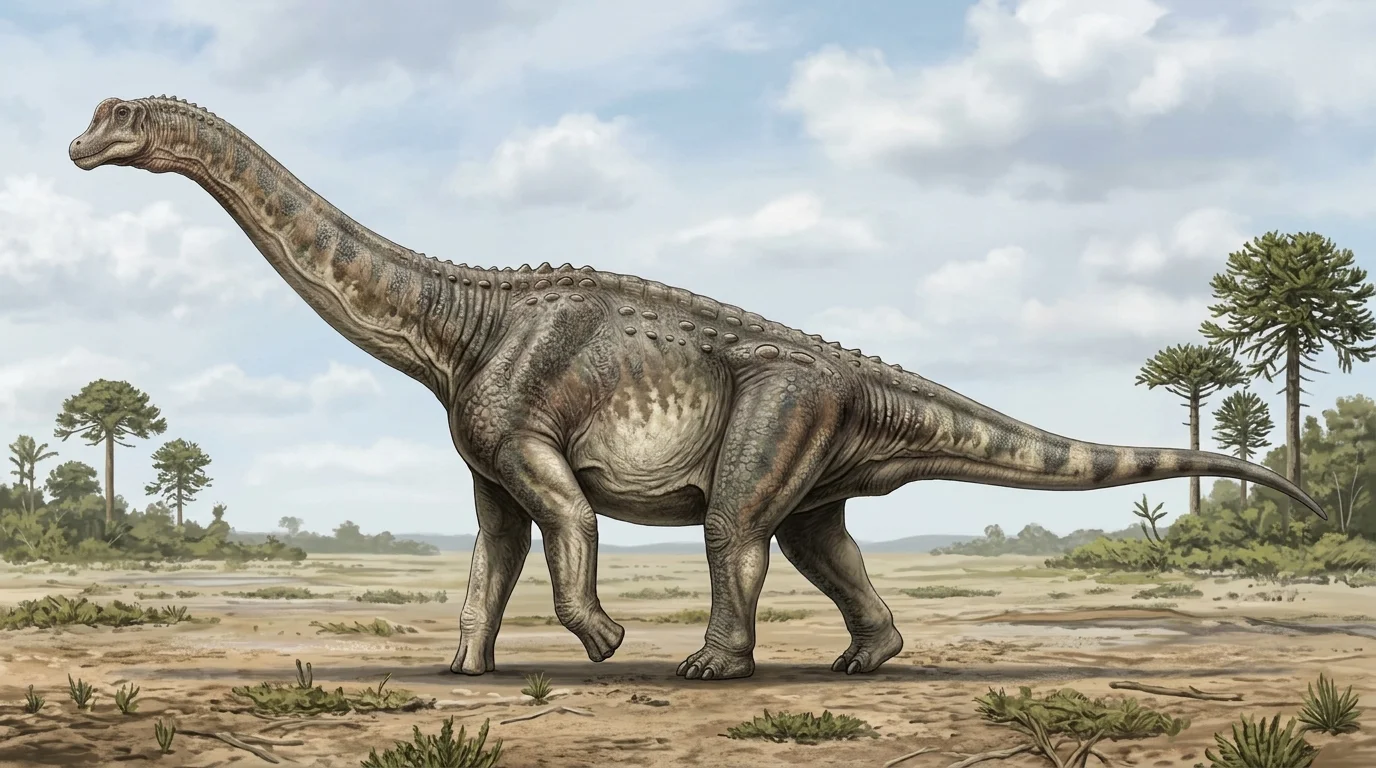
Scientific reconstruction of Dreadnoughtus (Dreadnoughtus schrani Lacovara et al., 2014) in its native Geological period: Cretaceous Period.
Image Credit: AI-generated scientific paleoart reconstruction synthesized from species-specific osteological profiles and peer-reviewed descriptions. (AI-Generated / Open Educational Media (DinoOrigin Spec))
Phylogenetic classification of Dreadnoughtus schrani Lacovara et al., 2014 based on peer-reviewed cladistic analyses of diagnostic skeletal synapomorphies.
| Taxonomic Rank | Taxon / Clade | Diagnostic Context |
|---|---|---|
| Kingdom | Animalia | Monophyletic prehistoric clade |
| Phylum | Chordata | Monophyletic prehistoric clade |
| Clade | Dinosauria | Monophyletic prehistoric clade |
| Order | Saurischia (Lizard-Hipped Dinosaurs) | Characterized ancestrally by a triradiate pelvis with an anteriorly pointing pubis. |
| Suborder | Sauropodomorpha | Herbivorous saurischians characterized by elongated necks, columnar limbs, and enormous body volumes. |
| Genus | Dreadnoughtus | Monophyletic prehistoric clade |
| Species | Dreadnoughtus schrani Lacovara et al., 2014 | Specific authority designation |
Dreadnoughtus was an immense titanosaur sauropod from the Late Cretaceous of Santa Cruz Province, Argentina. Named after the dreadnought battleships of the early 20th century because mature adults would have 'feared nothing', it possessed the greatest confirmed mass of any land animal with a complete enough skeleton for direct limb-bone mathematical calculation.
Over 70% of its postcranial skeleton was preserved, including complete limb bones, vertebrae, and the pectoral girdle.
Stocky, muscular titanosaur with an immensely broad chest, thick neck, and pillar-like limbs.
Anatomical dimensions relative to an average adult human (1.8 m / 6 ft tall)
Conifers, cycads, and ferns cropped and swallowed whole for fermentation in huge digestive guts.
Massive titanosaur sauropod that spent the vast majority of its time bulk feeding on conifer and fern foliage to sustain its gigantic body mass. Discovered in southern Patagonia, Dreadnoughtus is ecologically comparable to earlier colossal titanosaurs such as Argentinosaurus and Patagotitan.
Braided river floodplains, delta wetlands, and temperate forested lowlands of southern Patagonia.
Holotype preserving over 145 skeletal elements, making it the most anatomically complete giant titanosaur.
Discovered by Kenneth Lacovara and excavated over four field seasons; described in 2014.
The longest and final period of the Mesozoic Era, characterized by the rise of flowering plants, ceratopsians, hadrosaurs, tyrannosaurids, and concluding with the Chicxulub asteroid impact.
During the Mesozoic Era, continental drift progressively reconfigured land bridges, atmospheric currents, and regional precipitation regimes. Fossils of Dreadnoughtus evidence its adaptation to the paleoenvironments of South America.
Preserved within the Huincul, Candeleros, and Ischigualasto formations, hosting colossal titanosaurs and specialized abelisaurid and carcharodontosaurid apex predators.
The anatomical architecture of Dreadnoughtus serves as a crucial benchmark in vertebrate paleontology, illustrating key adaptive radiations within Sauropodomorpha.
Scientifically verified answers based on peer-reviewed paleontological evidence.
Dreadnoughtus lived during the Cretaceous Period Period, approximately 77–76 Ma (million years ago). This places it within the Mesozoic Era.
Paleontological estimates place Dreadnoughtus at a length of 24–26 m (78.7–85.3 ft), a hip/standing height of 5.5–6.5 m (18.0–21.3 ft), and a body mass of 35.0–49.0 metric tons (77,162–108,026 lbs).
Classified as a herbivore, Dreadnoughtus specialized in consuming Conifers, cycads, and ferns cropped and swallowed whole for fermentation in huge digestive guts..
Fossil specimens of Dreadnoughtus have been recovered from Cerro Fortaleza Formation, Santa Cruz, Argentina, with notable historic specimens documented in 2005. Discovered by Kenneth Lacovara and excavated over four field seasons; described in 2014.
Authoritative citations establishing the factual taxonomy, biometrics, and anatomy of Dreadnoughtus.
Lacovara, K. J., Lamanna, M. C., Ibiricu, L. M., et al. (2014). A gigantic, exceptionally complete titanosaurian sauropod dinosaur from southern Patagonia, Argentina. Scientific Reports, 4, 6196. https://doi.org/10.1038/srep06196
Curated & Verified: 2026-09-24Deposited in Mesozoic sedimentary strata preserving skeletal remains, teeth, or trace trackways.
Dreadnoughtus provides critical insights into the evolutionary radiation of Sauropodomorpha. Holotypes and fossil evidence indicate: Holotype preserving over 145 skeletal elements, making it the most anatomically complete giant titanosaur.
SauropodomorphaAmargasaurus cazaui Salgado & Bonaparte, 1991
A striking, double-sailed dicraeosaurid sauropod from Argentina sporting parallel rows of tall neck spines.
Featured SpecimenSauropodomorphaArgentinosaurus huinculensis Bonaparte & Coria, 1993
Among the largest and most massive terrestrial animals known to science, with scaled estimates reaching 65 to 80 metric tons based on fragmentary titanosaur remains.
SauropodomorphaNigersaurus taqueti Sereno et al., 1999
The 'Mesozoic lawnmower', a specialized sauropod with a wide, straight-edged mouth and 500 replaceable teeth.